Your search
Articles & Guides

Preparing for the future of transparency with the Digital Product Passport
What are the latest developments in the Digital Product Passport?
Watch this webinar with Trace For Good's Head of Business Intelligence and Intertek's Global Business Manager for Hardlines & Softlines to explore the latest regulatory updates, upcoming milestones, key data requirements, and the practical steps brands can take to prepare for DPP implementation.

PFAS in France: What the December 2025 decree changes for the textile sector
Introduction
Per- and polyfluoroalkyl substances, commonly referred to as PFAS, have been the subject of extensive regulatory work at European level for several years, particularly within the framework of the REACH Regulation. While a comprehensive EU-wide restriction on PFAS is still under review, its adoption has been repeatedly postponed, leaving Member States to move forward at different paces.
In France, this situation has led to a national regulatory initiative. Following the adoption of a dedicated law in February 2025, a decree published at the end of December clarified how these rules would be implemented, effectively anticipating a European framework that is still under construction.
Since 1 January 2026, French regulations have therefore prohibited the manufacture, import, export and placing on the market of certain categories of products containing PFAS, including specific textile products.
For players in the textile and apparel sector, this decree represents a significant shift. Scope of application, regulatory thresholds, affected products, exemptions and timelines: this article provides a detailed breakdown of this landmark text, with a specific focus on its practical implications for the textile industry.
PFAS: What are we actually talking about?
Per- and polyfluoroalkyl substances (PFAS) encompass several thousand chemical substances developed for their specific technical properties: water repellency, resistance to grease and stains, thermal stability, and ease of maintenance. In the textile sector, they have been widely used in surface treatments, coatings and functional finishes, particularly to provide water- and stain-repellent properties.
These substances are now commonly referred to as “forever chemicals” due to their extreme persistence: they degrade very slowly, accumulate in the environment, and can build up in the human body. Biomonitoring data confirm widespread population exposure. A recent study indicates that 94% of the individuals tested carry residues of at least one PFAS, highlighting the scale of their presence in the environment and in everyday consumer products
In response to these findings, authorities have progressively strengthened regulatory oversight. In France, this culminated in 2025 with the adoption of a specific legislative framework, followed by an implementing decree published in December. This decree does not introduce a new ban: it makes existing restrictions effective, measurable and enforceable by translating them into immediately applicable rules.
A clear legal framework for PFAS, in force since 1 January 2026
The law of 27 February 2025 established the principle of a progressive ban on PFAS in certain product categories. The decree of 28 December 2025 sets out the practical implementation of this ban and incorporates these provisions into the Environmental Code.
A key point for textile brands is that the restriction is not limited to sales within France. It applies to four distinct operations involving products containing PFAS:
- Manufacturing,
- Importing,
- Exporting,
- Placing on the market.
A non-compliant product may therefore neither be manufactured in France, nor imported, nor exported, even if it is intended for a market outside the European Union.
The decree applies to all relevant economic operators (manufacturers, importers, exporters and entities placing products on the market) and relies on an enforcement framework involving environmental authorities, customs and market surveillance bodies, whose roles are detailed later in this article.
Products covered by the PFAS ban
The decree applies to several product categories, including:
- Textile products,
- Footwear,
- Cosmetic products,
- Ski waxes,
- Waterproofing agents.
While this article focuses on textile products, it is important to note that the scope of the decree extends well beyond the textile sector.
It should also be stressed that not all textile products are treated identically. Certain products may benefit from exemptions (see section 5). As a result, the ban does not apply uniformly across all textiles, but depends on specific criteria linked to product use or composition.
The concept of “placing on the market” is interpreted broadly and includes any supply to a third party, whether free of charge or for consideration.
PFAS thresholds set by decree
The decree introduces precise quantitative thresholds, which form the core of the compliance framework.
Three situations are distinguished:
- Individually measured PFAS, excluding polymers: the threshold is set at 25 ppb.
- Total PFAS, measured as the sum of targeted PFAS analyses (with prior degradation of precursors where applicable): the threshold is set at 250 ppb.
- PFAS including polymers: the threshold is set at 50 ppm.
The decree also introduces a specific mechanism relating to total fluorine content. Where total fluorine exceeds 50 mg F/kg, the operator must be able to demonstrate whether this fluorine originates from PFAS or from other substances.
These thresholds are not fixed indefinitely and may evolve, particularly in line with future changes to the European regulatory framework.
Products exempt from the PFAS ban under the decree
The ban introduced by the decree is not absolute. It is accompanied by strictly regulated exemptions.
Use-based exemptions
The following products are notably exempt:
- Personal protective equipment (PPE),
- Industrial technical textiles,
- Certain medical textiles,
- Equipment intended for the armed forces, internal security or civil protection.
These exemptions are justified either by the absence of technically viable substitutes or by critical safety requirements.
The specific case of textiles containing recycled materials
As a general principle, the decree aims to ban the presence of PFAS in textile products. However, it introduces a targeted exemption for certain apparel textiles and footwear containing at least 20% recycled material derived from post-consumer waste.
This exemption is based on an operational reality: some recycled materials may contain legacy PFAS residues from previous uses, which cannot yet be fully eliminated.
Under this regime:
- PFAS are not authorised as such, but tolerated on a residual basis,
- This tolerance applies only to the recycled fraction of the product,
- The allowable PFAS content in the finished product is strictly proportional to the percentage of recycled material incorporated.
PFAS may therefore never be intentionally added. Their presence is only accepted as an unavoidable technical residue linked to the use of recycled materials, within strictly defined limits.
This regime entails strong traceability requirements: operators must be able to demonstrate the origin of the recycled materials used and, where relevant, explain the source of any PFAS detected in the finished product.

How does the French PFAS framework fit into the broader REACH regulatory process?
The French decree forms part of a broader European effort to regulate chemical substances. Ultimately, the stated objective is to achieve harmonised rules through the REACH Regulation.
However, at this stage, a comprehensive PFAS restriction under REACH has not yet been adopted. The dossier, supported by several Member States, has been subject to repeated delays, and its examination by the European Commission has been postponed until 2026.
In practical terms, this means that textile market players will still have to operate within a fragmented regulatory landscape for some time.
The French decree explicitly provides that the thresholds it sets may be revised in light of future European developments, notably under REACH and the POPs Regulation.
Unsold goods and PFAS: how should stock be managed?
Although the decree has been applicable since 1 January 2026, a stock clearance period is is provided for. Products containing PFAS and manufactured before this date may continue to be placed on the market or exported for a maximum period of twelve months, i.e. until 31 December 2026.
After this deadline, any manufacture, import, export or placing on the market of non-compliant products will be strictly prohibited.
Controls and sanctions: who enforces the PFAS ban, and how?
The PFAS ban is enforced by authorities that already oversee product compliance, environmental protection and trade flows.
Which authorities may intervene?
- Environmental enforcement authorities and competent State services (DREAL, DRIEAT, DEAL, authorised inspectors) carry out market controls, verify compliance with regulatory thresholds and examine supporting documentation (tests, certificates, technical documents).
- Customs authorities play a key role in import and export operations, fully within the scope of the ban. A non-compliant product may be blocked both on entry to and exit from the European Union.
- The DGCCRF (consumer protection authority) monitors consumer products placed on the market and verifies regulatory compliance as well as the availability of supporting documentation held by economic operators.
What happens in the event of non-compliance?
The decree does not introduce a standalone sanctions regime. In practice, enforcement measures fall under general legal frameworks (environmental law and customs law), which may result in:
- A ban on placing the products on the market, importing or exporting them,
- Withdrawal and, where applicable, recall of products,
- Administrative or financial penalties, or more severe consequences depending on the nature and seriousness of the infringement.
⚠️ Beyond product composition, the ability to demonstrate compliance (tests, certificates, supplier evidence) becomes a decisive factor during inspections.
Implement PFAS compliance with Trace For Good
Trace For Good enables you to manage PFAS compliance across your collections, by clearly identifying compliant products, at-risk products and those requiring corrective action, across all markets and supply chains.
How?
- By centralising all your technical certificates and documentation related to materials, treatments and finishes, so your teams can access the necessary information without multiplying manual searches.
- By collecting and tracking supplier declarations of compliance, systematically supported by documented evidence, securing your products’ compliance without increasing operational burden.
- By automatically analysing your testing documents, using OCR features to quickly identify tested substances, applicable thresholds and potential non-compliances.
- By ensuring continuous compliance monitoring, without additional manual effort across your collections and as regulations evolve.
PFAS compliance thus becomes a streamlined, industrialised process, rather than a one-off, time-consuming and reactive task.
Conclusion
With the December 2025 decree, the expectations of French authorities are now explicit. Brands know exactly what is prohibited, in which cases, under which thresholds and with what consequences. This marks a turning point: compliance is no longer just about meeting a regulatory requirement, but about recognising that PFAS management will fundamentally change how textile products are designed, sourced and placed on the market.
In this context, the challenge is no longer to “do things as inexpensively as possible”, but to identify and deploy viable substitute solutions that meet regulatory, technical and industrial constraints. This transition will take time. But before redesigning products, an immediate priority emerges: being able to prove that things are being done properly.
PFAS compliance depends as much on thresholds as on the methodology used to demonstrate them: data quality, material traceability, testing reliability, and the ability to produce evidence during inspections.
This is also what allows brands to prepare for what comes next. The expected revision of the European framework under REACH in 2026 will reinforce this logic. Structuring a robust, scalable compliance methodology today helps avoid facing new obligations tomorrow without knowing how to respond.
PFAS management is therefore not a one-off issue. It represents a foundational step towards a more demanding, better documented and more sustainable approach to chemical compliance in the textile sector.
.avif)
French eco-score: best practices and pitfalls to avoid
Introduction
You now know the essentials: the regulatory framework governing environmental labeling, the Ecobalyse methodology that defines its rules, and the direct impact this has on how you structure your data and communicate with your consumers. Once these foundations are clear, one question always comes up: how can you publish an environmental cost that is reliable, compliant, and easy to understand, without making mistakes?
To help you structure your approach and avoid the most common pitfalls, we have compiled a list of essential Do’s & Don’ts.
It brings together the best practices you should implement today, as well as the key errors to avoid, so you can secure the publication of your products’ environmental costs and deploy environmental labeling that is consistent, credible, and compliant.
10 best practices to secure your compliance with the French eco-score methodology
1. Centralize and structure your data
Reliable labeling starts with clean, consolidated and aligned data across product, sourcing, and supplier information. A single source of truth minimizes errors, duplicates and inconsistencies between teams.
2. Standardize your data formats
To avoid inconsistencies, adopt uniform formats: compositions, process types, locations, logistics flows. This will streamline imports and make it easier to update your products’ environmental costs.
3. Verify the quality and accuracy of every piece of information
The environmental cost must always reflect the actual product. Ensure that supplier data is complete, up to date and validated: materials, weights, processes, production sites, transport information…
4. Document your sources and evidence
Keep a record of where each data point comes from (supplier information, default values, internal measurements), along with exchanges, validations and assumptions. This will be essential during audits or when updating the score.
5. Use only the official Ecobalyse methodology
The rules, modules and impact factors defined by ADEME form the only authorized framework. Adhering to it ensures comparability and compliance for your products’ environmental costs.
6. Strictly follow the ADEME display template
Colors, units, typography, mandatory mentions: the graphic framework is not optional. It ensures score readability and strengthens your credibility.
7. Train your teams and your suppliers
Environmental labeling involves all stakeholders: buying, product, quality, sustainability, legal, communication, digital. Suppliers also need to understand what they must provide, and why.
8. Establish an internal validation workflow
Define who validates the data, who checks the evidence, and who publishes the score. A clear governance structure prevents last-minute mistakes.
9. Run a pilot before scaling
Testing a small group of products (a few dozen) will help you identify friction points, missing data or inconsistencies before rolling out at full scale.
10. Anticipate the link with the future Digital Product Passport
The data needed for environmental labeling will also be required for the future Digital Product Passport. Structuring your data now will prevent duplicated effort later.
10 critical mistakes you must avoid
1. Do not calculate your scores manually
Excel formulas, copy-paste, scattered files: it’s slow, fragile, and prone to errors. At collection scale, it becomes unmanageable and incompatible with regular updates.
2. Do not publish an environmental cost that is unjustified, incomplete or outdated
Any information that is undocumented or poorly updated can be considered misleading under the UCPD.
3. Do not confuse real data with default values
Ecobalyse default values are useful, but only when specific data is not available. Mixing them indiscriminately (or using them for convenience) artificially inflates your environmental cost and undermines your credibility.
4. Do not forget to recalculate the environmental cost after a production change
New supplier, updated composition, revised transport route… the slightest change may affect the score. Regular updates are essential.
5. Do not adjust the ADEME template
Changing colors, adding icons, “refreshing” the visual, even slightly, risks harming score readability and compromising compliance under France’s Climate and Resilience Law.
6. Do not reduce environmental labeling to a single number
Your environmental cost requires explanation: how it was calculated, what it represents, and why two similar products may show different results.
7. Do not compare your products with other brands outside the official framework
Comparisons are strictly regulated. Outside this framework, your environmental claims may be deemed misleading.
8. Do not assign responsibility to a single team
Environmental labeling is not a stand-alone sustainability project. It requires collaboration across product, quality, sourcing, legal, communication and digital teams. Working in silos leads to errors and possibly non-compliance.
9. Do not underestimate the complexity of calculating the environmental cost
Unlike simpler obligations (such as those related to the AGEC law), calculating your products’ environmental cost is a technical and time-consuming exercise. It requires numerous data points, multiple teams, and active supplier participation.
10. Do not forget to plan for ongoing updates
Your products’ environmental costs evolve over time. Without regular maintenance and periodic checks, the scores you calculate will quickly become outdated.
Conclusion
The French eco-score relies on reliable data, strong internal processes and clear communication. By applying these best practices and avoiding common pitfalls, you improve both the quality and the credibility of the environmental costs you disclose.
But one key question remains: how can you calculate these costs at scale, across your entire product range, without spending weeks on it or increasing the risk of errors?
In the next article, we break down the three possible approaches to industrializing environmental cost calculation: what they offer, where they fall short, and when each one makes sense.
.avif)
French eco-score for textiles: A stronger foundation for product communication
Introduction
Beyond the work it requires on the quality and organisation of your data, calculating the environmental cost of your products offers a decisive advantage: it is a clear, standardised and comparable indicator that finally allows you to talk about the impact of your products without slipping into greenwashing.
It is even the first step towards moving away from greenhushing: with this score, your environmental claims can now be justified, demonstrated and controlled.
But that only works if you understand the rules. On which channels can the score be displayed? In what format? And what becomes prohibited?
In short: how can you integrate your product’s environmental cost into your communications without missteps?
This is precisely what we explore in this second article of the module “The Impacts of Environmental Labelling for Your Brand.”
How to communicate your product’s environmental cost
Communicating an environmental cost is not simply “adding another line of information” to a product sheet. It means integrating into your communications a standardised format designed to be understood, compared and verified, without any marketing embellishment.
Depending on the customer journey, this score may appear online, in-store or on the packaging via a QR code. But what truly matters is not the channel itself; it is the way the information is presented. The environmental cost must strictly follow the official ADEME template.
Typography, colours, scale, units… none of these elements can be adjusted or reinterpreted. No “more flattering” shade of green, no positive icon, no customised visual layout. The format is intentionally locked down to prevent visual bias and ensure a neutral, comparable and transparent piece of information.
Your challenge is therefore not to make it attractive, but to integrate it seamlessly: visible enough to inform, discreet enough not to complicate the experience.
- On an e-commerce page, it naturally sits alongside other key product information.
- In-store, a QR code gives access to full details without crowding the label.
- And in marketing campaigns, the environmental cost remains a factual metric, never something to embellish or reinterpret.
What you’re no longer allowed to communicate
Article 2 of the Climate & Resilience Act introduces a major shift: you can no longer publish any environmental indicator unless the French eco-score of the product is displayed at the same time, in the same place, with equivalent visibility.
This means you can no longer communicate , without first displaying the environmental cost, the following:
- Your product’s CO₂ emissions,
- Water savings linked to its production,
- Or even any environmental impact calculated using the European PEF method.
The rule is crystal clear: any stand-alone or partial environmental figure, or any metric produced using internal calculations, may be considered misleading. The environmental cost becomes the mandatory reference point around which all other information must be framed.
In other words: no more “advantageous” figures taken out of context, no more in-house comparisons, no more selective indicators designed to flatter a material or process.
The moment you choose to communicate on environmental performance, you must, at minimum, disclose the environmental cost calculated using ADEME’s methodology.
Why communicating the score is strategic
As mentioned in the article “French eco-score for textiles: Why and how to ensure data reliability", one point is worth repeating: if you don’t communicate your product’s environmental cost, someone else will do it for you.
Marketplaces, retailers, NGOs, comparison tools… the entire ecosystem will have access to the public data needed to display your score.
And once that happens, you lose control over your message.
Communicating the environmental cost yourself enables you to:
- Control the narrative you want to put forward,
- Provide the explanations needed to understand the score,
- Add context to the results you publish,
- And prevent others from presenting your score without nuance.
It is also the simplest way to bring clarity to your eco-design approach and prepare for upcoming regulations: the ESPR, the Product Passport, the new rules on environmental claims…
The environmental cost: an antidote to greenwashing
Environmental labelling follows a simple logic: if you want to communicate about a product’s impact, you must rely on a standardised and comparable methodology.
As a result, your communication shifts from declarative claims to a robust framework grounded in measurable data.
This is precisely what makes the environmental cost such a strong barrier against greenwashing. The process is the same for all brands:
- A shared methodology,
- A standardised presentation,
- No way to visually “soften” a poor score,
- A requirement to link every claim to verifiable data.
You can no longer dress up a mediocre score, nor wrap it in a narrative that makes it appear more positive than it is.
The score says what it says. And that clarity is its strength.
It also legitimises all your other messages: material choices, impact improvements, progress from one collection to the next. You can explain, demonstrate and contextualise. But everything starts with a rigorous, comparable foundation.
Once integrated, the score becomes a powerful brand tool. It aligns communication, product teams and sustainability teams around a shared reference point. It highlights your progress season after season. It shows, clearly and measurably, that your material or process choices have a real impact.
Brands that adopt this mindset early gain a clear advantage: they learn faster, strengthen their data systems, structure their messaging and build credibility in a landscape crowded with vague environmental claims. They no longer talk about impact: they prove it.
Conclusion
Environmental labelling is not a marketing exercise; it is a complete shift in how brands communicate about impact. It brings structure, credibility and clarity. It aligns your data with your storytelling. And it finally allows you to communicate without falling into the traps of greenwashing.
By adopting this framework, you move from intention to demonstration. And in a market where environmental information is often partial or difficult to compare, that clarity becomes a true competitive advantage.
But now that you know what to communicate, one question remains: how do you avoid the most common mistakes? How do you stay compliant without limiting your creativity? How do you use the score without overusing it, and without undermining your credibility?
That’s exactly what the next article in this module covers: a clear guide to the do’s and don’ts of communicating your environmental labelling: with accuracy, transparency… and impact.

French eco-score for textiles: Why and how to ensure data reliability
Introduction
In the previous module, you explored the regulatory framework behind the French Eco-score and the calculation methodology used to assess the environmental cost of textile products.
This module focuses on its practical implications for your organisation, and more specifically on a critical component: product data.
Let’s start with a simple example.
A 100% cotton pair of jeans weighing 450 g, with spinning in Bangladesh, dyeing in Türkiye and assembly in Morocco, obtains a score of around 4,800 points when all information is accurately documented.
But if the product sheet is incomplete (i.e. with missing details on countries, processes or transport) the calculation defaults to worst-case assumptions.
The result? The very same jeans can score up to 7,500 points.
This gap illustrates a simple truth: incomplete data can artificially inflate your environmental impact.
And the challenge goes far beyond the calculation itself. As environmental labelling becomes mainstream, the quality of your data directly shapes your regulatory credibility, your ability to benchmark products, and ultimately the public perception of your impact.
So beyond calculation accuracy, why has data reliability become a strategic priority for brands, and how can you ensure it remains reliable over time?
Three reasons to ensure data reliability before calculating your products’ environmental cost
1. Your products’ environmental costs will be public and comparable
Within a year, French regulation will allow third parties, including consumers, NGOs, retailers and competitors, to access, compare and publish the environmental costs of textile products.
In other words, you will no longer control the narrative alone.
Imprecise data or missing information will no longer go unnoticed: your scores may be compared with similar products that are better documented.
The risk? A pair of jeans scoring 7,500 points will be perceived as more harmful for the planet, whether the score reflects reality or not.
As transparency becomes a strong purchasing criterion, poor-quality data turns into a reputational risk.
Ensuring data reliability also means protecting your brand and preventing incomplete information from backfiring.
2. Your products’ environmental cost evolves over time
Beyond reputational risks, imprecise data may also put you at regulatory risk. Environmental scores are not static: they reflect your product at a specific moment in time, and must evolve as the product evolves.
Whenever a parameter changes (material, supplier, production country, process or transport) the calculation must be updated to remain accurate (see the dedicated regulatory module).
The decree governing environmental labelling requires these regular updates to maintain accuracy in information communicated to consumers.
This means that data collection and management cannot be a one-off exercise. They must become a continuous process, embedded into product lifecycle management and your sourcing operations.
By structuring and securing your data, you’re building a living system able to adapt to changes in your supply chain and prevent outdated scores from jeopardising your compliance.
3. Your data will feed into other regulatory frameworks
The French eco-score is only the first step in a broader transformation toward product traceability and environmental performance.
The same datasets (composition, weight, origin, manufacturing processes, durability) will soon be required for other regulations:
- The ESPR (Ecodesign for Sustainable Products Regulation), whose delegated acts for textiles are expected in 2027, will likely define the EU-wide methodology for calculating product impacts, based on the PEF (Product Environmental Footprint). A PEF update is planned for 2026 to incorporate microplastic release.
- The Digital Product Passport (DPP), a pillar of the ESPR, which will require the same information defined in the 2027 delegated acts.
- Upcoming eco-modulation schemes, which may adjust financial contributions based on the environmental performance of your products.
In short, the effort you invest today to secure your data won’t only serve for French eco-score calculation: it will form the foundation of your future compliance, and a competitive advantage for your brand.
How to ensure your data is reliable
1. Centralise your scattered data
Most brands already have large amounts of information… but rarely a unified view.
ERP systems for product sheets, Excel sheets for suppliers, emails for transport details, PLM tools for certificates… Data is fragmented, and this fragmentation multiplies inconsistencies.
The first step is therefore to bring all this information together in a single source of truth, linking each piece of data to the relevant product (SKU, reference or PO level).
A centralised base allows you to:
- Cross-check information from multiple systems,
- Trace the origin of each data point (file, supplier, document),
- Identify inconsistencies more easily (weight, processes, countries, certificates),
- Automate part of the quality checks,
- And most importantly, reuse this data across regulatory frameworks (AGEC, ESPR, CSRD…).
By structuring your data today, you gain a competitive and operational advantage tomorrow.
2. Ensure the reliability of your data
Centralisation is not enough. Reliable data requires a combination of controls, rules, validations and evidence, ensuring that published information truly reflects your product.
Three levers strengthen data quality:
1. Standardising your data
Before even analysing your dataset, you must standardise how data is named, formatted and structured. One material can appear as “cotton”, “Ctn”, “CO”, “100% cotton”, and one supplier may appear under multiple spellings.
Without standardisation, this creates invisible duplicates, inconsistent entries and unnecessary back-and-forth with suppliers.
Harmonising units, controlled vocabularies and formats allows you to:
- Eliminate duplicates upon import,
- Secure the integrity of your data model,
- Compare products more easily,
- Avoid repeated supplier requests,
- Ensure each data point correctly feeds the environmental scores of your products.
Standardisation is a non-negotiable prerequisite for usable and trustworthy data.
2. Applying coherence rules
A weight consistent with the type of product, a composition that adds up to 100%, compatibility between countries and processes, realistic transport distances… Together, these rules act as an automatic control system capable of detecting inconsistencies instantly.
They allow you to identify anomalies before they affect the environmental cost calculation and ensure that every data point used is relevant, coherent and reliable.
3. Collecting supporting evidence
Material certificates, technical datasheets, invoices, due-diligence statements: each piece of information provided by a supplier can be supported by documentation. These proofs not only validate the accuracy of the data but also ensure full traceability. By systematically linking them to the information you collect, you strengthen the credibility of your approach and are able to demonstrate the reliability of the environmental costs you publish.
Ultimately, ensuring reliability means guaranteeing that every data point is accurate, complete, coherent and fully justifiable.
3. Engage your suppliers in the process
Suppliers hold a significant share of the essential data: exact composition, processes used, resource consumption, transport distances... Without their contribution, it is impossible to obtain a reliable score.
However, when they are asked to complete multiple Excel files or respond to repetitive requests, supplier fatigue quickly sets in, leading to delays, partial information or inconsistencies.
The solution is to simplify, harmonise and streamline data collection:
- Provide a single space where suppliers can submit information once
- Standardise formats to reduce manual data entry
- Filter and prioritise requests to avoid unnecessary solicitation
- Offer clear guidance and support to secure the quality of responses
A supplier who understands what is being asked, and why, delivers data that is more accurate and more complete.
4. Structure your internal processes to ensure long-term reliability
Ensuring data reliability does not rely on technology alone. It requires a robust internal organisation capable of maintaining data quality over time. This is often where brands encounter the limits of siloed ways of working.
To keep data reliable, each team must understand its role and responsibilities.
- CSR and compliance teams oversee regulatory requirements and manage the relevant indicators
- Production and quality teams ensure the technical coherence of the information provided (weights, processes, materials)
- Sourcing and supply chain teams play a key role in coordinating supplier relationships and collecting supporting evidence
- IT and data teams ensure system interoperability, smooth workflows and proper data flow across tools
This shared governance must be supported by clear rules. Which checks need to be carried out? At what stage? By whom? Which data points must be validated before a score can be generated? Who approves the final version that will be published?
Structuring your internal processes means ensuring that data quality does not depend on one-off efforts, but on an organisation designed to maintain reliability over time, aligned with the pace of your collections and the growing expectations of regulatory frameworks.
Conclusion
Ensuring the reliability of product data is not a technical formality: it is the foundation for calculating an environmental score that is both accurate and representative of your practices.
As we saw, data quality does more than influence calculation accuracy. It directly impacts:
- Your reputation, in a context where scores will be publicly comparable;
- Your compliance, as environmental costs must evolve with your products;
- Your ability to anticipate upcoming regulatory requirements, from ESPR to future eco-modulations.
By centralising your information, securing its quality, engaging your suppliers and structuring your internal processes, you build a system capable of supporting both real-time updates and future compliance needs.
In short: you build a strong, durable data foundation your brand can rely on.
And yet, ensuring data reliability is only the first step.
Once your products’ environmental costs are calculated, a new question emerges: how should you interpret, present and communicate these scores to your consumers?
Calculation your French eco-scores is not just a regulatory requirement: it is a driver for transparency, differentiation and trust.
In the next module, we’ll explore how to transform a technical score into a clear, controlled and compelling message, without falling into greenwashing.

Which tools can you use to publish the environmental costs of your products?
Introduction
Since October 2025, France’s textile environmental labelling framework has provided a regulated methodology for communicating the environmental impact of products. Published environmental costs will be based on the methodology developed by Ecobalyse and applied consistently across all textile products.
This shift raises a central question: which tools should brands use to calculate and publish these scores reliably, consistently, and at scale?
In theory, the process seems straightforward: collect data, apply the methodology, submit the score to ADEME, and make it visible to consumers. In practice, however, the challenge is much broader: structuring product and supplier data that is often scattered, incomplete, or hard to verify—before calculating environmental costs at scale and integrating them into your e-commerce experience.
Today, brands can rely on three main approaches, each with its own level of ambition, operational effort and ability to support industrial-scale deployment.
1. Calculating environmental costs manually using internal tools
Many brands begin here: using data already available in their internal systems (PLM, ERP, PIM, material libraries, BOMs) and applying the Ecobalyse documentation step by step.
While this method may appear accessible, it requires significant work. Each calculation involves:
- Identifying all data required by Ecobalyse (material, knitting/weaving, dyeing, manufacturing, packaging, transport, country of origin, precise weight, etc.);
- Assessing whether your internal data is complete and compatible with Ecobalyse formats;
- Reaching out to suppliers when information is missing (often the case for upstream stages such as spinning or dyeing);
- Choosing between real data and the conservative default values provided by ADEME;
- Manually entering all required parameters for each product.
This approach has three major limitations:
- It is extremely time-consuming, especially during the first iterations;
- It carries a high risk of error, since internal data is rarely structured consistently;
- It is nearly impossible to scale to catalogues of several hundred products.
In short: manual calculation works if you want to test the methodology or train your teams, but not if you need to publish environmental costs at scale.
2. Using ADEME’s Ecobalyse platform directly
ADEME’s public tool allows you to enter products one by one into the official simulator.
Access the simulator here: https://ecobalyse.beta.gouv.fr/versions/v7.0.0/#/textile/simulator
This tool ensures:
- Strict application of the regulatory methodology;
- Full transparency on assumptions;
- Immediate access to ADEME’s recommended default values;
- The ability to save your calculations directly on the platform.
It is an excellent way to familiarise yourself with the environmental labelling framework, test different scenarios for a given product, and verify the consistency of your assumptions.
However, the platform was designed as a pedagogical and exploratory tool, not an industrial solution. As such, it presents the same limitations as the manual method:
- One-by-one product entry;
- Heavy reliance on default values if your real data is not structured;
- The need to develop your own connectors to integrate it with internal tools;
- No automation for missing data collection or score updates.
Using the Ecobalyse simulator directly can work for a small catalogue or for a pilot project. But for annual, seasonal, or continuous publication, it quickly becomes too complex.
3. Using a specialised platform
The third, and only truly scalable approach, is to rely on a platform dedicated to environmental labelling and product/supplier data management.
These solutions cover the entire process, from data collection to score publication. They enable brands to:
Structure and enrich product data
Specialised platforms connect to your internal tools (ERP, PLM, PIM, supplier databases), identify missing environmental-impact data, and request it automatically from the relevant suppliers.
They standardise data, apply consistency checks, eliminate duplicates, and ensure that all information used in the calculation is traceable and reliable, which is essential in case of audits.
Automate Ecobalyse calculations
The Ecobalyse methodology is integrated directly into the platform’s calculation engine.
Whenever a product is updated or a supplier provides new information, the score can be recalculated and automatically reflected on your product pages.
Centralise evidence
Every data point can be linked to supporting evidence: material declarations, certificates, invoices, location proofs, etc.
This is a critical requirement: any information used to calculate a product’s environmental cost must be provable if authorities request it.
Submit scores automatically to ADEME
Platforms connected to the ADEME portal allow brands to transmit scores without manual entry, reducing errors and streamlining publication.
Prepare for future regulatory requirements
A specialised solution also helps you centralise data to meet existing and upcoming obligations, such as:
- The AGEC law,
- The ESPR, including the upcoming Digital Product Passport,
- Eco-modulations.
This makes it a long-term investment that extends well beyond the calculation of environmental costs.
How to choose the right solution?
Three key factors will guide your choice:
Your product volume
The number of references you manage is one of the most decisive criteria.
Manual methods are workable for a few dozen products but become unsustainable beyond 80 to 100 references, where individual entry, corrections and seasonal updates consume excessive time.
The larger your catalogue, the more essential automation becomes to manage volume and reduce human error.
The maturity of your data
Ecobalyse calculations rely on technical, logistical and supplier data that must be reliable and structured.
If your information is scattered, inconsistent or stored across multiple tools without alignment, you face a higher risk of gaps, duplication and incoherence—all of which directly affect score quality.
A specialised platform creates significant value by centralising data, applying consistency checks, identifying missing elements and linking each data point to verifiable proof. This ensures reliable, repeatable and compliant results, particularly as regulatory expectations evolve.
Your communication ambitions
Your objectives also influence your choice:
- Pilot or minimum compliance: internal tools or the Ecobalyse platform can be sufficient to test the methodology and publish a handful of scores.
- Enhanced visibility, QR codes, e-commerce integration, comparisons, long-term monitoring: you will need a tool that automates calculations, documents evidence and publishes scores at scale.
In summary, if your objective is occasional or exploratory, your internal tools combined with Ecobalyse are sufficient.
If you aim to deploy environmental labelling continuously, structure your communication, or manage significant volumes, a dedicated platform becomes essential.
Conclusion
Publishing the environmental cost of your products is not just a technical step: it is a process that engages your organisation, the quality of your data, and your ability to collaborate with suppliers over time. Manual approaches help you explore the methodology and experiment with Ecobalyse, but they quickly show their limits when managing a full catalogue, updating scores regularly, or ensuring season-to-season consistency.
Specialised platforms offer a more sustainable answer: they automate calculations, structure information, centralise evidence and make publication seamless. Most importantly, they provide an evolving framework capable of supporting future regulatory requirements and rising consumer expectations.
Speak with a Trace For Good expert and explore the solutions best suited to your needs.
.png)
Introduction to the French eco-score for textile products
Introduction
Consumers increasingly want to make informed and responsible choices: six in ten French consumers say they want to buy more sustainably. Yet in fashion, a fundamental question remains unanswered: how can we reliably compare the environmental impact of two garments?
Unlike the food sector, there is no “nutri-score” equivalent offering a simple and trustworthy indicator.
To address this gap, the French Climate and Resilience Law introduced environmental labelling. The goal is straightforward: assign a harmonised environmental score to every textile product, calculated using a methodology defined by ADEME. Starting 1 October 2025, this system will become a concrete requirement for the entire sector.
A single score designed to guide decision-making
Although not mandatory, the score must follow a strict methodology based on life-cycle assessment. The result is a single indicator reflecting the true footprint of a garment across its entire life cycle.
For consumers, this score provides a clear and immediate point of reference. It helps compare similar products and identify which one has the lowest impact, making responsible purchasing easier and more intuitive.
A strategic lever for brands
For brands, environmental labelling extends far beyond consumer information. It highlights eco-design efforts, supports continuous improvement, and prepares the ground for the future Digital Product Passport, which will likely include an environmental impact score aligned with either the French or EU methodology.
What you’ll learn in this module
In this module, you will explore:
- the regulatory framework behind environmental labelling;
- the methodology used to calculate the score;
- what these requirements change for your operations;
- best practices to structure and prepare your data;
- tools that can support you in implementing this new framework.
Ready to dive into environmental labelling? Let’s get started.
.png)
Methodology of the French Eco-score calculation
Introduction: Why measure the environmental impact of textiles?
As explained in our article on the regulatory framework for the textile French Eco-score, the goal of calculating an environmental cost for apparel products is to make their impact measurable, comparable, and transparent to consumers.
But this system goes beyond transparency. Calculating the environmental cost also serves as a regulatory readiness tool. It helps companies anticipate the requirements for the upcoming ESPR (Ecodesign for Sustainable Products Regulation) and prepare for the future Digital Product Passport (DPP), which will likely include an environmental impact index for textiles.
This guide details the methodology behind this environmental cost based on the official ADEME validated framework and implemented through the state start-up Ecobalyse.
For a deeper understanding on the regulatory context and obligations related to environmental labeling in the textile industry, see our dedicated article.
1. French Eco-score: a Life Cycle Assessment better designed for textiles
To guarantee consistency and avoid unreliable or non-comparable scoring methods, the textile environmental cost is determined through a Life Cycle Assessment (LCA) method specifically developed for the industry.
This method is based on the European Product Environmental Footprint (PEF) framework, the scientific standard used for Life Cycle Assessments (LCAs). It has been adjusted for the textile industry to account for specific factors such as microfiber release during washing and the export of end-of-life products outside Europe.
In practice, the calculation is performed by Ecobalyse, the state-supported platform managed by ADEME.
Free and open source, Ecobalyse enables any brand to generate a standardized environmental score using its own product data.
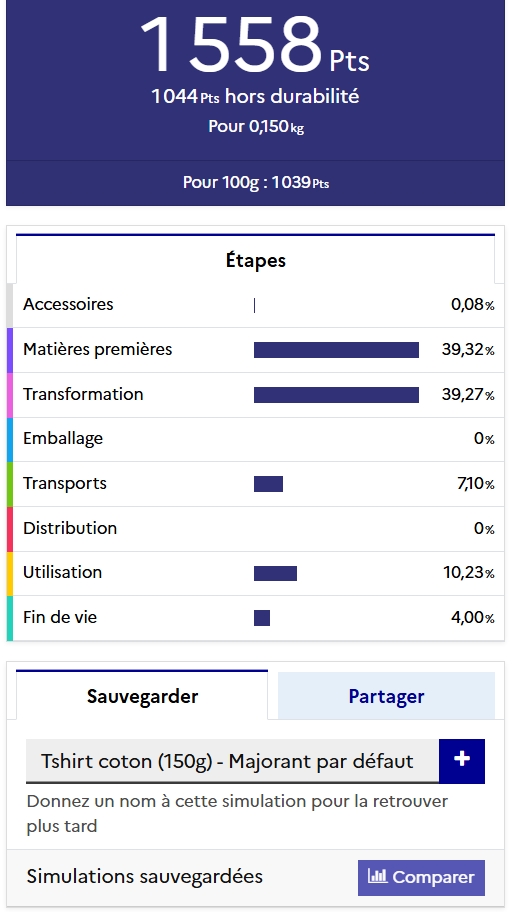
💻 Ecobalyse interface: each product is assigned a single score (in points) representing one millionth of the average annual impact of an EU citizen.
2. Input data required for calculating and declaring the textile environmental cost
Test submission
- Field name:
test - Description: indicates whether this is a test declaration or a real submission. This field is sent to the ADEME reporting platform, along with the data used to calculate the environmental cost.
- Data type: boolean (
true/false) - Expected value:
true= test,false= real - Requirement: optional
- Use: exclusively for the ADEME platform
Product GTIN/EAN codes
- Field name:
gtins - Description: list of unique GTIN (or EAN) codes used to identify the product.
- Data type: list of strings (
string[]) - Expected value: 8 or 13 digit codes (eg.
1234567890123) - Requirement: mandatory
- Use: exclusively for the ADEME platform
Product internal reference
- Field name:
internalReference - Description: internal reference specific to the brand.
- Data type: string (
string) - Expected value: eg.
REF-123 - Requirement: mandatory
- Use : for ADEME reporting and internal identification
Product brand
- Field name:
brand - Description: brand name of the textile product.
- Data type: string (
string) - Expected value: eg.
Trace For Good - Requirement: optional
- Use: exclusively for the ADEME platform
Product environmental cost
- Field name:
declaredScore - Description: represents the environmental cost calculated by Ecobalyse, if this cost has already been computed before sending data to the ADEME platform. If the cost calculated by Ecobalyse does not match the one reported by ADEME, the product will trigger an error in ADEME’s submission system.
- Data type: number (
number) - Expected value: eg.
7421 - Requirement: optional
- Use: exclusively for the ADEME platform
Mass of the finished product
- Field name:
mass - Description: total weight of the finished garment.
- Data type: number (
number) - Expected value: in kilograms, min.
0.01(eg.0.17) - Requirement: mandatory
- Use: ADEME and Ecobalyse platforms
Product category
- Field name:
product - Description: type of textile product covered.
- Data type: string (
string) - Expected value: amongst:
chemise,jean,jupe,manteau,pantalon,pull,tshirt,chaussettes,calecon,slip,maillot-de-bain - Requirement: mandatory
- Use : ADEME and Ecobalyse platforms
Product composition (raw materials)
- Field name:
materials - Description: list of materials used with their origin.
- Data type: object type (
array) - Data sub-type:
- id: material identifier (Ecobalyse list)
- share: material share (0–1, sum= 1)
- country: source country (ISO 2 letter code)
- Expected value:
{ id: "cotton", share: 0.65, country: "IN" } - Requirement: mandatory
- Use: ADEME and Ecobalyse platforms
Air transport ratio
- Field name:
airTransportRatio - Description: share of air transport between manufacturing and distribution
- Data type: number (
number) - Expected value: between
0and1(eg.0.1= 10 %) - Requirement: optional
- Use: ADEME and Ecobalyse platforms
Company size
- Field name:
business - Description: company size and repair service availability.
- Data type: string (
string) - Expected value:
small-business: Micro-enterprise and SMEslarge-business-with-services: large business with repair service availabilitylarge-business-without-services: large business without repair service availability
- Obligation : mandatory
- Use : ADEME and Ecobalyse platforms.
Dyeing/ finishing countries
- Field name:
countryDyeing - Description: country where the dyeing or finishing of the textile takes place. The country should be indicated using the two-letter ISO 3166 code available at: https://www.iso.org/obp/ui/#search.
- Data type: ISO 2 letter code (
string) - Expected value: eg.
IN,TR,PT - Requirement: mandatory
- Use: ADEME and Ecobalyse platforms
Country of fabric production
- Field name:
countryFabric - Description: country of the weaving/knitting stage of the textile
- Type de donnée : ISO 2 letter code (
string) - Valeur attendue : eg.
CN,FR,BD - Obligation: mandatory
- Usage : ADEME and Ecobalyse platforms
Country of manufacture
- Field name:
countryMaking - Description : country of manufacture of the garment.
- Data type: ****ISO 2 letter code (
string) - Expected value: eg.
MA,BG,FR - Requirement: mandatory
- Use : ADEME and Ecobalyse platforms
Spinning country
- Field name:
countrySpinning - Description: Country where the textile yarns are spun.
- Data type: ****ISO 2 letter code (
string) - Expected value: eg.
IN,EG,CN - Requirement: optional. If this field is blank, it will automatically default to the country indicated for the main material.
- Use: ADEME and Ecobalyse platforms
Washout process
- Nom du champ :
fading - Description : indicates whether a fading process has been applied (particularly relevant for jeans).
- Type de donnée : boolean (
true/false) - Valeur attendue :
true= faded,false= non faded - Obligation : optional
- Usage : ADEME and Ecobalyse platforms
Total number of references
- Field name:
numberOfReferences - Description: number of references in the brand’s catalog.
- Data type: number (
number) - Expected value: between
1and999 999 - Requirement: mandatory
- Use: ADEME and Ecobalyse platforms
Product price
- Field name:
price - Description: product selling price including tax, used to estimate durability.
- Data type: number (
number) - Expected value: between
1and1000€ - Requirement: mandatory
- Use: ADEME and Ecobalyse platforms
Printing process
- Field name:
printing - Description: details of the printing process applied to the product.
- Data type: object (
object) - Sub-data type:
- kind: printing type (
pigmentorsubstantive) - ratio: printed surface ratio (0 to 0,8)
- kind: printing type (
- Expected value:
{ "kind": "pigment", "ratio": 0.1 } - Requirement: optional
- Use : ADEME and Ecobalyse platforms
Garment accessories (buttons, zipers, elastics, etc.)
- Field name:
trims - Description: list of garment accessories (e.g., buttons, zippers, cords, elastics), which are included in the environmental impact calculation
- Data type: array of objects (
array) - Sub-data type:
- id: unique identifier of the accessory (type
string, format UUID). The complete list of accessories is available in the Ecobalyse reference database on le référentiel Ecobalyse. - quantity: Number of units of this accessory present on the product.(type
integer, minimal value:0).
- id: unique identifier of the accessory (type
- Expected value:
{ "id": "zip", "quantity": 1 } - Requirement: optional
- Use: ADEME and Ecobalyse platforms
Remanufactured/ upcycled product
- Field name:
upcycled - Description: indicates whether the product was produced using upcycling or remanufacturing methods.
- Data type: boolean (
true/false) - Expected value:
true= remanufactured product - Requirement: optional
- Use: ADEME and Ecobalyse platforms
Note: If some fields are left blank, Ecobalyse automatically applies default “penalizing” values (e.g., “unknown country,” “ultra fast-fashion”).
Providing accurate data is the first step toward improving your environmental score.
Each data field below is required to perform the environmental cost calculation and to submit results to ADEME’s official reporting platform.
.avif)
3. The French Eco-score calculation method
Pre-calculation – Data collection and processing
The platform consolidates all declared data such as mass, materials, countries of origin, manufacturing stages, transport, durability, and accessories to precisely model the garment’s full life cycle, from raw material extraction to end-of-life.
When data are missing, default values are automatically applied to maintain consistency and accuracy across all calculations.
Step 1 – Life Cycle Assessment (LCA) following the PEF method (EF 3.1)
Ecobalyse calculates environmental impacts across 16 PEF categories, such as climate change, water use, acidification, resource depletion and freshwater ecotoxicity, etc.To allow for meaningful comparison, impacts are normalized against the average annual footprint of a European citizen and weighted according to their environmental relevance.
Climate change
21.06 %
Freshwater ecotoxicity (corrected)
21.06 %
Acidification
4.91 %
Particles
7.10 %
Water resources
6.74 %
Fossil resources
6.59 %
Mineral resources
5.98 %
Soil use
6.29 %
Other categories
2 to 5 % each
Eg: Climate change and freshwater ecotoxicity each account for 21.06% of the total weighting, while others vary between 2% and 7%.
Methodological adjustments include:
- Exclusion of human toxicity indicators (carcinogenic and non-carcinogenic).
- Doubling of organic molecule impacts in freshwater ecotoxicity to better reflect biodiversity effects.
- Exclusion of long-term emissions (> 100 years) and correction of uranium resource weighting to reflect the EU electricity mix.
Based on the entered data, Ecobalyse quantifies the impact of each life cycle stage and consolidates them into a single score, expressed in Points (Pts).
Does using recycled material always reduce the score?
Not necessarily. The impact depends on the material and recycling process.
Ecobalyse integrates this effect using the Circular Footprint Formula (CFF), which models the real benefits and impacts of recycling based on both input (R1) and end-of-life (R2) material flows.
For example, recycled cotton often improves the score, while recycled polyester may not, due to the additional processing required.
Step 2 – Textile-specific additions
Two addiitonal indicators (outside the LCA scope and not included in the standard PEF), are added to reflect textile-specific realities:
- Export of end-of-life products outside Europe.
Measures the impact of post-consumer textile exports, typically treated as waste abroad. Formula: 0.005 Pts/ kg x product mass x export probability (12.1% for synthetic textiles; 4.9% for others). - Microfiber emissions.
Models the release of plastic or natural microfibers throughout the life cycle, using a coefficient of 0.001 Pt/kg adjusted by fiber type and biodegradability.
Step 3 – Aggregation into a single score
The 16 impact categories derived from the PEF methodology, tailored to the specificities of the textile sector, are then consolidated with the two additional indicators: microfiber emissions and exports outside Europe to produce an overall environmental score.
The result is an overall score, expressed in Points (Pts) and representing the product’s total environmental impact from production to end-of-life.
Step 4 – Applying the ‘durability’ coefficient
Finally, the score is adjusted to reflect product durability, using a coefficient that rewards garments designed for longevity and repairability.
This coefficient ranges from 0.67 (low durability) to 1.45 (high durability), based on two criteria:
- The presence of repair or after-sales services, and
- The width of the product range (fewer variants = higher durability).
The more durable the product, the lower its environmental cost.
Step 5 – Final Eco-score
The final environmental cost is automatically generated by Ecobalyse or through the ADEME submission platform (if used directly).
It is expressed in Points (Pts), a standardized unit allowing product-to-product comparison.
Conclusion
The environmental cost tells the story of your product, from design and production to transport, use, and end-of-life.
The score isn’t the goal; it reflects the quality and reliability of your data across the supply chain. It also reveals gaps and inconsistencies, helping you improve data accuracy and reduce real environmental impact.
More than a compliance metric, it’s a strategic communication tool that helps brands speak credibly about their impact, show progress, and earn consumer trust.
The next module explores why data reliability matters for both compliance and brand performance and how this score can drive transparent, trustworthy communication about sustainability.

Regulatory framework for the French Eco-score in the textile industry
Introduction: why a textile Eco-score system?
The textile industry carries a heavy environmental legacy: it alone accounts for 20% of global water pollution and 10% of greenhouse gas emissions. The rise of ultra–fast fashion only accelerates the push for higher and higher production volumes.
At this pace, global textile production could increase by more than 150% by 2030.
Yet this rapid growth is increasingly at odds with what consumers want and value. Sixty percent of consumers say they want to adopt more sustainable consumption habits, and seven in ten are ready to change brands to favor products with a lower environmental impact (1).
It is at the crossroads of this ecological and social pressure that the French eco-score emerges. Designed as a standardized framework, it aims to combat greenwashing, still practiced by some, and to rebalance the flow of information between brands and consumers.
Often described as the potential “Nutri-Score” for fashion, the system introduces a quantified environmental cost for each product. While it is non-mandatory for now, this initiative could spark a genuine paradigm shift across the textile industry.
However, as essential as it is challenging, this ambition is difficult to translate into practice. Providing consumers with clear, comparable, and scientifically robust information on the environmental impact of products requires overcoming many technical, economic, and organizational challenges.
What remains to be understood is how this ambition translates into law. The French eco-score is no longer just an idea: from the AGEC Law to the Climate and Resilience Law, and now the 2025 Decree, it is built on a solid legal foundation that defines its framework and introduces the first obligations for the textile industry.
1. Legal foundations: from the Grenelle de l’Environnement measures to the Climate & Resilience law
The ambition to create a French eco-score is not new. As early as 2009, the Grenelle de l’environnement initiated the concept of informing consumers about the environmental footprint of products.
It took more than a decade, however, for this vision to become true. In 2020, the AGEC Law (Anti-Waste for a Circular Economy) enshrined the principle of environmental information for consumer goods.
One year later, the Climate and Resilience Law broadened the scope of the initiative. Article 2 introduced the framework for mandatory labelling for various industries, including textiles, to ensure “reliable, comparable, and verifiable” information on product environmental impacts throughout their life cycle.
Decree No. 2025-957 of September 6, 2025 turns this ambition into action by setting the practical rules for the French eco-score's implementation. Importantly, it remains voluntary but regulated: any communication must follow the calculation and presentation standards defined by the decree. The text also outlines company obligations and assigns ADEME (the French Agency for Ecological Transition) the role of overseeing and ensuring consistency of the system.
2. The central role of ADEME
It’s impossible to talk about the French eco-score without mentioning ADEME. As the driving force behind the initiative, France’s Agency for Ecological Transition ensures both scientific credibility and operational consistency of the French eco-score system. By standardizing practices, ADEME helps prevent the proliferation of private labels built on inconsistent or competing methodologies.
After leading the initial experimentation phase, ADEME now works alongside the State-backed start-up Ecobalyse to develop the calculation methodology.
ADEME also manages the national platform where companies must submit their data. From the official graphic template to calculation protocols and data integrity, ADEME ensures that brands comply with the regulatory framework.
- ADEME – official website on environmental labeling.
- ADEME, methodological reports (2022-2024).
3. Current status and timeline
First mention of a French Eco-score to help with consumer awareness on environmental matters.
Establishes the legal foundation for environmental information on consumer goods.
Defines a clear framework for the French Eco-score for different industries, including textiles.
Large-scale tests are done in the textile, food, and hospitality industries to refine methods and assess usability.
Official calculation and communication rules for the textile French Eco-score are defined.
The French eco-score becomes applicable. Labelling is voluntary, yet strictly regulated.
Retailers and digital platforms may display environmental scores. Alignments are expected with the PEF methodology to avoid redundancy.
4. Companies and products affected by the French textile eco-score
The September 2025 Decree clearly defines the scope of application:
It applies to manufacturers, importers, and distributors placing textile products on the French market. The term “placing on the market” refers to the first time a product is made available on the French national market.
As for the products themselves, the scope is deliberately limited. The text applies only to clothing textiles, whether new or remanufactured. Footwear and other textile articles are not yet included, as they require further methodological development before being incorporated into the framework.
The scope will be confirmed by a joint decree from the Ministries of Economy and Environment, in alignment with the EU Regulation No. 1007/2011 on textile fibre labelling.
The French eco-score goes beyond the textile sector. Other pilot industries, such as the food and hospitality industries, are also taking part in this initiative.
That said, our module is primarily designed for textile brands, as this sector is the first to be directly affected by the decree’s entry into force.
Manufacturers, importers, and first distributors on the French market
Apparel textiles (new or remanufactured)
Products placed on the French market
5. Practical rules and obligations
1. Data collection and submission to ADEME
For the environmental score to reflect reality, brands must rely on reliable, verifiable, and complete data, avoiding approximations or default “proxy” values that can inflate the final score. The quality and precision of the information provided directly determine the credibility and reliability of the score.
The data must be:
- Documented, backed by verifiable sources such as life-cycle assessments (LCAs), certificates, or traceability documents.
- Submitted to the national platform managed by ADEME before any public communication.
Each product sheet must be calculated using the Ecobalyse methodology (aligned with the PEF and other textile-specific parameters) and uploaded to the ADEME portal. The data submission must include: product identification, methodology used, calculation date, impact breakdown by category.
The data provided may be publicly disclosed, consistent with the system’s commitment to transparency.
2. Communication of the environmental cost follows strict rules
Communication rules make sure brands are compared fairly and transparently.
Companies cannot change the environmental score format or showcase only the indicators that make them look better.
Brands must use the official ‘eco-score’ format

The environmental cost must be displayed using the template established by ministerial decree (format, pictogram, unit).
The information must be visible at the time of purchase, both online and in stores, and reproduced identically across all media.
No graphic modification, simplification, or rewording is allowed: consumers must be able to compare two products on the same basis.
Brands must publish complete environmental impact scores
If a brand communicates on one metric, such as carbon footprint or water usage, it must also show the full environmental cost, calculated with ADEME’s official methodology.
This rule prevents “green cherry-picking” and gives consumers a clear picture of the product’s overall impact.
Data must be consistent and traceable
The displayed score must exactly match the version submitted to the ADEME platform.
Any discrepancy between the communicated score and the recorded data constitutes a breach of the law.
The environmental cost of textile products must be updated regularly
The framework requires continuous monitoring of data quality and relevance. The eco-score must never rely on outdated or incomplete information.
- Data must be updated at least once a year and whenever there is a significant change in sourcing, material mix, or industrial processes.
- The environmental cost can be recalculated every three months at most.
- If the official methodology changes, the score must be updated within a maximum period of twelve months.
- Companies must maintain full traceability of all calculations, sources, and supporting documents.
3. Non-compliance will lead to sanctions
ADEME and the DGCCRF (French Consumer Protection Authority) may audit data and communications.
Any misleading or incomplete information may qualify as deceptive commercial practice under Articles L121-2 of the French Consumer Code.
Violations can result in:
- administrative fines
- legal proceedings for non-compliance or misrepresentation
- suspension of the right to communicate environmental scores
6. Toward European harmonisation
While France leads the way with the eco-score, its framework is part of a broader EU effort to create a common approach to environmental labeling.
In March 2025, the technical secretariat of the Product Environmental Footprint (PEF) recommended that environmental scores be used only for B2B communication, as they are too complex for consumers to understand.
France, however, chose a different path: keeping environmental scores visible to consumers (B2C).
This means companies will have to work with two complementary systems:
- French Decree: B2C consumer labelling
- EU PEF: B2B data harmonization
By 2026, three major EU initiatives- the Ecodesign for Sustainable Products Regulation (ESPR), the Green Claims Directive, and the Digital Product Passport (DPP)- are expected to come together under a single method. The goal is to prevent greenwashing and ensure fair competition across the EU market.
Conclusion
Textile environmental labeling is no longer just a political idea: it’s now supported by a strong legal framework, built through the AGEC Law, the Climate & Resilience Law, and the 2025 Decree.
For brands, this is an important step towards being more transparent, compliant, and responsible.
Starting early helps you stay compliant, lower risks, and keep control of your environmental messaging, especially as data sharing becomes increasingly accessible to third parties.
The key question now is: how is the environmental cost actually calculated?
The legal framework is already in place, but it’s the methodology developed by ADEME and Ecobalyse that brings it to life.
The next section of this module will take you through the step-by-step process behind calculating the environmental score.
(1) Kantar sustainability sector Index report, 2025
Decoding the law: Understanding the UCPD
Introduction
In the article “After the Green Claims: Embracing Responsible Communication in Fashion”, we explained that one of the main challenges for brands in 2025 lies in navigating a fragmented regulatory landscape, with no clear directive governing environmental claims.
While this statement is accurate, it is also incomplete: in reality, a legal foundation already exists.
The European directive UCPD (Unfair Commercial Practices Directive), transposed at the national level by member states, clearly defines a number of prohibited (or strongly discouraged) behaviors when it comes to environmental communication. It is not a technical regulation per se: the directive does not set thresholds, standards, or controlled terminology. And it is precisely this non-technical nature that explains why it remains relatively overlooked by brands today.
Yet this directive offers national authorities a solid legal basis to sanction greenwashing, relying on general rules regarding unfair commercial practices. In France, in 2024, the DGCCRF inspected nearly 1,800 businesses as part of an investigation into environmental claims: over a third were found to have problematic practices.
A close reading of the text leaves little doubt: many practices currently in use are non-compliant.
In this article, we therefore offer a comprehensive breakdown of the directive, with a practical, hands-on approach: concrete obligations, recommended best practices, frequent mistakes, and key watchpoints to consider in any environmental communication strategy.
Understanding the Framework of the UCPD
In the third paragraph of point 4.1 of the document Communication from the Commission — Guidance on the interpretation and application of Directive 2005/29/EC on unfair commercial practices, it states:
"The UCPD does not lay down specific rules on environmental claims."
This statement can be misleading if one does not grasp the exact scope of the directive.
In concrete terms, this means that the UCPD:
- Contains no dedicated technical chapter on environmental claims;
- Offers no ecological normative framework;
- Defines no specific terminology (such as the terms “sustainable,” “neutral,” “organic,” etc.).
This lack of a technical framework may have led to the mistaken belief that, regarding environmental claims, there were neither rules nor explicit prohibitions. However, the legal reality is quite different.
Environmental claims are indeed governed by Articles 5 to 12 as well as Annex I of the directive, which list misleading, unfair, or prohibited commercial practices.
As such, any claim is subject to five fundamental requirements:
- Truthfulness and accuracy of the information provided;
- Clarity and unambiguity in wording;
- Availability of verifiable evidence;
- No exaggeration of environmental benefits;
- Actual relevance of the claim concerning the product's impact.
In practice, European and national authorities interpret these principles with increased rigor when it comes to environmental claims. This heightened requirement is explained by several factors:
- The sensitive and ethical nature of environmental issues (climate, pollution, biodiversity);
- The consumer's vulnerability to “green” promises;
- The weight of these arguments in purchasing decisions.
Key takeaway:
- Specific ecological criteria
- Any misleading environmental claim
- A list of authorized labels
- Misuse or vague use of any label
- A legal definition of 'sustainable'
- Any vague or eggagerated wording
- A sector-specific manual
- Any practice that does not comply with the principles of fairness, clarity and verifiability of information
In essence, the UCPD grants brands the freedom to express themselves but imposes a duty of justification. It is thus possible to claim that a product is “sustainable,” provided that one can explain what this means, prove its truthfulness, and articulate it clearly. This is the subtlety of the text: the directive does not set mandatory wording, but any claim that misleads can be sanctioned as a deceptive practice.
To help brands stay within the framework, eight major principles derived from the UCPD anchor environmental communication that is both compliant, fair, and operational. They form a vigilance grid to integrate into your validation, proof, and dissemination processes.
Principle #1 - Every environmental claim must be true, specific, clear, and non-misleading
Regulatory focus
According to Article 6 of the UCPD:
A commercial practice is considered misleading if it contains false information or, even in the absence of falsehood, deceives or is likely to deceive the average consumer, leading them to make a commercial decision they would not have otherwise taken.
For environmental claims, this implies that:
- The information must not contain factual errors (e.g., stating "zero emissions" if not measured).
- The claim must not be vague or general: it should be specific, contextualized, and understandable without excessive interpretation.
- It must be accurate regarding scope and subject: the product concerned, lifecycle stage, actual benefit...
The directive adds that even factually correct formulations can be considered misleading if they suggest an exaggerated positive impact or conceal other significant aspects.
✓ Recommended best practices
Use concrete and measurable terms:
- "Contains 60% GOTS-certified organic cotton"
- "According to data provided by our supplier, it consumes 30% less water in the dyeing stage compared with the model produced in 2022. This data can be consulted here (insert link to supplier data)."
Always specify the scope:
- "Made with 100% renewable electricity (excluding transport and finishing)"
- "Biodegradable in industrial composting according to EN 13432", and specify the standard's context
Use accessible and neutral language, avoiding emotive or subjective terms:
- Prefer: "15% reduction in CO₂ emissions compared to the 2023 version"
- Avoid: "conscious," "respectful," "good for the planet," "green"
Support every claim with quantified and precise elements, and mention the source:
- Is the claim based on an internal study, external audit, standardized test, certification? Always mention which and its validity period.
✗ Common non-compliance cases
- Referring to a "sustainable product" without specifying what that means: does sustainability concern the product's lifespan, durability, environmental impact?
- Using "carbon neutral" without mentioning that it relies on offset credits, nor explaining how they work.
- Employing iconography (tree, green globe, leaves) that creates an exaggerated perception of eco-responsibility, while the product's overall impact is neutral or negative.
- Communicating on a single positive point (e.g., % of recycled material included in the product) while hiding others (uncontrolled chemical treatment, long transport, etc.).
Principle #2 - Every environmental claim must be supported by solid evidence, available at the time of publication, and ready to be provided to authorities
Regulatory focus
Article 12 of the UCPD stipulates that:
Control authorities may require the professional to provide evidence of the accuracy of their claims. If such evidence is not provided or deemed insufficient, the claim is considered inaccurate.
This concretely means that:
- The brand bears the burden of proof.
- The evidence must be:
- In the brand's possession from the moment the claim is used.
- Understandable to a competent authority (you cannot merely offer a technical table or a link to a supplier's website).
- Independent: ideally validated by a third party (audit, test, certification, LCA...).
- Verifiable and kept up to date as long as the claim is used.
In the absence of sufficient evidence, the claim may be presumed misleading, even if factually correct.
✓ Recommended best practices
Prepare an evidence dossier from the claim's development:
- The covered scope
- The calculation or evaluation method
- The measurement or certification date
- The name of the certifier or laboratory
- Any limitations or assumptions
Use solid and recognized sources (specifying their scope):
- Tests according to ISO standards (14040, 14067, etc.)
- Certification audit (GOTS, EU Ecolabel...)
- Life cycle assessment (LCA) with available report
- Evaluations from public bodies or independent third parties
Plan for centralized and durable storage of this evidence:
- Keep your product dossier in your traceability solution or PLM
- Ensure easy access for legal, CSR, or marketing personnel
Periodically review the evidence:
- If the claim remains published on the website, in a brochure, or on the product, the evidence must always be valid.
- In case of changes in production, supplier, process, it must be updated.
✗ Common non-compliance cases
- Presenting a claim based on an unverified supplier promise, and settling for an email or commercial description.
- Using an unsigned or undated Excel file as the sole evidence of an LCA or environmental impact calculation, without guaranteeing the integrity, method used, or traceability of source data.
- Mentioning specific environmental performances (like “biodegradable,” “low carbon,” “climate-friendly”) without providing associated test, standard, or protocol, nor specifying validation conditions (industrial vs. home compostability, measured CO₂ scope, etc.).
- Publishing a figure or quantified commitment (“70% fewer emissions”) without indicating the calculation method, comparison basis, or assumptions made.
Principle #3 - Any claim based on a label, logo, or certification must be transparent, justified, and accompanied by accessible and verifiable information
Regulatory focus
The UCPD considers that labels, logos, or certifications used in an environmental context constitute claims in their own right. Their use is acceptable only if:
- They do not mislead the average consumer about the actual scope of the environmental benefit.
- The professional specifies what the label covers (e.g., material, process, packaging…).
- It is indicated who issues the certification (public or private body, independent third party or not).
- The label's awarding criteria are clear, discriminating, public, and accessible.
- The label or symbol does not create confusion with an official system if it is private.
- The consumer has direct access to information (e.g., via QR code, link, tooltip) to understand the label's meaning and scope.
The UCPD also specifies that affixing a label or logo alone does not suffice to prove the validity of a claim: it must always be explained.
✓ Recommended best practices
✓ Recommended Best Practices:
- Clearly specify:
- What the label covers: raw material, manufacturing step, entire product?
- Who issued it: public authority, private body, self-certification?
- Validation criteria: traceability, impact reduction, environmental audit?
- Whether third-party verification was conducted, by whom, and using which method.
- Make information accessible:
- Provide a direct link to the page detailing the label's criteria.
- Add an explicit note near the claim or logo (e.g., "Label applies only to the main material – excludes finishes").
- Avoid acronyms or symbols that are incomprehensible without explanation (e.g., "GRS certified" without clarification).
- Ensure message clarity and fairness:
- Choose robust, recognized labels (e.g., EU Ecolabel, Blue Angel, GOTS).
- Verify that criteria are up-to-date, truly distinctive, and appropriate for the product.
- Refrain from using visuals that could be mistaken for official labels if they are not.
✗ Common non-compliance cases
- Displaying a "GOTS" logo on a finished product when only the fiber is certified, without clarification.
- Mentioning "sustainable cotton" or "responsible material" without indicating the system or standard used, nor providing a link to associated criteria.
- Displaying a fabricated or internal private label (e.g., "Eco approved" or "Green Certified") without a public standard, third-party audit, or verification possibility.
- Using green pictograms, leaves, or stamps visually similar to official labels, creating intentional or unintentional confusion for the consumer.
Principle #4 – Carbon neutrality claims must be substantiated and verifiable
Regulatory focus:
The UCPD states that carbon neutrality claims are acceptable provided they:
- Specify the method: which part of the life cycle is considered? (production? transport? usage?)
- Distinguish between actual reductions and offset mechanisms.
- Justify the quality of carbon credits used: additionality, traceability, transparency, audit.
- Do not use carbon neutrality to mask a lack of direct reduction efforts.
✓ Recommended best practices
- Specify the calculation basis:
- Which emissions are measured?
- Which emissions are reduced? Which are offset?
- Provide understandable information on:
- The offset project (type, location, method)
- The amount of emissions offset
- The direct link to the product
- Avoid generalities:
- Ban vague slogans such as: "carbon neutral," "good for the planet."
- Prefer: "Emissions related to textile production are offset by 30% through the implementation of [project X] certified by [label X]," and specify the label's framework.
✗ Common non-compliance cases
- Claiming carbon neutrality of a product or activity without any explanation of the calculation method, the scope covered (scope 1, 2, 3?), or distinction between reduced and offset emissions.
- Announcing carbon offsetting directly on packaging or in an advertisement, without mentioning the offset project, its certification level, or the life cycle stages concerned (production, transport, usage…)
- Using "voluntary" carbon credits from projects with low environmental integrity (non-additional, unverified, or difficult to trace), without transparency on their real impact or external audit proof.
- Highlighting offsetting as a central marketing argument, while no significant effort has been made to directly reduce emissions in the value chain, effectively diverting the concept of carbon neutrality for image purposes without structural commitment.
Principle #5 – Environmental comparisons must be fair, consistent, and verifiable
Regulatory focus:
According to the UCPD and Directive 2006/114/EC on comparative advertising, an environmental comparison is acceptable if it meets four cumulative requirements:
- It must not mislead the consumer (per Articles 6 and 7 of the UCPD).
- It must compare products or services that meet the same needs or are intended for the same purpose.
- It must be based on objective, verifiable, and representative criteria.
- It must rely on a consistent and reproducible assessment method.
✓ Recommended best practices
- Clearly state:
- What the comparison refers to (product, stage, impact)
- The scope and methodology used (e.g., LCA, standards)
- The source of comparative data (e.g., independent, internal)
- Use relative rather than absolute phrasing:
- Prefer: "30% less CO₂ compared to our 2023 version."
- Avoid: "The cleanest on the market."
- Verify reproducibility:
- Any comparison must be reproducible (and auditable) under the same rules.
- Clearly state:
✗ Common non-compliance cases
- Comparing non-equivalent products in terms of use or target (e.g., comparing a dress shoe with a sports sneaker, or a child's jeans with adult trousers), which distorts the perception of relative impact.
- Using a non-coherent or non-comparable measurement method between analyzed products: different evaluation scopes, heterogeneous input data, misaligned assumptions, or lack of transparency on the method used.
- Making an environmental comparison without being able to provide verifiable or accessible proof, such as a publication, working document, or third-party analysis result, making verification impossible for the consumer or authorities.
- Basing the comparative claim on outdated or non-representative data, for example, comparing a current product with a competitor's version that is no longer on the market or has since been improved, creating an unfounded illusion of advantage.
Principle #6 – Environmental claims must address the product's most significant impact and be assessed across the entire product life cycle
Regulatory Focus:
The directive states that environmental claims must:
- Address the product's most significant impacts;
- Not divert the consumer's attention to a minor benefit;
- Take into account the entire product life cycle: sourcing, production, transport, usage, end-of-life.
It explicitly prohibits unjustified impact shifting: an improvement in one area cannot be used to conceal a worsening elsewhere, unless the net environmental impact is demonstrably improved (e.g., via LCA).
Highly polluting industries are expected to be especially cautious: they are encouraged to use relative claims (e.g., "less harmful to the environment") rather than absolute ones (e.g., "environmentally friendly").
✓ Recommended best practices
- Conduct a full Life Cycle Assessment (LCA) to substantiate key claims (e.g., low carbon, impact reduction).
- Clearly define the scope:
- Which stages are included? (Raw materials? Manufacturing? Transport? Packaging?)
- Which methodology is used? (LCA, PEF, etc.)
- Align the claim with the assessed scope:
- Prefer: "Product made with 40% recycled polyester, not traceable across the full life cycle."
- Avoid: "15% net emissions reduction (including scopes 1 to 3)."
✗ Common non-compliance cases
- Presenting a product as "sustainable" based solely on a single material (e.g., organic cotton) without assessing real durability (lifespan, reparability, etc.) or other stages of the life cycle.
- Highlighting a marginal environmental benefit (e.g., waterless dyeing, recycled packaging) while the overall process remains carbon-intensive.
- Making a claim based only on marketing intuition or a supplier statement without any structured LCA or quantified analysis across the full value chain.
Principle #7 – Any visual element (name, color, image, symbol, logo) may constitute an environmental claim
Regulatory Focus:
The UCPD considers that:
- A claim can be implicit and misleading, even without words;
- Visuals such as green colors, leaves, trees, animals, or natural imagery can mislead consumers if not substantiated;
- Product or collection names like "Greenline", "EcoSoft", or "Sustainable Series" are subject to the same rules as textual claims;
- The same applies to icons, pictograms, graphic logos, or "eco" stamps.
✓ Recommended best practices
- For every visual element used in an environmental context (websites, labels, social media):
- Ensure it is substantiated by evidence;
- Contextualize it with an explanatory note nearby;
- Ensure the visual's prominence reflects the product's actual impact.
- If a collection or brand name carries environmental connotations:
- Either the claim must be true for all products in the range;
- Or it must be accompanied by an explicit disclaimer.
- For every visual element used in an environmental context (websites, labels, social media):
✗ Common non-compliance cases
- Using evocative icons (leaves, trees, planets, water droplets, green tones) without justification or evidence, leading to exaggerated perceptions of sustainability.
- Naming a collection with an ecological term (e.g., "Greenline") when it only contains a low proportion (e.g., 15%) of recycled or certified materials, without explanation.
- Designing a product label with dominant green color or "nature" themes without supporting evidence or explanation.
Principle #8 – Even in constrained formats, environmental claims must be understandable and not misleading
Regulatory Focus:
The directive acknowledges that some formats (labels, stories, product pages, ads) have limited space, but still require:
- Clear and specific language;
- Avoidance of vague terms without immediate clarification;
- Easy access to additional details (e.g., QR code, direct link, popup).
It is considered misleading to make the consumer dig through multiple pages to understand an environmental claim.
✓ Recommended best practices
- Use appropriate formats for each medium:
- Packaging: link to full explanation via QR code
- Social media: share explanatory carousels
- E-commerce: include tooltips or expandable content for full details
- Embed necessary clarifications directly:
- e.g.: "Certified recycled cotton: more information via QR code."
- Use appropriate formats for each medium:
✗ Common non-compliance cases
- Using strong environmental terms ("green", "eco", "bio") on packaging, product sheets, or labels without any clarification or source.
- Optimizing product titles or URLs for SEO (e.g., "eco hoodie") while the actual product page contains no environmental substantiation.
- Publishing a promotional visual with a claim like "carbon neutral" or "responsible" without clickable access to supporting documentation.
- Using a constrained medium (label, ad insert, social media post) without any link or reference for further details.
Principle #9 – Misleading or unsubstantiated claims can lead to sanctions by national authorities
Regulatory Focus:
Article 12 of the UCPD allows national authorities to request supporting documentation at any time. If the evidence is deemed insufficient, the claim is presumed false.
Annex I of the directive lists practices that are banned in all circumstances, including:
- Falsely displaying a label or certification;
- Claiming adherence to a code of conduct without proof;
- Presenting legal obligations (e.g., banned substances) as product benefits.
Authorities can impose:
- Suspension or removal of a product or campaign;
- A ban on further advertising;
- Administrative fines (e.g., DGCCRF in France);
- Civil actions in case of harm to consumers or competitors;
- Reputational damage from public disclosure.
✓ Recommended best practices
- Maintain a central, up-to-date archive of substantiating evidence, ready for disclosure.
- Set up an internal audit procedure to regularly review claims and visuals across all channels.
- Monitor regulatory developments, guidelines from the CPC, and national case law.
✗ Common non-compliance cases
- Being unable to provide documented evidence for a claim in a timely manner after a complaint or request by authorities.
- Using official labels (e.g., EU Ecolabel, Nordic Swan, Blue Angel) without authorization or on products not covered by certification.
- Promoting a regulatory requirement as a voluntary commitment (e.g., "free from banned substances" or "REACH compliant").
UCPD – Key points summary
All claims must be true, specific, clear, and not misleading.
- Use concrete and measurable terms
- Specify the scope
- Use accessible, neutral language
- Support each claim with quantified, sourced data
- Using “sustainable product” without defining sustainability
- Claiming “carbon neutral” without explanation
- Exaggerating impact through green visuals
- Highlighting one benefit while masking others
All claims must be backed by evidence available upon publication.
- Prepare a structured, time-stamped evidence file
- Use robust sources (ISO, LCA, audits, labels)
- Store proof in an accessible system
- Regularly update the documentation
- Relying on unverified supplier claims
- Using only an unsigned Excel as proof
- Making claims without tests, standards, or protocols
- Publishing a figure without method or reference baseline
Labels, logos, and certifications must be transparent, justified, and verifiable.
- Specify what the label covers (material, stage, product)
- Indicate the certifying body
- Make criteria accessible (link, QR code)
- Choose recognized and verifiable labels
- Using a “GOTS” logo when only the fiber is certified
- Using a fictitious private label with no public reference
- Employing icons resembling official labels
- Omitting validation criteria
Carbon neutrality claims must be rigorous, explained, and verifiable.
- Specify the basis: measured, reduced, and offset emissions
- Describe offset projects (type, location, method)
- Avoid vague slogans like “carbon neutral”
- Justify credit quality and certification
- Vague neutrality claims with no method or scope
- Mentioning offsets without project or certification
- Using low-integrity or unverifiable credits
- Using offsets as central marketing argument
Environmental comparisons must be fair, consistent, measurable, and verifiable.
- Specify what is compared and how
- Compare equivalent products
- Use relative wording (e.g. “30% less than…")
- Ensure reproducibility and proof
- Comparing non-equivalent products
- Using inconsistent or non-transparent methods
- No proof or publication to back up the claim
- Comparing with outdated or unrepresentative products
Claims must relate to significant impacts across the life cycle.
- Base major claims on full life cycle assessment
- Specify covered stages: material, transport, use, etc.
- Avoid highlighting minor or isolated benefits
- Emphasizing marginal improvements
- Claiming “durable” without proof of longevity or use
- Making a claim based on intuition or supplier statements
Any visual presentation may constitute an environmental claim.
- Justify every icon, color, or image used
- Contextualize with nearby text or link
- Limit green visuals to what is demonstrably supported
- Using nature-related icons with no justification
- Naming a line “green” when only 15% of the product qualifies
- Using green backgrounds or planet icons without clarification
Even in constrained formats, environmental claims must be understandable and not misleading.
- Use QR codes, tooltips, or explainer carousels
- Provide key clarifications directly or via one click
- Using vague slogans with no supporting info
- Mismatch between product name and actual content
- No access to proof on social media or packaging
Authorities may inspect, sanction, or withdraw misleading or unsubstantiated content.
- Keep an updated, accessible proof register
- Conduct regular audits of published materials
- Implement legal monitoring
- Unable to provide proof upon request
- Displaying labels without official certification
- Presenting legal obligations as voluntary commitments
Conclusion: A false sense of leeway
While waiting for the Green Claims Directive, many brands believe they are operating in a grey area.
The absence of a specific, technical framework creates the impression that there’s still some leeway, that avoiding excesses or staying “within the spirit” of responsible communication is enough.
But in reality, this margin is much narrower than it seems.
Because a legal foundation already exists. The UCPD allows authorities to sanction any claim deemed misleading, vague, unsubstantiated, or poorly worded- even when made with sincere intentions.
And this isn’t just theoretical. In France, the DGCCRF is actively conducting enhanced inspections, including on environmental claims. In 2024 alone, over 21,000 warnings and 2,300 fines were issued across all sectors, and greenwashing is clearly on the regulator’s radar.
In other words: Just because there are no “positive” rules yet doesn’t mean rigor is optional. And just because a brand isn’t lying doesn’t mean it’s compliant.
The UCPD doesn’t only target blatant abuses: it also applies to vague statements, shortcuts, and flattering yet unclear wording.
And for all brands committed to greater transparency, it offers a clear and already applicable framework, provided it's implemented today.

Beyond the Green Claims vacuum: Communicating responsibly in fashion
Introduction
With the Green Claims Directive currently at a standstill, the initiative meant to bring long-needed clarity to environmental communication is now suspended, held back by political tensions over provisions considered too heavy for small and medium-sized enterprises.
At first glance, this might sound like a relief for brands. But in practice, it creates a vacuum, one that collides with ever-growing consumer expectations.
And if we want to avoid repeating the same mistakes, we need to look back.
When, once upon a time, bold commitments had become the new black. When “eco-responsible,” “climate-friendly,” and “conscious” statements took over lookbooks and product pages, rarely backed by proof. When ambition blurred into overstatement, and a lack of definitions or legal standards left the door wide open to greenwashing.
That moment in time triggered a backlash. And that backlash sparked regulation. Not to punish ambition, but to establish a minimum standard of credibility.
Today, that regulatory framework is at a standstill. And brands are left to navigate without it.
So how can they communicate progress without falling into the same traps?
Let’s find out.
Communicating responsibly in fashion, part one: From loud to silent
Let’s rewind.
To fully understand how to avoid the green communication trap, it’s essential to first grasp where it comes from.
If we consider the fact that brands went from claiming their commitments loud and proud to burying them deep in the “CSR” tab of their corporate websites, one thing becomes clear: Somewhere along the way, they lost confidence in what they could say, and how to say it safely.
The birth of green communication
Between 2015 and 2020, as sustainability rose on the public agenda, fashion brands started to respond, with words before systems.
Communicating about impact became a way to stand out, signal values, and respond to growing consumer expectations. Terms like eco-responsible, green, ethical, planet-friendly, and sustainable began to appear in lookbooks, product pages, newsletters and window displays.
Campaigns even featured natural imagery, climate-positive tones, and reassuring narratives; often without much detail to support them.
It wasn’t always malicious. In most cases, brands were only trying to express their intentions.
But in the absence of clear definitions or legal guidance, intentions blurred into marketing language, and marketing language turned into potential overstatements.
And that trend didn’t go unnoticed.
The Fashion Transparency Index, published annually by Fashion Revolution since 2017, consistently highlighted a growing gap between what brands claimed and what they could actually prove in terms of supply chain data, materials traceability, or environmental impact reporting.
In parallel, a 2021 report from the Changing Markets Foundation showed that nearly 6 in 10 green claims in fashion were vague, unsubstantiated, or potentially misleading.
And the European Consumer Organisation (BEUC) warned that this lack of clarity was feeding consumer distrust and confusion.
So, what was missing?
- A shared vocabulary,
- A common baseline,
- A standard of proof.
Green communication was born in good faith. But it grew up in a vacuum.
The rise of legal accountability
Between 2021 and 2024, a series of regulatory moves began to reshape the landscape of green communication in Europe.
- In May 2022, the revision of the Unfair Commercial Practices Directive (UCPD) [Directive 2005/29/EC] made misleading, vague or unsubstantiated environmental claims explicitly illegal.
The revised directive now includes environmental impact and durability under deceptive commercial practices.
- In March 2023, the European Commission proposed the Green Claims Directive: a potential game-changer for environmental communication. It aimed to require that any environmental claim (at the product or company level) be specific, science-based, and independently verified. However, in June 2025, the proposal that was supposed to move forward has been stopped in its tracks, and negotiations have been stalled.
- In February 2024, the Empowering Consumers for the Green Transition Directive was formally adopted by the European Parliament.
It requires companies to provide clear, reliable, and comparable information on product durability and environmental performance. Member States must transpose it into national law by early 2026.
Meanwhile, enforcement was already picking up speed.
In France, the DGCCRF began issuing warnings and sanctions as early as 2022 against brands using terms like “carbon neutral,” “eco-friendly” or “climate positive” without clear methodology, time horizon, or traceable data.
Across Europe, NGOs and watchdogs challenged marketing campaigns they deemed misleading (genuine intentions or not), if proper documentation was missing.
Within just a few months, the message was clear: words that once built trust were becoming potential liabilities.
The great pullback
The regulatory shift had a chilling effect.
As rules tightened and enforcement ramped up, brands didn’t just adapt. Many withdrew.
A 2022 report by South Pole revealed that 1 in 4 companies with net-zero targets chose not to communicate them, mainly due to fear of being accused of greenwashing.
Across the fashion industry, this trend was visible: Product descriptions were simplified, sustainability pages were scaled back, and messages were diluted, or deleted.
Not because actions had stopped, but because the risk of saying too much felt greater than the benefit of saying anything at all.
This was no longer a strategic silence. It had become a defensive one.
Communicating responsibly in fashion, part two: When silence backfires
While greenwashing became a reputational threat, greenhushing quickly settled in as its safer, quieter cousin. For many brands, not communicating at all seemed like the most rational answer to a suddenly high-stakes environment.
But now, let’s come back to the present.
Nearly a decade after sustainability became the new marketing frontier, and two years after regulation began catching up, a strange paradox has taken shape: brands are acting more, and saying less.
The visibility gap
From the outside, it may seem like the sector is slowing down. In reality, many companies are moving forward: They’re switching to certified materials, launching take-back programs, mapping their supply chains in detail. Some are rolling out repair services, others are piloting decarbonisation plans or aligning their sourcing strategies with science-based targets.
But in public? Radio silence.
According to the Fashion Industry Charter for Climate Action, nearly 70 global fashion brands have now pledged to reach net zero by 2050. In France, the “repair bonus” has already supported more than 800,000 product repairs in a single year, a clear signal of institutional and consumer support for durability. Circular platforms like Vestiaire Collective openly communicate their impact, claiming up to 90% fewer emissions when buying second-hand.
And yet, the brands enabling these changes are often the least vocal.
Even more striking: upstream actors like raw material suppliers, recyclers or certifiers are now the most active voices in sustainability storytelling. It’s not necessarily because they do more, but rather because the legal constraints they face seem more indirect. In this imbalance, a strange dynamic has taken hold: suppliers talk, consumers listen, and brands vanish from their own narrative.
The transparency shift
This growing silence would be surprising in any context, but it’s particularly striking in the face of rising consumer expectations.
According to the 2025 KPMG x FMC report, 65% of French consumers now consider a brand’s environmental commitment a key factor in their purchasing decisions. 40% actively prefer brands that enable more responsible behaviours. Among women, nearly two-thirds say they’re willing to pay more for garments produced in a socially responsible supply chain.
People aren’t looking for perfection, they’re looking for clarity. And silence, contrary to popular belief, is not a neutral stance. It creates confusion, opens the door to doubt and most importantly, it comes at a cost.
The illusion of safety
When a brand doesn’t tell its story, someone else eventually will. Without a consistent, credible narrative, trust erodes, consumers lose their reference points and partners begin to question coherence. Internally, teams disconnect from progress they no longer see: invisibility doesn’t read as prudence, it reads as disengagement.
Impact efforts that go unseen also fail to deliver strategic value. They don’t support marketing, don’t strengthen employer brand and don’t justify positioning. And in a market where differentiation often hinges on transparency, what isn’t communicated can’t set you apart.
Of course, caution was understandable: the backlash against greenwashing was necessary and clearer rules were long overdue. But the answer can’t be silence forever. Fear may have been a short-term reflex, but it cannot become a long-term strategy.
Because if saying too much might get you in trouble, saying nothing will make you irrelevant.
Communicating responsibly in fashion, part three: Escaping the trap by turning action into proof
The fear of overpromising is real. The threat of reputational damage is real. But so is the need to move forward.
Today, especially with the Green Claims Directive on pause, brands can no longer afford the comfort of silence or the risk of empty promises. What’s needed now is not more noise, but sharper focus: a way of speaking that is clearer, more grounded, and built to last.
Escaping the green communication trap doesn’t begin with bold slogans or feel-good videos. Communicating sustainability today is less about storytelling than about structuring and data: it begins with internal alignment and methodological clarity.
The good news? Many brands already have more to say than they think. What’s often missing isn’t substance, it’s a framework for expression. And instead of overreaching, brands should start by communicating on solid, verifiable and contextualised initiatives.
Laying the groundwork: Building the backbone of credible messaging
Before communicating any sustainability claim, brands need internal clarity: not just on what they do, but on what can be explained, evidenced, and assumed publicly. This preparation phase is critical to build a safe and coherent message.
Here are three essentials:
- Clarify what exists and why: Map current initiatives — certifications, traceability tools, ESG dashboards — and clearly separate what’s mandatory from what’s voluntary. This helps frame messages accurately, without confusing obligation with commitment.
- Ground every message in evidence: No claim should go public without solid proof: clear data, scope, methodology, and known limitations. If it can’t be substantiated, it shouldn’t be said.
- Align teams and define priorities: Legal, sustainability, product and comms must share the same vocabulary and validation process. Focus first on low-risk, well-documented actions (e.g. durability, repair, verified traceability), and set rules on what can be shared now vs later.
From action to expression: What to communicate, and how
Once the structure is in place, brands can move from intention to visibility. That doesn’t mean saying everything. It means saying what matters, and saying it well.
Traceability can highlight the logic behind sourcing decisions (provided those decisions aren’t simply restatements of legal obligations). What matters is what the brand chooses: supplier mapping, audit frequency, or multi-tier visibility. Certifications add weight when they’re explained, not just named. If a label applies only to a component or to a step, it should be made explicit. The value isn’t in the acronym: it’s in the transparency around it.
Supply chain transparency is often misunderstood as a regulatory burden. But when shared with clarity, it becomes a sign of commitment. Which tiers are monitored? What are the criteria? How does the brand respond to issues? Even when the supply chain is complex, a simple explanation of the approach builds credibility.
Durability is one of the most underused levers. Testing abrasion, reinforcing key seams, designing for repair: all are technical decisions with environmental value. With the ESPR making many of these requirements mandatory, what can be communicated must go beyond the legal baseline. What’s tested? What threshold is met? What effort was made? That’s where the message lies.
Repair and after-care show care in action. Repair guides, in-store services, or repairability guarantees are tangible signals that a brand takes product longevity seriously. And if data exists (number of items repaired, participation rates) it should be shared. Better still, if the user is involved, the communication becomes participative.
Second-hand and resale initiatives, when operated well, provide measurable impact. Whether run in-house or via a partner, they extend product life and reduce emissions. Here too, it’s not enough to claim the concept: impact should be evidenced, even via external benchmarks. A statement like “resale saves up to 90% CO₂ compared to new” is only valid if contextualised.
In short: structure enables substance. And substance, expressed with context and control, becomes your best protection, and your best message.
Because when the impact is real, it deserves to be seen.
Conclusion: When accountability starts from within
In a landscape where reputational risk is high and regulatory guidance is fragmented, brands no longer have to choose between silence and overstatement. The path forward lies elsewhere: in clarity, structure, and internal accountability.
Even in the absence of an EU-wide directive, the expectations remain clear. Consumers demand transparency. Regulators still act at national level. And watchdogs will continue to challenge misleading claims.
That makes internal rigour not just a best practice, but a form of self-regulation that protects both reputation and trust.
To escape the green communication trap, brands must shift the question from “what can we say?” to “what can we prove, explain, and stand by?”
That means:
- Auditing your actions before crafting your messages
- Separating regulatory minimums from voluntary efforts
- Documenting everything before publishing anything
- Aligning internal teams before reaching out to the public
- And building a decision framework for every claim you make
In short, don’t let fear dictate your message. Let structure and data support it.
Because when the work is real, the story deserves to be told clearly, and confidently.

The Good Guide: Using traceability data for smarter quality management
Introduction
Reducing traceability to a mere CSR issue is a common — and costly — mistake.
Of course, a structured approach helps meet regulatory requirements and provide the guarantees consumers expect. But stopping there means underusing a tool with far greater potential.
In reality, traceability goes far beyond documenting product origins or collecting certificates.
It provides unique access to a valuable asset: supplier data. And when that data is properly structured, verified, and used over time, it becomes a real lever for operational performance — especially when it comes to quality.
Why? Because strengthening traceability isn’t just about enriching your product database.
It’s about building a detailed map of who does what, where, with what processes, and on which batches.
It’s about moving from passive documentation to active knowledge of your supplier network.
And that knowledge is what allows you to better identify risks, define expectations more clearly, and anticipate defects before they impact your margins.
In other words: quality isn't only built on your control lines. It’s shaped upstream — in the way you manage your supply chain.
And when used wisely, traceability is one of the most powerful tools you have to do just that — provided you know how to activate it effectively.
From mapping your supply chain to proactively identifying at-risk suppliers, here are four key levers to turn traceability into a true driver of quality.


répond-elle à vos besoins ?
Remplissez le formulaire et récupérez votre checklist pour découvrir si votre solution de traçabilité répond réellement à vos enjeux.
1. Use your supplier data to map your network beyond Tier 1
You receive an order and discover a quality defect. Your immediate reaction? Act fast to secure the next deliveries and limit the impact on your current collection. And your suppliers? They’re your garment makers and like 80% of brands, you have no visibility beyond that. Not to worry though, they'll handle it.
But let’s take a step back. If you don’t know exactly who’s involved beyond your Tier 1 supplier, or if you only communicate through agents, can you truly address the root cause of the issue? By constantly reacting to emergencies, you risk treating the symptom without ever resolving the underlying problem.
And the essence of a long-term quality strategy requires moving beyond ‘reacting to defects’ to ‘understanding where they come from’ - and why they keep happening.
But to do that, one step is essential: mapping your entire supplier network.
This means going beyond direct suppliers to trace all the way back to production sites, raw materials, and subcontractors. Without this level of visibility, it's nearly impossible to assign responsibility, prioritize corrective actions, or engage the right people — yet those are all critical to driving long-term improvement.
In practice, mapping your supplier network allows you to:
- Connect each product, order, and batch to the suppliers actually involved in its production — including beyond Tier 1 suppliers.
- Link this information with your existing systems (PLM, ERP, etc.) to streamline operational management — without creating new silos.
- Quickly identify the root cause of a defect, whether it comes from a non-compliant material, an uncontrolled production site, or an unapproved subcontractor.
The key? Relying on a tool that fully integrates with your internal ecosystem. For mapping to be truly actionable, the solution you choose must be interoperable with your internal systems — PLM, ERP, PIM. And most importantly, it should go beyond network visualization by enabling clear, structured communication of your requirements throughout the entire supply chain.
2. Structure the oversight of your indirect suppliers with a dedicated tool
You’ve now identified the root causes of your quality issues and gained clear visibility over your entire supplier network. That’s a major step forward — but it’s only the beginning. In most cases, quality deviations aren’t the result of bad intentions. They often stem from a lack of structure and clarity.
Upstream subcontractors, especially those working with your garment manufacturers, often have only a partial understanding of your expectations. Without clear guidelines, and under cost pressures driven by sourcing teams, they make decisions that may compromise final product quality.
To prevent these deviations from recurring, it becomes essential to create a clearer framework across the entire chain — by defining shared standards, communicating best practices, and holding each link accountable. But this requires a careful balance: your dyers and weavers aren’t your direct partners, they’re your manufacturers’ suppliers. In other words, bypassing your manufacturer to intervene directly may damage the commercial relationship, or be perceived as undermining your partners' authority.
The challenge is to establish a structured framework without overstepping responsibilities — by equipping your finished goods suppliers to relay, apply, and monitor your requirements within their own supply chains.
An effective traceability platform helps you meet both objectives: structuring how your quality standards are shared, while preserving smooth, respectful collaboration with your suppliers. It acts as an operational intermediary — streamlining onboarding, communication, and compliance tracking without overcomplicating internal workflows or upsetting established dynamics.
Practically speaking, managing supplier relationships through a dedicated platform enables you to:
- Maintain continuous, multilingual communication, through interfaces tailored to your suppliers’ real-world constraints. They can ask questions at any time and get answers in their own language, in real time.
- Collect and verify compliance documents over time, by requesting certificates, attestations, or quality-related documentation directly. These materials support supplier claims and strengthen the reliability of your product data.
By structuring responsibilities and interactions in this way, you empower your direct suppliers to effectively pass on your expectations — with no disruption, no ambiguity, and no information lost along the way. You're no longer just defining standards from the top down: you’re creating the practical conditions for those standards to be understood, implemented, and maintained on the ground — right through to the last subcontractor involved in your production.
3. Analyze your collected data to identify high-risk suppliers faster
You've now mapped your supplier network and engaged your partners in a structured approach. You're in a position to act effectively when a quality issue arises. But here’s a key question: what if you could prevent these issues before they even occur?
A visible defect is often just the tip of the iceberg — the symptom of an existing imbalance. Weak signals usually appear earlier: unusually slow response times, missing or inconsistent documents, irregular communication, or an erratic track record.
The real problem might not be a lack of information if your teams are already collecting data, but rather the absence of structured consolidation. And it’s precisely this consolidation that enables you to build a risk score incorporating quality indicators, allowing you to spot vulnerabilities early, before they escalate into operational problems.
To move from reactive handling to proactive risk management, several indicators can be consolidated into a dedicated supplier risk scoring model. This scoring framework helps objectify your decisions and flag risky situations before any defects appear.
Signals to track might include:
- Operational interaction data, such as response times, document completeness, and update frequency — all valuable clues about a supplier’s long-term reliability.
- Detected anomalies, like an inconsistent or expired certificate, a questionable document, or sudden behavioral changes over time.
- External enriched data, including location, geopolitical risks, or third-party sources (sanctions lists, audit outcomes, ESG ratings), which help refine your understanding of the supplier’s overall context.
There are several ways to build this scoring system: manually, through in-house development, or via a traceability platform. The latter offers a more scalable, flexible approach by automatically consolidating these signals, at the supplier or product level. This enables you to go beyond generic supplier evaluations and pinpoint risk areas based on product type, material, or production site.
By centralizing these inputs into a dynamic, shareable score, you shift from defect management to proactive quality and risk control. You gain visibility, reliability, and the ability to act before issues become critical.
4. Build a pool of reliable suppliers to fall back on when performance drops
You’ve identified your highest-risk suppliers — those whose shortcomings, even if not yet visible, will inevitably impact the quality of your products… and your margins. You know that asking your agents or manufacturers to switch partners is no small matter. Even a single substitution can destabilize your supply chain and create internal or external friction.
This puts you in a difficult position: should you maintain the relationship by putting safeguards in place? Or consider a replacement, with all the risks that entails?
In practice, many organizations choose to remain in limbo — tolerating subpar performance for lack of a clear alternative. And yet, that alternative often already exists… within your own supplier base. Some partners you’re already working with — reliable, committed, and proven — may very well have the skills and capacity to take over a critical production line.
But how can you identify these alternatives without wasting time or introducing new risks?
This is where a well-structured traceability platform becomes essential: by centralizing supplier data and making available capacities visible across your network, it becomes a powerful decision-making tool.
In practical terms, it enables you to:
- Build and maintain a pool of qualified suppliers, with up-to-date profiles, performance history, and proven operational readiness.
- Track supplier reliability over time, using documented incidents, performance data, and real-world feedback.
- Manage transitions smoothly, with immediate access to critical documents (technical specs, contracts, quality validations, etc.).
In short, it turns a complex and risky decision into a controlled process — where each step is anticipated, documented, and aligned with your operational goals.
Conclusion
For a long time, product quality was managed downstream — through inspections, audits, and corrective actions. Not because quality teams believed this was the most effective approach, but simply because they lacked upstream data to act differently.
Yet in today’s increasingly complex supply chains, this reactive model no longer holds up.
Improving quality sustainably starts with understanding where it comes from.
The most advanced brands know this: quality performance doesn’t just depend on what happens at the factory or on the inspection line. It hinges on the ability to see, structure, and secure every link in the chain — from raw material sourcing to the last subcontractor involved in production.
That’s where traceability comes into play. Not as a box-ticking compliance tool, but as a foundational approach — one that transforms scattered data into actionable insights and operational levers.
When thoughtfully designed and well integrated, traceability becomes a powerful backbone for quality management. It aligns stakeholders, informs decisions, and enables you to anticipate risks rather than just respond to them.
And over time, it helps your brand shift from reactive firefighting to a strategic, collaborative, and continuous quality management approach.

The Good Guide: How to choose a traceability platform that truly meets your needs
Introduction
Have you identified recurring issues in your traceability strategy? Low supplier engagement, a rigid platform, operational overload, unreliable data… These warning signs are hard to ignore — chances are, your current solution is reaching its limits.
Before thinking about switching platforms, you first need to understand what separates a good tool from a poor one.
That’s exactly what this guide is here for: to help you gain clarity, define the right criteria, and choose a platform that’s truly built to go the distance — even at scale.
An effective traceability solution should act as a driver of agility, not an added constraint. It needs to adapt to your unique requirements, simplify collaboration with your suppliers, ensure the quality of collected data, and handle growing demands without friction.
So what are the key criteria that really make a difference?
Ready to dig in? Let’s break down the essentials to help you make the right call.
Fill out the form to download our 1-page checklist and evaluate if your traceability platform is really up to the task.
1. Your platform should reduce supplier fatigue
A traceability process only works if your suppliers actively participate. They’re the ones who hold and share the essential information about raw materials, production sites, and certifications.
Naturally, if your traceability platform is too complex, time-consuming, or unintuitive, supplier engagement drops — and with it, the quality and completeness of your data.
A high-performing platform should:
Provide a dedicated supplier space directly linked to your platform
Instead of juggling endless emails and spreadsheets, your suppliers should have access to a single, centralized portal for all your traceability requests. This space should allow them to manage and share their data easily — including with their own subcontractors — while protecting the confidentiality of their contacts when needed.
Reduce your suppliers’ workload
Suppliers often work with multiple brands and receive redundant requests. A good platform should auto-fill previously submitted information (for a product or collection) to avoid duplicate entries. It should also group similar requests, so if a supplier is asked for the same data across multiple products or orders, they only need to submit it once.
Automate supplier follow-ups and track engagement
Waiting without visibility can slow down your entire traceability process. A reliable platform should:
- Automatically follow up with suppliers so your teams don’t have to do it manually.
- Notify your team when a key supplier hasn’t responded or is falling behind.
These automations help you collect data more quickly and smoothly — and free up valuable time for your internal teams.
Be easy for your suppliers to use
Supplier engagement hinges on how user-friendly your platform is. A good solution should be:
- Clear and intuitive, with smooth navigation
- Available in multiple languages, to avoid language barriers
- Easy to use, with minimal need for training
2. Your platform must be flexible
For a traceability platform to be truly effective, it needs to adapt to the specificities of each business — not the other way around. As we discussed previously, a rigid solution that imposes standardized formats or overly strict constraints will quickly become a barrier to your organization and your traceability efforts.
It’s the platform that must adapt to your operations — not the other way around.
To truly align with your brand’s needs, an effective traceability platform should:
Take your different supply chains into account
No two brands operate the same way. Some manage seasonal collections, others handle regular restocks, and some do both. A good platform must support these varying models without forcing you to re-request information that’s already been collected for recurring references.
Adapt to your manufacturing model
The diversity of manufacturing processes (finished product vs. Cut Make Trim) calls for a traceability system that can follow those specific workflows without introducing unnecessary rigidity. Some brands may even use both models simultaneously across different product lines. Your platform needs to accommodate these realities without slowing you down.
Enable tailored data collection
Traceability needs often go far beyond regulatory compliance. You might have developed your own internal risk assessment model, track specific ESG indicators, or collect environmental impact data. A good platform should allow you to capture all the data points that matter to you, without forcing you into a rigid or predefined structure.
Handle multiple traceability chains with ease
You may have different traceability requirements depending on your product categories:
- 100% textile products
- Products combining textile and accessories
- Products containing leather or other specific materials
The platform must support these variations without adding unnecessary complexity.
Adapt document verification to your internal standards
Collecting data is only part of the story — compliance depends on the supporting documents you require. Some brands go beyond market standards, asking their suppliers for specific documents or certifications aligned with their internal commitments.
Your platform must allow you to define your own compliance rules (e.g., requiring a scope certificate for a particular material, or a social audit based on country of origin), and automatically verify that the submitted documents meet those expectations — not just general standards pre-built into the tool.
Offer flexible management of consumer-facing product pages
Traceability doesn’t stop at data collection — it must also be transparent and accessible. Your platform should let you generate consumer product pages tailored to your needs:
- You choose who manages them — either directly within the platform or internally via your teams.
- You control the design, thanks to brand asset integration for visual consistency.
- You decide what to show, whether it's regulatory data (legal requirements) or additional information (ESG criteria, environmental scores, material origin details, etc.).
Flexibility is therefore a key success factor: it enables efficient traceability without excessive constraints, reduces supplier fatigue, and improves data quality.
But flexibility alone is not enough. Your platform must also consistently ensure data reliability — regardless of scale or maturity.
3. Your platform must ensure the quality of the data you collect
As the volume of data you collect increases, the risk of degradation in quality grows too. The key to effective traceability lies not just in collecting large amounts of information, but in ensuring that information is accurate, verifiable, and actionable.
A robust platform should:
Continuously improve data accuracy
A good platform doesn’t freeze information at a single point in time. It should allow you to refine and enrich data as you go, integrating new inputs from your suppliers.
For instance, you might initially only have the recycled content percentage for the main component of a product. As your supplier shares more data about the other components, the platform should be able to automatically recalculate the overall recycled content, bringing it closer to reality — which is critical for requirements like France’s AGEC law.
The result? More precise, more reliable data — without creating extra work for your teams.
Allow suppliers to upload supporting evidence
A self-declared data point is only as strong as the documentation behind it. Your platform should enable suppliers to attach evidence (certificates, audits, invoices, attestations, etc.) directly to the information they provide. This not only strengthens reliability but also helps reduce the risk of errors or manipulation.
Standardize your data to make it usable
Effective traceability often involves exchanging information with other systems (like ERP, PLM, or compliance software). Your platform must support data standardization, ensuring interoperability without compromising quality or introducing inconsistencies during transfer.
Give you control over what’s displayed to consumers
Not all data collected is ready to be published as-is. Your platform should give you full control over which information is made public, especially when anomalies or questionable data points arise. That way, you can avoid sharing inaccurate or misleading content — protecting your brand’s transparency and credibility.
An effective platform doesn’t just ensure reliable data — it also gives you control over how it’s used and shared.
But as the volume of data increases, the manual effort required to qualify and verify it becomes a real bottleneck. That’s where automation comes in.
4. Your platform must automate low-value tasks
As the number of orders, suppliers, and product references grows, collecting and verifying traceability data becomes increasingly complex. Without automation, your team’s workload quickly balloons — slowing down processes and putting data quality at risk.
A truly effective platform shouldn’t just centralize information: it should automate as many tasks as possible to ensure smooth, scalable traceability management.
A solution that’s truly scalable should offer:
Automated data collection
Once your traceability process is in place, your platform should be able to take over automatically — sending requests to the right suppliers at the right time, with no manual intervention.
The result: your teams no longer waste time chasing responses, and your data is collected faster, more proactively, and without friction on the supplier’s end.
Automatic document reading and data extraction
Managing certificates and compliance documents shouldn’t be a time sink. Your platform should integrate AI technologies to extract key information from your scope certificates, transaction certificates, social audits, and more. This allows you to:
- Automatically link certificates to the right products
- Reduce the manual burden of sorting and verifying documents
- Gain speed and accuracy in document processing
Automated non-compliance alerts
Discovering a problem after a product hits the market can be costly — think product recalls, reputational damage, or regulatory penalties. Your platform should automatically flag non-conformities upstream, with alerts tailored to your specific requirements. This way, any anomaly in a certificate, attestation, or supplier-provided data can be caught before the traced product is commercialized.
Automated QR code and traceability page generation
A high-performing platform should also automatically generate product QR codes and dynamic traceability pages that consolidate and display the most up-to-date information.
A solution that automates these steps can handle growth without overloading your team. It improves data quality, reduces human error, and frees up time for higher-value work.
Conclusion: A good platform must tick these 4 boxes
Supplier engagement, flexibility, data quality, automation… Effective traceability relies on balancing these four pillars.
Too often, brands choose tools that perform well on one front — but fall short on the others. And yet, it’s the combination of these capabilities that really makes the difference.
No supplier engagement without a smooth user experience. No reliable data without proper document verification. No scalability without automation. And no efficient traceability without a solution that fits your internal processes.
Choosing the right platform means choosing a solid foundation for your traceability strategy — one that can support your goals today, and evolve with you tomorrow. And while supplier engagement is often the most visible piece, it won’t work without the right technical and functional backbone.
Want to go deeper into this topic?
Download our Supplier Engagement Playbook for concrete advice and best practices to help build a long-lasting, collaborative approach.
.png)
The true cost of quality defects: How poor supplier management eats into your margins
Introduction
In today’s supply chain reality, where volatility is the norm and pressure on costs is relentless, quality defects are more than just operational glitches. They’re margin killers—and more often than not, a direct consequence of poor supplier management.
While many quality or production leaders focus on inspection protocols and factory audits, the real issue often lies upstream: lack of visibility, lack of accountability, and lack of agility in supplier operations.
And the numbers speak for themselves—brands working with fragmented, unsupervised supplier networks can lose up to 30% more on quality defect-related costs, from rework delays to lost sales.
In the following article, we’ll uncover why quality defects persist, how poor visibility creates silent risks across operations, and what it takes to build a supplier network you can truly rely on.
From a lack of visibility to a lack of control
When a batch fails final inspection or issues are flagged at intake, it’s already a problem. But the real risk begins when it happens again. That’s when you know the issue wasn’t identified—or worse, that your teams weren’t equipped to trace it back to the source.
At its core, managing recurring quality issues comes down to two possible scenarios:
You have a well-structured facility:
- You know where the product was made and who among your suppliers and subcontractors handled it before it arrived at your warehouse.
- You have a clear understanding of what materials or processes were involved, and you have the certificates to back up any claims about your products.
- You can track and score your suppliers so that you can take action if this type of issue has occurred before.
You operate with little to no visibility into your suppliers:
- Your supplier data is not connected to your product data, and you have no visibility into your subcontractors (tier 2 and 3 suppliers).
- Your teams struggle to find batch-level information because it is not tracked that way or is siloed from the information you use every day.
If, like most companies, you fall into the second category, your teams can't pinpoint the source of quality defects when they occur. Instead, they typically launch time-consuming internal investigations, try to contact multiple suppliers, and hope for answers that take a long time to come. Most importantly, your teams are forced to absorb the costs because they can't assign responsibility to the right supplier.
According to McKinsey, 45% of quality problems in the fashion and apparel industry are caused by Tier 2 or Tier 3 suppliers. Yet less than 20% of brands have active visibility beyond Tier 1.
In short? If you can't track it, you can't fix it - and you certainly can't prevent it from happening again.
From poor oversight to recurring failures
Most quality defects don't come from bad intentions. They come from lack of oversight, unclear expectations, and inconsistent execution across suppliers.
When onboarding is rushed, training is superficial, and there's no structured follow-up, your suppliers may fall back on their own practices. And these are rarely aligned with your standards: Technical specifications are misinterpreted, materials are substituted without approval and agreed-upon processes are skipped under time pressure.
At first, it may look like isolated human error. But when the same mistakes happen again and again, it's no longer an exception - it's a systemic problem.
And without feedback loops, supplier scorecards, or shared performance benchmarks, you have no way to compare suppliers or spot early warning signs. You're flying blind, hoping the next batch will be better.
Still not convinced? A 2022 QIMA benchmark found that brands with little to no supplier engagement had 32% more critical quality defects. Worse, nearly 60% of these defects weren't discovered until final inspection or after delivery - at a point where fixing the problem is already expensive and disruptive. Yet only 4 out of 10 brands audit their Tier 2 suppliers, even once a year.
The result? Your teams have no choice but to go into perpetual firefighting mode. Instead of improving processes, they're manually investigating every issue, managing urgent rework, approving emergency shipments, and fielding supplier excuses.
It's a slow drain on your resources, time and margin - and the longer it goes on, the harder it is to regain control.
From lack of agility to constant underperformance
When a supplier consistently underperforms, the logical decision is to move on. But in reality, most production teams can't act on that decision-not because they lack a strategy, but because their systems don't support it.
Without real-time visibility into your supplier network, without documented workflows for qualification and onboarding, the process of switching becomes painfully slow, uncertain, and resource-intensive.The question shifts from "Should we replace them?" to "Can we afford the cost of replacing them?"
And that's the real trap: you know the supplier isn't delivering, but the lack of infrastructure makes it safer to continue tolerating the problem than to risk further disruption.
Why? Because too often, you don't have a bench of pre-vetted alternatives ready to take over. You don't have reliable performance data to justify the change internally, or the workflows to quickly test and ramp up a replacement without compromising timelines. Instead, you find yourself having to wait, renegotiate, or lower expectations. And the business absorbs the costs-quietly, but steadily.
According to a study by APQC, only 31% of companies have developed alternative sourcing options for more than 70% of their tier-1 suppliers. This means the majority of companies still rely heavily on single-source suppliers—making fast, low-risk transitions nearly impossible when problems arise.
But this lack of agility doesn't just affect quality. It slows down your sourcing strategy, weakens your resilience, and puts pressure on every launch cycle. Your teams are caught between urgency and inertia, forced to solve short-term problems with long-term inefficiencies.
What best-in-class operations teams are doing differently
Leading brands aren’t simply adding more quality checks. They’re rethinking how supplier performance is monitored, managed, and corrected—shifting from reactive inspection to system-wide traceability and agility.
Here’s what this shift looks like in practice:
Each issue can be traced to a specific supplier and process
Every product, batch, or component is tied to detailed supplier data: the facility, the subcontractor, even the exact production stage if needed. Traceability is not limited to documentation—it’s operational. When a defect occurs, teams don’t waste time identifying the source. They isolate the origin, assess the risk, and act with precision.
Supplier relationships are managed through performance data
The evaluation of suppliers no longer relies on anecdotal feedback or one-off audits. Brands use structured performance indicators—defect rates, resolution times, compliance breaches—to assess and compare suppliers over time. This data is shared across departments to ensure sourcing, quality, and production are aligned in their decisions.
Switching suppliers is a process, not a disruption
When a supplier fails to meet expectations, the ability to switch quickly is critical—but rarely achievable without preparation. High-performing teams maintain a pool of pre-qualified alternatives and rely on standardized onboarding workflows. Legal, technical, and operational requirements are digitized and accessible, reducing transition time from months to days. Supplier change becomes a managed process, not an operational risk.
Platforms like Trace For Good help brands implement this structure at scale by automating traceability, linking product and supplier data, and enabling fast decision-making when issues arise.
Conclusion: Quality is not just a production issue—it’s a strategic lever
Too often, brands treat quality issues as inevitable. A cost of doing business. Something to be “managed.”
But the truth is, most quality defects are preventable—if supplier relationships are structured, traceable, and performance-driven.
Production and Quality Directors today are no longer just responsible for outputs. They’re responsible for orchestrating complex ecosystems of suppliers, facilities, and processes across multiple geographies and tiers. That demands a new kind of control—built on data, visibility, and speed.
By investing in better supplier management and not just quality control, you unlock:
- Faster resolution of issues,
- Fewer critical defects,
- Stronger supplier accountability,
- And ultimately, healthier margins.
Quality is not a line on your dashboard. It’s a lever for operational and financial performance. And in a world where disruption is constant, brands that take control of their supplier network will outperform those who don’t.
It’s not just about avoiding mistakes. It’s about building a supply chain that can move fast, react smart, and deliver on promise—every time.
.png)
Scaling traceability: Is your platform up for the challenge? 5 warning signs to look out for
Introduction
Traceability requirements have evolved rapidly in recent years, driven by stricter regulations and an increasing demand for transparency. Brands must ensure flawless compliance, and to do so, their traceability strategy must fully adapt to their specific needs.
Not all companies face the same challenges. Their production models, supply chain structures, and regulatory requirements are unique, and their traceability platform should be able to accommodate these complexities.
For example, some brands juggle multiple manufacturing models, requiring different approaches to effectively track suppliers. Others need to collect and validate specific data that go beyond standard market requirements. For fast-growing businesses, the ability to handle large volumes of data without compromising quality becomes a critical challenge.
Yet, many companies - even those already equipped with a traceability platform - face major limitations: rigid tools, unreliable data, lack of automation, or low supplier engagement.
The result? Partial, time-consuming, and difficult-to-use traceability.
So, is your traceability platform up to the challenge?
Discover the five bottlenecks that could be compromising your traceability process.
1. You struggle to engage suppliers beyond tier 1
A robust traceability platform should not just collect tier 1 supplier data (e.g., manufacturers) but also enrich it by mapping your entire supply chain, including raw material suppliers. If your traceability stops at the first level, beware: your tool is not a true traceability solution.
Why does this happen?
- Your suppliers lack a dedicated platform to submit their data and that of their subcontractors.
- Your platform doesn’t automatically follow up with tier 2, 3, and beyond—leaving your team to do this manually.
- The system doesn’t guarantee data confidentiality between supply chain partners, discouraging transparency.
- The platform isn’t designed to facilitate supplier collaboration, making data transfer between supply chain levels inefficient.
What are the risks?
- You waste time manually following up with suppliers. Without automation, your team must constantly chase data, slowing down processes and diverting valuable resources.
- You risk non-compliance. Some regulations, like the EU Deforestation Regulation (EUDR), require fully documented traceability across all supply chain tiers. Failing to prove data collection and validation could lead to fines of up to 4% of your turnover.
A platform that doesn’t structure traceability across all levels won’t provide the visibility needed to meet growing regulatory demands—and this is just the first issue.
2. Your suppliers complain about your traceability process
Supplier engagement is critical to effective traceability. Your platform should make participation easier—not harder. If you notice slow response times, frequent complaints, or a low completion rate for requests, your traceability platform might be a roadblock rather than a solution.
Common causes include:
- Your platform is not supplier-friendly:
- The interface is too complex or unintuitive.
- It lacks proper translations for supplier languages.
- Suppliers receive redundant and repetitive requests.
- Your suppliers lack onboarding and support:
- They haven’t been properly trained on the system.
- They don’t receive assistance when facing difficulties.
- They don’t understand exactly what data your company requires.
What are the risks?
- You frustrate your suppliers. An unintuitive platform, redundant requests, or lack of support make traceability feel like a burden, not a collaboration.
- You decrease supplier engagement and slow down data collection. Struggling suppliers take longer to respond, ignore certain requests, or abandon the process—leading to gaps in your traceability.
- You damage your commercial relationships. A cumbersome process may push suppliers to prioritize working with other brands that make collaboration easier.
The result? Your entire traceability strategy suffers.
But low supplier engagement is just one symptom of a platform that isn't meeting your needs. Other signs may indicate that your tool is holding you back.
3. You spend too much time reprocessing your traceability data
A traceability platform should not only collect information but also structure and make it immediately usable. If you still find yourself manually reprocessing data in Excel or other external software, your solution is not meeting your needs.
Why are you still relying on manual processing? Several factors may be at play:
- Your platform imposes a rigid model: Instead of adapting to your requirements, it forces you to adjust your processes to its limitations. As a result, you waste time reformatting data to make it usable internally.
- It is not interoperable with your other tools: There is no seamless integration with your ERP, PLM, or PIM, making data exchange with other solutions impossible without manual intervention.
- The collected data is not usable as-is: Data is not standardized, as each supplier provides information in a different format. Too many errors and inconsistencies require manual correction before the data can be used.
What are the risks?
- Your team experiences operational overload: Employees waste valuable time correcting, reformatting, and structuring data instead of focusing on strategic tasks. At scale, this workload slows down efficiency and responsiveness.
- You risk increasing errors and inconsistencies: Each manual intervention raises the risk of mistakes, potentially distorting reports and analyses. Poorly structured or inconsistent data complicates compliance and may lead to decisions based on incorrect information.
- You lack visibility and struggle to manage your traceability strategy effectively: Dispersed or non-standardized data prevents a clear overview of product traceability. This slows decision-making, complicates risk management, and weakens your ability to meet regulatory requirements.
A high-performing platform should provide immediately usable data with minimal reprocessing required. If you spend more time reformatting and correcting information than analyzing and using it, your solution is slowing you down rather than helping you. And when data quality is not properly managed, another issue quickly emerges: inconsistencies in product and supplier information.
4. You identify inconsistencies in your product or supplier data
Reliable traceability relies on accurate and verifiable data. If you notice discrepancies between collected information (expired or missing certificates, incorrect production site addresses, conflicting data from different suppliers), it’s a sign that your platform does not guarantee data quality.
Why does this happen?
- Your data is not verified: The platform collects information without ensuring accuracy or requiring supporting documents (certificates, audits, attestations).
- Your documents are not consolidated: Compliance proofs are not directly linked to collected data, making validation more complex.
- There is no cross-checking mechanism: No automated control process detects inconsistencies (e.g., a production site declared differently by multiple suppliers).
What are the risks?
- You provide incorrect information to consumers: Mistakes about material origins or product compliance damage your credibility and weaken your commitment to transparency.
- You submit incorrect data to authorities: Unreliable declarations may lead to penalties, particularly under regulations that require documented evidence (e.g., EUDR, due diligence laws).
A robust platform should incorporate verification and consistency mechanisms, ensuring every collected data point is justified and reliable. If not, you expose yourself to errors that complicate compliance and traceability management. This challenge intensifies further when certificates and critical documents are stored in a separate system, disconnected from your traceability platform.
5. You manage your certificates and documents in a separate platform
Traceability relies on documented proof (certificates, audits, attestations) that validate the accuracy of collected information. However, some platforms lack proper document management capabilities, making their handling time-consuming and inefficient. The result? Your teams spend countless hours searching, verifying, and manually processing these documents instead of focusing on traceability improvements.
Why is this happening?
- Your platform doesn’t link documents to other information: Its data structure was not designed to automatically associate a certificate with a product, production site, or supplier.
- No automation for reading and extracting information: Your platform does not leverage AI to extract key details (validity dates, references, compliance status), requiring all data to be manually input.
- Your documents are not proactively managed: There are no automated alerts for expired, missing, or non-compliant certificates, meaning you may discover too late that a critical document has become obsolete - putting product compliance at risk.
What are the risks?
- Your collected data is not verified: Without proof to back up supplier declarations, it’s impossible to ensure data reliability. Self-declared traceability without supporting documents is insufficient under regulatory scrutiny and consumer expectations.
- You risk regulatory non-compliance: An expired or missing certificate could result in failure to meet legal requirements (e.g., EUDR, due diligence laws, forced labor regulations), exposing your company to financial and legal penalties.
- Your product commercialization is at risk: If a critical certificate for a product or supplier expires without alert, it could block product launches or disrupt supply chain operations.
Your Checklist: Key warning signs to watch for
You struggle to engage suppliers beyond tier 1
- No dedicated space for suppliers to submit their own data
- No automated follow-ups for tier 2 and 3
- No guarantee of data confidentiality- Tool not suited for supplier collaboration
- Increased administrative workload (manual follow-ups)
- Limited visibility on the supply chain
- Risk of regulatory non-compliance (e.g., EUDR)- Financial penalties and reputational impact
Your suppliers complain about your traceability process
- Unintuitive interface, lack of translations
- Redundant requests, no automation
- Lack of onboarding and support
- Supplier frustration and disengagement
- Delays in data collection
- Weakened commercial relationships
- Reduced traceability data reliability
You spend too much time reprocessing data
- Rigid platform, incompatible data formats
- Lack of integration with internal tools (ERP, PLM, PIM)
- Non-standardized supplier data
- Excessive manual workload (data corrections)
- Increased errors and inconsistencies
- Lack of visibility and difficulty managing traceability
You identify inconsistencies in product or supplier data
- No validation checks or supporting documents
- Disorganized and unstructured data
- Errors in certificates or production site addresses
- Risk of communicating incorrect information to consumers
- Submission of inaccurate data to authorities
- Regulatory non-compliance, with potential fines
You manage certificates and documents in a separate platform
- No link between certificates and product data
- No automation for certificate reading and extraction
- No alerts for expired or missing documents
- Regulatory non-compliance (e.g., EUDR, due diligence laws)
- Financial or legal penalties
- Delayed product launches due to missing compliance documents
Conclusion
Your traceability platform can no longer be just a data collection tool. It must be a performance driver, ensuring seamless, reliable, and compliant traceability while simplifying internal processes.
If your current solution fails to meet these criteria, it might be slowing down your operations instead of optimizing them. Difficult supplier engagement, inconsistent data, administrative overload, and lack of automation are clear warning signs that your platform could be limiting your efficiency.
Have you recognized some of these bottlenecks in your processes?
It may be time to reassess your solution to ensure it fully supports your traceability strategy.
Fashion compliance essentials for 2025
🎥 Fashion brand decision makers, this webinar is designed exclusively for you. It will provide you with actionable guidance on navigating the complex landscape of ESG regulations in the upcoming year.
With 2025 bringing significant changes to product traceability requirements, this webinar will give you a comprehensive approach for you to:
- Understand new regulatory challenges
- Develop proactive compliance strategies
- Transform regulatory requirements into a competitive advantage
Don't risk falling out of compliance as new regulations take effect. Watch this webinar and uncover essential insights and practical solutions that will help you meet upcoming requirements with confidence.
Language: English

Behind the scenes: The hidden threats that could harm your brand
Introduction
Many brands in the fashion industry have faced severe scandals linked to their supply chains.
While the collapse of the Rana Plaza in 2013 remains one of the most shocking incidents, other recent events continue to make headlines: floods in an illegal textile workshop in Morocco, child labor in Asia, the use of illegal workshops in Italy…
Faced with these disasters, several questions arise: what invisible threats weigh on your brand? What are their impacts? And most importantly, how can you anticipate them?
The illusion of control: Four preconceived notions and their devastating impacts
To identify the threats to your brand, it is crucial to start by deconstructing preconceived notions that can distort your perception of risk. Among them, four frequently arise, each representing a major risk to your brand.
❝ A scandal could tarnish our image, but its impact will be short-lived.❞
While scandals are handled differently today than a decade ago, they remain ticking time bombs, capable of causing immense damage. Brand reputation damaged, stock market valuation plummeting, consumer boycotts… These are just a few consequences that highlight a commonly underestimated reality: ignoring the risk of scandal endangers your company's resilience and competitiveness.
Remember, 2020. At the height of its growth, a British fast fashion giant found itself at the center of a major scandal. An investigation by The Sunday Times exposed appalling working conditions among its UK suppliers: wages half the legal minimum and ignored safety standards.
The reaction was swift. Within days, the brand's market valuation dropped by 40%, losing over a billion pounds sterling. Several retailers cut ties with the brand to avoid association with the scandal. Outraged consumers called for a boycott.
In 2022, history repeated itself. Another undercover investigation by The Times once again placed the British brand in the spotlight, this time accused again of worker mistreatment in its supply chain.
And this is not an isolated case. Year after year, similar scandals emerge, exposing recurring flaws in supply chains. So why aren’t these crises anticipated? Let’s debunk a second misconception.
❝ Our partners are reliable: they are regularly audited to prevent scandals.❞
Audits are essential control tools, yet they remain insufficient in preventing scandals. The main issue lies in their execution. Instead of being conducted unexpectedly or undercover, they are often announced in advance, giving suppliers time to temporarily adjust their practices. The result? Biased evaluations, limited transparency, and an underestimation of actual risks within the supply chain.
Still not convinced? History has shown the limitations of social audits.
In November 2021, Public Eye revealed alarming working conditions at a Chinese fast fashion giant: meager wages, workweeks exceeding 70 hours, no social protections. Two years later, another investigation reached the same conclusions, despite audits conducted by well-known organizations and heavily promoted by the brand.
The consequence? The brand's U.S. IPO faced significant hurdles. Concerns about its supply chain pushed the company to consider London instead… where similar hesitations emerged. Doubt persists, and the IPO remains on hold.
If audits alone are not enough to ensure responsible practices, then prioritizing shorter, well-controlled supply chains seems like the best answer. Producing locally with certified suppliers appears to be the ideal solution.
Yet, once again, we face another misconception.
❝ Our local production guarantees an ethical supply chain.❞
Certified suppliers, contract manufacturing, nearshore supply chains… These strategies are intended to reduce risks in your supply chain. However, they remain imperfect: none of them guarantee full control over supplier practices.
Even worse, they can create a false sense of security, making it seem as though everything is under control while gaps still exist. An underestimated danger that can be costly.
While supply chain scandals are often associated with fast fashion, 2024 has proven that even luxury is not immune to this illusion of control; last year, two major fashion houses paid the price.
Behind an apparent mastery of their production, these brands outsourced certain goods to local workshops, which in turn subcontracted parts of the work to undeclared workshops in the Milan region. The result? Underpaid workers, forced to work beyond legal limits, in precarious safety conditions.
Although the integrity of the parent brands was never called into question, the Italian subsidiaries of these luxury houses were placed under judicial administration, proving that in the textile industry, a local supply chain does not guarantee total control over suppliers.
Could experienced teams have prevented these failures? Are these scandals ultimately the responsibility of the departments in charge? It is time to deconstruct one final misconception.
❝ Our Procurement and CSR teams are experienced and fully understand these issues.❞
Having strong CSR and Procurement departments is undoubtedly an asset, but it does not guarantee full control over compliance and traceability issues. Regulations evolve, supply chains become more complex, and risks often remain invisible until it is too late. Even the most seasoned teams face major challenges: lack of supplier transparency, limitations of traditional audits, and the growing number of legal obligations.
The evidence is clear: in 2020, the Supply Chain Director of a well-known Swedish brand responded to allegations concerning his company. Their products could potentially contain cotton sourced from Xinjiang, a Chinese region that accounts for 20% of global cotton production and became infamous in 2020.
Despite commitments to traceability and strict procurement policies, he admitted before a British parliamentary committee that the complexity of the supply chain made full traceability of their products impossible. The blending of fibers from different regions complicates the precise identification of cotton origins.
This case highlights an uncomfortable reality: even the most structured brands, with well-trained Procurement and CSR teams, can be blinded by the lack of transparency from their suppliers. The risk of exposure to non-compliant practices remains very real.
So, how can you protect your brand from these threats? If audits, certifications, local production, and even dedicated teams are not enough, what solutions can truly safeguard your company from scandal?
Uncompromising control: Three solutions to protect your brand
In an environment where transparency is no longer optional, any unanticipated weakness can turn into a crisis with major financial, regulatory, and reputational consequences. However, it is possible to shift the dynamic: companies that take a proactive approach to traceability can even turn risk into a competitive advantage.
Far from being a mere constraint, control should become a strategic lever—but it must be structured intelligently.
1. Strengthen your control systems
Relying solely on periodic audits or supplier declarations means risking overlooking non-compliant practices. An announced audit rarely ensures long-term compliance: the rising number of scandals tied to inadequate certifications or biased audits proves this.
To secure your brand, control should no longer be a static snapshot but a continuous and automated process. True reliability comes from a systematic analysis of supplier data, supported by intelligent alert mechanisms that integrate both regulatory requirements and your own compliance criteria.
By leveraging systems that go beyond mere document collection, you don’t just mitigate risks—you gain a competitive edge, strengthening your credibility with investors, distributors, and consumers by proving that your commitments are backed by concrete facts.
2. Master your supply chain
Having perfect visibility over your direct suppliers is one thing. But what do you really know about your suppliers’ suppliers?
Too many companies focus solely on their tier-1 suppliers without mapping the deeper levels of their supply chain. However, these deeper levels often conceal the real risks: forced labor, circumvention of social and environmental standards, or opaque sourcing of raw materials.
Managing suppliers without a clear understanding of the entire supply chain is akin to making strategic decisions based on incomplete data. Today, regulatory requirements demand far greater traceability, and brands that fail to anticipate these obligations risk being excluded from key markets. The future belongs to companies capable of mapping their entire production ecosystem, not just to avoid crises but to create long-term commercial advantages.
A transparent supply chain is not just a safeguard against sanctions and reputational damage—it is also a powerful differentiator. By proving, with reliable data, that you control every step of your production, you enhance your credibility and gain a crucial trust advantage that competitors will struggle to match.
3. Empower your teams for complete traceability
Compliance and traceability challenges can no longer be managed in silos, nor can they rest solely on Procurement or CSR teams without the right tools and resources. Given the increasing complexity of compliance requirements, it is essential to equip your teams with the necessary means to ensure effective and proactive management.
Regulations are constantly evolving, obligations vary by market, and risk assessment methods continue to improve. In this context, having a clear and structured vision of traceability within your organization is crucial to staying ahead. Don’t just react to new requirements—structure your processes, equip your employees with the right tools, and embed traceability into a sustainable compliance strategy.
Let your competitors view new regulations as a constraint. Invest in upskilling your teams and turn these challenges into opportunities: make traceability a resilience factor, a business accelerator, and the key element of your sustainable development strategy.
Conclusion: From illusion to resolution
For too long, supply chain risk management has been based on an illusion of control. Periodic audits, certifications, and local production—while essential—are no longer enough to guarantee real risk management. The frequent scandals that arise prove this: what exposes your brand is not a lack of control but an outdated and incomplete approach to control.
Recognizing this reality is the first step. Implementing tailored solutions is the second. Traceability can no longer be just a compliance exercise—it must become a continuous, automated, and strategic process, capable of identifying risks in real time and reinforcing your company’s credibility with stakeholders.
Don’t just minimize crises—turn traceability into a true lever for resilience and differentiation.
With Trace For Good, take back control of your brand.
- Equip your teams with an automated and fully flexible solution
- Ensure complete visibility over your entire supplier network
- Reduce risk by ensuring the quality of your data.*
Want to learn more?

A guide to US fashion regulations: Sustainability and compliance in 2024
Introduction
The regulatory landscape for the fashion industry in the United States is changing. At both the federal and state level, lawmakers are implementing stricter sustainability standards. California, often at the forefront of sustainability initiatives, is leading the way with innovative policies that are setting the standard for the rest of the country.
From banning hazardous substances and curbing misleading green claims to introducing extended producer responsibility (EPR) schemes and sustainability reporting requirements, the evolving regulatory framework demands that brands stay ahead of the curve. These changes underline one critical lesson: knowing your supply chain and maintaining transparency are no longer optional but essential for compliance and building trust with consumers and stakeholders.
In this article, we explore the key regulatory trends shaping the future of fashion in the US.
Protecting US. consumers: Tackling toxic substances and greenwashing in fashion
Consumers are increasingly demanding safer products and truthful sustainability claims, and lawmakers are responding with tough regulations banning harmful chemicals like PFAS and tackling deceptive marketing through updated Green Guides.
This section looks at key legislative measures aimed at protecting consumers while holding brands more accountable.
Tackling toxic substances in the USA: TSCA and PFAS regulations
The fashion industry's reliance on chemical treatments has led to increased scrutiny over the safety of substances used in production.
At the federal level, the Toxic Substances Control Act (TSCA), established in 1976, provides a framework for registering and reviewing the use of chemicals to ensure they meet safety standards. Recent updates to TSCA focus on addressing the environmental and health risks associated with per- and polyfluoroalkyl substances (PFAS), also known as "forever chemicals".
Under the TSCA, the PFAS Reporting Rule requires manufacturers, including those in the fashion industry to report data on PFAS use, production volumes, disposal methods, exposures and hazards for the period between January 1 2011 and December 31 2022. While the data submission period has been postponed, it is scheduled to start on July 11, 2025 and close on January 11, 2026. Small companies will have an extended deadline until 11 July 2026. This reporting requirement underscores the importance of monitoring chemical use throughout supply chains.
In addition to the federal Reporting Rule, several US states have introduced regulations to curb the intentional use of PFAS in textiles, signaling a shift toward stricter chemical governance. Here are two significant examples:
- California (AB 1817):
Effective in 1 January 2025, California will prohibit the sale of new textile products containing intentionally added PFAS exceeding 100 ppm of total organic fluorine. This threshold will be reduced to 50 ppm by January 1 2027, with an exception for "clothing for severe wet conditions," which will be subject to restrictions from 1 January 2028. The regulation covers a wide range of products, including clothing, accessories, handbags, furniture and bedding.
- Colorado (S.B.24-081):
By 1 January 2025, Colorado will require disclosure for outdoor clothing designed for severe wet conditions and ban PFAS in indoor textile furnishings. By 1 January 2027, the ban will be extended to outdoor textile furnishings, with a complete ban on textile products and commercial outdoor apparel containing PFAS starting January 1 2028.
As more states implement similar regulations, including Connecticut (S.B.292), Maine (LD 1503), Massachusetts (S.2902), Minnesota (HF 359), New Hampshire (H.B.1649), New York (S.6291), Rhode Island (S.B.2152) and Vermont (S.25), the message is clear: fashion brands must prioritize chemical transparency and innovation to address the PFAS issue.
Navigating Green Claims in the USA: The role of the FTC's Green Guides
The Federal Trade Commission (FTC) has stepped up its efforts to ensure that environmental marketing claims are truthful and transparent and to protect consumers from deceptive claims. The Guides for the Use of Environmental Marketing Claims, commonly known as the Green Guides, were first introduced in 1992 and last updated in 2012. They are designed to help marketers avoid making deceptive environmental claims, which would violate Section 5 of the FTC Act.
The Green Guides outline key principles for ensuring that environmental claims are clear and substantiated:
- Clarity and prominence: Disclosures must be conspicuous, understandable and presented in a way that avoids confusion.
- Specificity: Claims should clearly indicate whether they refer to a product, its packaging, a service, or specific components thereof.
- Comparative claims: When making comparisons, marketers must avoid ambiguity and provide evidence to support the comparison.
The Green Guides emphasize that broad, unqualified claims such as "environmentally friendly" or "eco-friendly" are misleading and almost impossible to substantiate. According to FTC studies, consumers often interpret these terms to encompass a wide range of positive attributes that very few, if any, products can genuinely achieve.
Additionally, marketers are advised not to overstate the significance of any specific environmental benefit. For instance, a claim about recyclability should consider the product's overall lifecycle to avoid implying that a negligible benefit is meaningful.
The Green Guides also offprovide detailed guidance on how to make specific environmental claims, such as those relating to:
- Carbon offseting
- Certifications and labels
- Compostability, degradability and non-toxicity
- Recyclability and recycled content
These guidelines are backed up by enforcement actions: the FTC can prosecute companies that fail to meet the standards outlined in the Green Guides.
For detailed guidance and real-world examples, marketers can read the full Green Guides document and explore cases on the FTC’s Green Guides webpage.
In the meantime, anti-greenwashing regulations are also emerging in the European Union.
Improving fashion waste management: Extended Producer Responsibility (EPR) for products and packaging in the US
The growing global waste crisis has put a spotlight on the fashion industry, where overproduction and disposable culture contribute significantly to the problem. In response, Extended Producer Responsibility (EPR) schemes are emerging as a key policy tool, holding brands accountable for the lifecycle of their products and packaging.
In this section, we examine how EPR is reshaping the US. fashion industry, with a focus on packaging and textiles.
Packaging EPR and recycled content requirement laws across US. states
Packaging waste is a significant contributor to the environmental impact of consumer goods, and the fashion industry is no exception.
To address this challenge, seven US. states have introduced Extended Producer Responsibility (EPR) programs to manage packaging waste or recycled content requirements, with varying timelines: California (SB 54 Plastic Pollution Prevention and Packaging Producer Responsibility Act), Colorado (Producer Responsibility Program for Statewide Recycling Act), Maine (An Act to Support and Improve Municipal Recycling Programs), Maryland (Statewide Recycling Needs Assessment and Producer Responsibility for Packaging Materials Act), Minnesota (Packaging Waste and Cost Reduction Act), Oregon (Plastic Pollution and Recycling Modernization Act), and New Jersey (Recycled Content Law).
In California, Colorado, and Oregon, producers are already required to register with the Circular Action Alliance (CAA), the approved Producer Responsibility Organization (PRO), that will provide them with guidance and compliance resources. Key fee obligations include:
- Oregon: The program begins on July 1, 2025, with fee obligations for producers.
- Colorado: Fee obligations will start in January 2026.
- California: Fees are due starting January 2027.
- Maine: Producers must join the approved PRO (not yet appointed) by May 2026 and pay fees within six months of its approval.
- Minnesota: A non-profit PRO must be appointed by January 1, 2025, with mandatory producer participation by July 1, 2025, and program rollout in early 2029.
In New Jersey, the Recycled Content Law sets a minimum percentage of recycled content for specific packaging materials, including glass, rigid plastics, and carryout bags. Thresholds are still being finalized.
Extended Producer Responsibility for textiles in the US: Closing the loop
The implementation of Extended Producer Responsibility (EPR) for textiles marks a shift in sustainability efforts by holding brands accountable for the lifecycle of their products, and is complementary to the EPR for packagings.
California is leading the way in the US. with the Responsible Textile Recovery Act, which targets marketers of apparel, footwear, and textile products with annual global revenues exceeding $1 million.
The law applies to a wide range of textile goods, including:
- Apparel: Everyday clothing items like shirts, dresses, athletic wear, uniforms, and outerwear, as well as footwear and accessories such as handbags and backpacks.
- Textiles: Household and decorative items like blankets, curtains, bedding, towels, and fabric window coverings.
The implementation timeline of the Responsible Textile Recovery Act is the following:
- Before January 1, 2026: Organizations seeking to become the official Producer Responsibility Organization (PRO) must submit applications to CalRecycle, the state’s regulatory body overseeing recycling and waste management. A selection will be made by March 2026.
- July 1, 2028: Marketers must join a PRO and submit a detailed plan covering the collection, transportation, repair, sorting, and recycling of textile products.
- July 1, 2030: Non-compliance with the plan could result in fines of up to $50,000 per day.
New York is also considering its own Extended Producer Responsibility Program for Textiles (Senate Bill S6654). While still under review, the proposed legislation is expected to mirror similar requirements, focusing on producer accountability and waste reduction strategies.
These regulations are an opportunity for brands operating in the US. to lead the charge in circular practices, from minimizing waste to ensuring textile materials are effectively recycled and reused.
Navigating growing due diligence laws in the US: What fashion brands need to know
As sustainability becomes a key concern for governments and consumers alike, due diligence laws in the US. demand increased accountability from brands, ensuring their supply chains meet ethical, environmental, and social standards. From California’s landmark legislation to federal mandates like the UFLPA, and state-level proposals inspired by the New York Fashion Act, the regulatory landscape is evolving rapidly.
Fashion brands must now comply with existing rules and stay ahead of new proposals that are redefining industry norms. This section explores how these laws impact businesses and what they mean for the future of sustainable fashion.
California’s landmark due diligence laws
California has long been at the forefront of regulatory efforts to address labor rights and ethical practices in supply chains. Two key laws, the Transparency in Supply Chains Act and the Garment Worker Protection Act, demonstrate the state’s commitment to ensuring fair treatment of workers and accountability from brands operating within its borders.
Effective since 2010, the Transparency in Supply Chains Act (SB 657) applies to retail sellers or manufacturers operating in California with annual global gross receipts exceeding $100 million. Its goal is to fight human trafficking and forced labor in global supply chains by mandating transparency.
Companies subject to the act must disclose on their website their efforts in the five following areas:
- Verification: Assessing risks of human trafficking and slavery within their supply chains, specifying whether third-party verifications are used.
- Audits: Conducting supplier audits to ensure compliance with company standards, noting if these are independent and unannounced.
- Certification: Requiring direct suppliers to certify that their materials comply with laws against slavery and trafficking in the countries where they operate.
- Internal Accountability: Establishing and enforcing standards for employees and contractors who fail to meet anti-slavery and anti-trafficking benchmarks.
- Training: Providing targeted training for employees and management responsible for supply chain oversight to help mitigate trafficking risks.
This act empowers consumers to make informed choices about the brands they support.
In addition, the Garment Worker Protection Act prohibits since 2022 garment manufacturers from paying workers below minimum wage and makes ordering brands accountable, to prevent exploitation within their supply chains.
Together, these laws reflect California’s leadership in advocating for labor rights and supply chain transparency, setting a benchmark for other regions to follow.
Understanding the Forced Labor Prevention Act (UFLPA): Key obligations for importers
Enacted in 2022, the Uyghur Forced Labor Prevention Act (UFLPA) represents a significant step in the United States’ efforts to combat forced labor and uphold human rights within global supply chains. The law applies to all importers of high-risk products, such as ready-to-wear garments, cotton, tomatoes, and polysilicon.
Under the UFLPA, importers must ensure that no part of their goods originates from forced labor within the Xinjiang Uyghur Autonomous Region (XUAR) or entities listed on the UFLPA Entity List. If goods are linked to the XUAR or an Entity List member, they must provide evidence that they were not produced with forced labor.
Failure to meet these criteria will result in the goods being barred from entering US. commerce, with financial and reputational repercussions.
To mitigate risks and ensure compliance, businesses must implement comprehensive due diligence systems, which should include:
- Supply chain mapping: Trace the supply chain from raw materials to finished goods to identify exposure to forced labor.
- Supplier engagement and code of conduct: Work with suppliers to assess and address forced labor risks. That includes establishing written commitments addressing risks associated with forced labor schemes.
- Training programs: Educate employees and agents involved in supplier selection and management about forced labor risks.
- Monitoring and remediation: Regularly monitor supplier compliance, address any forced labor conditions identified, or terminate relationships with non-compliant suppliers.
- Independent verification and transparency: Conduct third-party evaluations to ensure the due diligence system’s effectiveness and publicly report on due diligence performance and stakeholder engagement.
Importers are encouraged to use available resources, such as CBP’s FAQs or Operational Guidance for Importers, and Forced Labor Enforcement Task Force’s UFLPA Strategy.
The UFLPA underscores the critical importance for brands to have in-depth knowledge and robust control over every stage of their supply chain.
Proposed state-level acts addressing supply chain transparency and sustainability in the US
As sustainability regulations evolve, several US. states are drafting groundbreaking legislation focusing on supply chain mapping and accountability, emphasizing both environmental and human rights diligence in the fashion industry.
The proposed New York Fashion Act targets apparel and footwear retailers with annual revenues exceeding $100 million. Businesses conducting operations in New York will need to:
- Implement and monitor due diligence efforts for both environmental and human rights issues.
- Map their supply chains, ensuring transparency from production to raw material sourcing.
- Set and adhere to climate impact reduction targets in line with the Paris Agreement.
This ambitious framework was on the 2024 legislative agenda, but has been postponed to 2025 due to a lack of time. It has also inspired similar draft laws in other US. states.
The Massachusetts Draft Proposal for a Fashion Sustainability and Social Accountability Act will apply to companies in the fashion sector with annual gross receipts over $100 million.
While still in review, it is likely to set these key requirements:
- Comprehensive supply chain mapping, encompassing all production tiers, from manufacturers to raw material suppliers.
- Submission of a detailed due diligence report, which outlines sustainability and human rights compliance efforts.
Washington's Draft Proposal for a Fashion Sustainability Accountability Act shares similarities with the two previously mentioned state initiatives. Applicable to fashion businesses with global revenues over $100 million, the act would mandate:
- Supply chain mapping covering at least 50% of suppliers across all stages of production.
- Public disclosure of environmental due diligence policies and outcomes.
While each proposal includes unique elements, all share a central emphasis on supply chain transparency. Mapping supply chains and making key data publicly accessible are becoming non-negotiable components of sustainability compliance in the US. fashion sector.
Businesses will need to adapt swiftly to meet these emerging traceability requirements and demonstrate accountability across their operations.
Sustainability reporting in the US: New laws shaping the fashion industry
In addition to the measures regarding due diligence, the regulatory landscape surrounding sustainability reporting is evolving rapidly in the US., with several new proposals pushing for greater transparency, such as California's Climate Corporate Data Accountability Act (SB 253). These developments mirror the growing push for sustainability and stakeholder transparency in other regions such as the U.K. and the European Union.
As the US. regulatory framework continues to evolve, fashion companies are facing rising pressure to align with these new reporting requirements to stay compliant and competitive.
California's legislation on climate-related reporting
California is leading the way in climate-related reporting in the US. with two significant pieces of legislation set to impact businesses in the state: the California Climate Corporate Data Accountability Act (SB 253) and the California Climate-Related Financial Risk Act (SB 261).
SB 253 mandates that, starting in 2026, companies with revenues over $1 billion doing business in California must report their greenhouse gas emissions annually. This includes emissions from all three scopes: direct emissions (Scope 1), emissions from electricity use (Scope 2), and, beginning in 2027, emissions from supply chains and other indirect activities (Scope 3).
In addition, from January 2026, SB 261 will require companies with revenues of more than $500 million to report twice a year on their climate-related financial risks. This includes assessing the potential threats posed by climate change and detailing the strategies companies are using to mitigate and adapt to these risks.
Together, these two laws are forcing companies operating in California to be more transparent with investors and to undertake detailed analysis of their supply chains to meet compliance requirements.
SEC climate-related disclosure rules
In March 2024, the US. Securities and Exchange Commission (SEC) introduced a significant rule requiring publicly listed companies to disclose detailed climate-related information.
This rule mandates disclosures on four key areas:
- Greenhouse Gas (GHG) emissions
- Climate-related risks
- Climate-related governance
- Information supporting climate-related goals
The SEC's goal is to provide investors with consistent, comparable, and reliable data to assess companies' exposure to climate risks and their efforts to address them.
However, several stakeholders have raised concerns, leading to ongoing litigation that has resulted in the suspension of the rule for the time being. A key point of contention is how the SEC's rule will align with similar regulations in other jurisdictions, for instance, the European Union's Corporate Sustainability Reporting Directive (CSRD) and California's state-level climate laws, including the California Climate Corporate Data Accountability Act (SB 253).
In any case, companies must prepare for increasingly stringent requirements concerning transparency and understanding of the risks and impacts across their supply chains.
Conclusion: Embracing transparency and supply chain accountability as the new standard
In a rapidly evolving regulatory landscape, transparency and a deep understanding of the supply chain have become non-negotiable for businesses. Pioneering laws in California, federal initiatives like the UFLPA, and legislative proposals in other states signal a growing demand for accountability - not only from regulators but also from shareholders and consumers.
This trend is not confined to the United States; similar regulations, if not even more ambitious, emerge in other world regions such as the European Union and the UK. These increasing requirements for sustainability and due diligence practices are becoming a worldwide standard.
This new standard requires proactive anticipation. Managing every link in the supply chain while communicating impacts and commitments clearly and accurately has become critical. Companies that meet these challenges will not only achieve compliance in the US and globally, but will also strengthen their reputation and resilience in the face of future demands.

Navigating CSR regulation in the EU: Key issues and insights from Germany and Italy
Key elements of CSR regulation in the EU
Corporate Social Responsibility regulations in the EU cover a wide range of issues, each targeting critical environmental and social challenges. Key areas of focus include:
- Hazardous substances
- End-of-life management of products and packaging, including Extended Producer Responsibility (EPR)
- Social and environmental due diligence
- Consumer communication and transparency
- Sustainability reporting
- Ecodesign principles
Understanding these issues is essential for companies to navigate the complex regulatory environment and align with emerging sustainability trends. In the following sections, we explore each of these topics, highlighting their significance and providing illustrative examples.
Hazardous Substances and Product Safety in the EU
The EU has implemented several pieces of legislation to tackle dangerous substances and ensure product safety to protect consumers and encouraging innovation in safer and more sustainable alternatives.
REACH Regulation: ensuring chemical safety
The Registration, Evaluation, Authorisation and Restriction of Chemicals (REACH) regulation sets out procedures for the registration and testing of chemical substances used in the EU. REACH includes a ban on PFHxA (Perfluorohexanoic acid) in consumer textiles from October 2024.
An EU-wide project to ban all PFAS, led by Germany, the Netherlands, Sweden, Denmark, and Norway, is currently under review by the European Chemicals Agency (ECHA). Product categories to be covered are under review.
General Product Safety Regulation
The new EU General Product Safety Regulation, which comes into force on 13 December, 2024, introduces stricter safety requirements for marketers. For example, economic operators will be required to make supply chain traceability information available to market surveillance authorities on request. This includes identifying the economic operators who have supplied them with a product or its components, as well as those to whom they have supplied the product.
National Initiatives: France’s proposed PFAS ban
France has proposed a phased ban on per- and polyfluoroalkyl substances (PFAS). Starting in 2026, the ban will apply to cosmetics, waxes, clothing, footwear, and their waterproofing agents, with exemptions for protective equipmennt such as military or firefighter clothing. By 2030, the ban will extend to all textiles, including furniture, with specific exemptions for technical textiles used in industrial applications which will be defined by decree.
Extended Producer Responsibility (EPR) across EU Member States
Extended Producer Responsibility (EPR) is a policy approach that makes producers responsible for the entire life cycle of their products, including post-consumer waste management. Most of the time producers join a Producer Responsibility Organisation (PRO) that manages the collection, recycling and disposal of products on their behalf. Initially applied to packaging, EPR schemes have been extended in several countries to include other product types such as textiles.
EPR systems are well established in many European countries and are mandatory for packaging under the EU Waste Framework Directive.
In 2008, France was the first country to introduce EPR for textiles: producers have to declare quantities and pay a fee to the eco-organization Refashion which can be lowered according to environmental performance criteria. Other European countries, such as the Netherlands and Sweden, have also introduced such systems, and similar initiatives are underway in Italy and Spain.
The European Union is actively working on a project to harmonize EPR schemes across Member States. This initiative, included in the Proposal for the revision of the Waste Framework Directive, aims to standardize requirements and reduce administrative burdens for producers operating in multiple countries. This Directive will introduce mandatory extended producer responsability at European level for the Textile, Linen and Footwear sectors between 2026 and 2030.
Social and Environmental Due Diligence: Legal frameworks and key examples
The origins of modern due diligence requirements can be traced back to the tragic collapse of the Rana Plaza factory in Bangladesh in 2013 which drew global attention to the unsafe working conditions and human rights abuses prevalent in many supply chains. In response, countries and organizations began developing frameworks to ensure greater accountability and protection for workers and the environment.
In 2017, France introduced the Duty of Vigilance Law, which requires large companies to establish and implement a vigilance plan. This plan must identify and mitigate risks of serious violations of human rights and fundamental freedoms, as well as threats to the health, safety, and environment in relationn to their operations and supply chains.
The French legislation has inspired similar initiatives around the world. Germany, for instance, enacted the Lieferkettensorgfaltspflichtengesetz (Supply Chain Due Diligence Act, or LKSG), which imposes due diligence obligations on companies to identify and address human rights and environmental risks in their supply chains. At the European level, the Corporate Sustainability Due Diligence Directive (CSDDD) was adopted in 2024 and will be effective from 2027. It aims at establishing a unified framework for due diligence across all member states.
For more in-depth look at social and environmental due diligence, refer to our dedicated article on this topic.
Consumer communication: Tackling greenwashing and enhancing transparency
Transparency in consumer communication has become a critical focus of CSR regulation. Misleading or vague environmental claims, often referred to as greenwashing, are increasingly being scrutinized and subject to legal action under consumer protection laws in many countries.
In France, greenwashing has been explicitly classified as a misleading commercial practice and the law prohibits certain claims. In addition, textile products and their packaging must now include a product sheet detailing their environmental qualities and characteristics. At European level, efforts are underway to explicitly regulate environmental claims through the Empowering Consumers Directive and the Green Claims Directive Proposal. For further insights, refer to our dedicated article on greenwashing regulations.
The European Commission is also working on a digital product passport initiative which is included in the ESPR. This passport, which is expected to come into force by 2026-2027, will require mandatory disclosure of key environmental information, increasing transparency and enabling consumers to make more informed choices.
Sustainability Reporting: Transition from NFRD to CSRD
The Corporate Sustainability Reporting Directive (CSRD) has replaced the Non-Financial Reporting Directive (NFRD), marking a significant step forward in sustainability disclosure requirements for companies operating in the EU. The CSRD introduces reporting standards and the concept of double-materiality, broadens the scope of companies covered and requires assurance of the reported data.
It will apply uniformly across all EU member states, creating a level playing field for companies operating in the single market and providing stakeholders with more reliable and comparable sustainability information.
For a detailed breakdown of the CSRD and its implications, check out our dedicated article on this topic.
Eco-Design: Legal incentives and frameworks across Europe
Eco-design is the integration of environmental considerations into product design to ensure minimal environmental impact throughout the product’s entire life cycle. This approach prioritizes resource efficiency, durability, and recyclability.
In France, the AGEC law (Anti-Waste for a Circular Economy) introduces an obligation for producers to implement an eco-design plan and deliver it to Refashion. The Climate and Resilience law requires the implementation of an environmental impact score on textile articles, according to a methodology and graphic charter defined by public authorities. The associated decree is currently in its final consultation phase for use from 2025.
At the European level, the eco-design regulation ESPR specifies that eco-design requirements for each sector must be set by future delegated acts, to be published in the coming years, with priority given to the textile sector.
Eco-design principles are further reinforced by eco-modulation within EPR schemes, for instance in France. This system combines eco-design with financial incentives, by reducing or increasing producer fees according to criteria on products, defined by each Producer Responsibility Organisation.
The emphasis on eco-design is in line with Europe’s broader strategy, included in the Green Deal, to reduce environmental impact and promote innovation in sustainable product development.
Focus on National CSR Laws and regulations in Germany
Germany has implemented significant national legislation related to corporate social responsibility (CSR). These include a well-established and operational EPR system for packaging, and a ground-breaking Supply Chain Due Diligence Act (Lieferkettensorgfaltspflichtengesetz or LKSG).
We will now take a closer look at these measures to provide a clearer understanding of Germany's approach to corporate social responsibility.
Extended Producer Responsibility for Packaging in Germany: The VerpackG Act
Germany’s Packaging Act, known as the Verpackungsgesetz (VerpackG), has been a cornerstone of its extended producer responsibility (EPR) system since its implementation in 2019. The legislation requires companies to take financial and operational responsibility for the end-of-life management of their products.
In order to comply with the VerpackG Act, businesses must follow these three steps:
- Register with the Zentrale Stelle Verpackungsregister (Central Packaging Register Office, or ZSVR): Producers must register with the LUCID Packaging Register to obtain an EPR registration number.
- Join a dual system recycling scheme: Producers must enter into a licensing agreement with an authorized recycling system to handle the collection and recycling of their packaging waste.
- Report packaging data and pay recycling fees: Businesses must report the quantities of packaging they distribute in Germany and pay fees to support the recycling programme.
From July 1, 2022, online marketplaces and platforms must ensure that their business partners comply with the EPR obligations. This includes checking:
- EPR registration numbers from their partners.
- Proof of system participation in the system, such as a certificate or invoice from a licensed recycling system provider.
Fashion brands distributing their products in Germany through third party platforms must therefore ensure they can provide both of these proofs of compliance.
Note that the Verpackungsgesetz defines the producer as the first entity to place packaging filled with goods on the German market. This can include:
- Manufacturers, retailers selling private-label brands, and importers of packaged goods.
- E-commerce companies that use shipping packaging for deliveries.
- Companies offering service packaging at the point of sale (e.g., bakery bags or coffee cups).
This broad definition ensures that all entities contributing to packaging waste are accountable under the law.
Germany’s Supply Chain Act (LKSG): Comprehensive Due Diligence Requirements
Germany’s Supply Chain Due Diligence Act, known as the Lieferkettensorgfaltspflichtengesetz (LKSG), represents a major step forward in promoting corporate accountability for human rights and environmental protection. Effective since 2023, the law imposes strict due diligence obligations on companies with at least 1,000 employees in Germany.
The LKSG requires companies to take responsibility for their supply chains, extending beyond their immediate operations to cover all stages of production. Key obligations include:
- Risk management system: Companies must establish a system to identify, prevent, and mitigate risks of human rights abuses and environmental damage throughout their supply chain.
- Complaint mechanisms: Enterprises must establish accessible and effective channels for individuals to report concerns about potential violations.
- Regular reporting: Organizations must publish detailed reports on their compliance with the law, ensuring transparency and accountability.
The LKSG imposes severe financial penalties for non-compliance, with fines of up to €8 million or 2% of annual global turnover.
Italy: Spotlight on national CSR laws and regulations
Italy has introduced several measures to improve corporate social responsibility (CSR), particularly in the areas of packaging waste management and environmental claims.
In the following sections, we will explore Italy’s approach to CSR, focusing on its packaging EPR system and labelling requirements, the proposed EPR for textiles, and its legislative efforts to regulate environmental claims.
Extended producer responsibility and environmental labelling requirements for packaging
In Italy, the concept of Extended Producer Responsibility (EPR) for packaging has been in place since 2006. The Italian National Packaging Consortium (Consorzio Nazionale Imballaggi, called CONAI) is the main body responsible for implementing and monitoring the EPR regulations.
Producers must register with CONAI, report annually on the quantity of packaging placed on the Italian market, and pay an environmental contribution based on the total quantity, weight, and type of packaging material used.
Since 2023, there are also environmental labeling requirements for packaging in Italy consisting of:
- An alphanumeric code in accordance with Decision 97/129/EC, indicating the material composition of the packaging.
- Disposal instructions in Italian, provided only for packaging intended for the final consumer.
In addition to these mandatory elements, there are also optional features available for producers, such as suggestions for efficient separate waste collection. Further details can be found in the guidance provided by EPR Italian organization CONAI on its website, or the guidelines from the Italian government. Here is an example of how a label can look like:
.png)
A future extended Producer Responsibility for textiles in Italy
Italy is at the forefront of implementing the European Circular Economy Action Plan in the textile sector. In December 2022, followed by an updated draft decree in June 2023, Italy presented a proposal to establish an Extended Producer Responsibility (EPR) scheme for textiles.
The proposal remains on hold pending updates to the European Waste Framework Directive, which will establish a harmonized EPR system across Europe.
In the meantime, Italy has already implemented a significant step ahead in the EU timeline: the obligation to separately collect textile waste has been in force since the beginning of 2024, anticipating the EU requirement, which is set to take effect by 2025.
For further details and specific guidance, interested parties can consult the dedicated FAQs section: ERP Italia Tessile FAQs.
Restrictions on environmental claims in Italy: Consumer code and marketing communications
In Italy, environmental claims in marketing are subject to strict rules designed to prevent misleading or unsubstantiated claims. These rules are set out in both the Italian Consumer Code (Codice del Consumo) and the **Code of Marketing Communication (**Codice di Autodisciplina della Comunicazione Commerciale), with the goal of ensuring transparency and protecting consumers from misleading environmental claims.
In Measure 28060 of 20 December 2019, based on the Consumer Code, the Competition and Market Authority (AGCM) stated that claims should reflect the actual environmental benefits of a product and must be communicated in a timely, unambiguous manner. In particular, the AGCM has clarified that:
- Environmental claims must be scientifically verifiable and convey information that is adequately documented and limited to specific, verifiable aspects of the product.
- Claims should reflect significant environmental benefits compared to similar products on the market.
The AGCM has also warned against the use of vague or generalized terms such as "sustainable", "biodegradable", or "compostable” which are often vague or misleading.
A notable example of this regulation in practice is a recent investigation launched by the Italian Competition Authority against Shein for potential misleading advertising in relation to environmental claims, highlighting the enforcement of these rules in the fashion and retail sectors.
In addition, since the late 1980s, Italy's Istituto di Autodisciplina Pubblicitaria (IAP) has been active in monitoring advertising practices, particularly those involving environmental claims. Article 12 of the Code of Marketing Communication states that:
- Advertising that claims or suggests environmental benefits must be based on truthful, relevant, and scientifically verifiable evidence.
- Clear communication is required to ensure that the specific aspect of the product or activity to which the environmental benefit applies is easily understood by consumers.
Conclusion: The growing need for traceability in response to growing regulatory requirements
Across Europe, the CSR and environmental regulatory landscape is evolving rapidly with each country introducing its own set of rules to ensure sustainability and corporate responsibility, leading to greater transparency and accountability throughout the supply chain. This trend is expected to continue as the EU pushes for more harmonized legislation.
For companies in the fashion industry, these increasing regulatory demands emphasize one key aspect: traceability. To comply with new requirements, businesses must be able to track and report on every step of their supply chain—from raw materials to finished products and their packaging.
Without a robust traceability process, companies risk penalties, loss of credibility, and failure to meet the expectations of both regulators and consumers.
As regulatory requirements continue to grow across Europe, it is vital for fashion brands to adopt effective traceability practices now. By doing so, they can keep up with the pace of new regulatory challenges, build consumer confidence, and contribute to a more sustainable future.

All you need to know about CSR textile legislation in the UK
Understanding the impact of UK CSR regulations on the textile industry
The UK has established itself as a pioneer in corporate social responsibility (CSR) and sustainability legislation. As one of the first countries to introduce a legally binding commitment to achieve net zero emissions by 2050, the UK has set the tone for other nations.
In this article, we'll take a look at the UK's key CSR regulations that affect the fashion industry. From protecting consumers from hazardous substances and greenwashing, to introducing stricter laws on supply chain due diligence and transparency, and tackling packaging waste, these measures are setting new standards for sustainability.
For brands, understanding and complying with these regulations isn't just a legal obligation - it's an opportunity to build trust, meet consumer demand for transparency and contribute to a more sustainable future.
Let's explore the details behind these significant laws and their impact on the fashion industry.
Consumer protection and greenwashing regulations in the UK fashion industry
The UK has robust regulations in place to protect consumers from harmful substances and misleading marketing practices. From the General Product Safety Regulations (GSPR), which ensure that only safe products are placed on the market, to the UK's REACH chemical safety requirements and stricter rules on environmental claims, these laws set clear expectations for fashion brands to know their products and base any claims on solid evidence.
General Product Safety Regulations (GSPR): Ensuring safe products for UK consumers
Since 2005, the General Product Safety Regulations (GPSR) have played a vital role in protecting UK consumers by ensuring that all products placed on the market are safe to use.
Manufacturers, including importers, have specific obligations to ensure the safety of products. They must ensure that products are safe for use under normal or foreseeable conditions and provide consumers with essential information to enable them to assess potential risks and take the necessary precautions. To ensure traceability, producers must indicate their name and address on the product or its packaging, together with product references or batch information. They are also required to monitor risks by testing samples and investigating complaints, and to keep distributors informed.
If a product is found to be non-compliant, the manufacturer must inform the relevant enforcement authority of the risks and the corrective action taken.
For the textile industry, compliance with the GSPR requires a thorough assessment of potential risks, such as harmful chemicals used in fabric production or physical hazards such as flammability. These regulations require manufacturers, importers and distributors to implement rigorous testing and quality control processes to meet strict safety standards.
Failure to comply can lead to product recalls, hefty fines (up to £20,000) or imprisonment, and damage to a brand's reputation.
By complying with the GSPR, textile companies can protect consumers and demonstrate their commitment to safety.
REACH: From EU Regulation to UK REACH Post-Brexit
With Brexit, the UK has adopted its own version of the EU's REACH (Registration, Evaluation, Authorisation and Restriction of Chemicals) regulation, now known as UK REACH.
This legislation regulates the use of chemicals in products placed on the UK market, including textiles. UK REACH requires manufacturers and importers to register chemicals used in their products, assess their risks and ensure they do not pose a threat to human health or the environment.
Companies must comply with UK REACH to demonstrate due diligence and ensure consumer safety.
Restricting Greenwashing: The Green Claims Code and Consumer Protection Regulations
To protect consumers from misleading environmental claims, the UK enforces the Consumer Protection from Unfair Trading Regulations, which prohibit businesses from making misleading claims about their products or services.
Complementing this framework, the Green Claims Code, introduced by the Competition and Markets Authority (CMA) in September 2021, provides specific guidance on how to make accurate, clear and evidence-based environmental claims.
The Code is based on six core principles:
- Claims are truthful and accurate: Claims should reflect the reality of a product's environmental impact and avoid exaggeration or misrepresentation;
- They are clear and unambiguous: the language used should be simple and ensure that consumers understand the claim without confusion or the need for additional clarification;
- They present complete information: Important details about the environmental impact of the product should not be omitted or hidden.
- They provide fair and meaningful comparisons: Where claims involve comparisons (e.g. with other products or services), they must be meaningful, based on accurate data and clearly explained:
- They consider the entire life cycle: Environmental claims must account for the full life cycle of the product, avoiding a narrow focus that misrepresents the overall impact,
- They are substantiated: Each claim must be supported by credible, up-to-date evidence that can withstand regulatory or consumer scrutiny.
Companies are encouraged to follow a detailed checklist based on these core principles.
Failure to meet these standards can lead to enforcement action under the Consumer Protection Act, underlining the importance of gathering evidence throughout the supply chain to support each claim.
For more details, see the CMA's Green Claims Code and checklist on the UK government's official website.
Supply chain transparency and due diligence in the UK: Key legislation for ethical business practices
The UK legislative framework includes measures and draft regulations designed to improve supply chain transparency and promote ethical practices across all industries.
For the textile sector, these include the Modern Slavery Act, the proposed Commercial Organisations and Public Authorities Duty (Human Rights and Environment) Bill, climate-related disclosure requirements and a Sustainability Reporting Standards project.
This section explores how these regulations are pushing companies to take responsibility for their supply chains, address human rights and environmental risks and report transparently on their sustainability efforts.
Modern Slavery Act: Improving supply chain accountability
Since 2015, the Modern Slavery Act has applied to all commercial organisations operating in the UK that supply goods or services and have an annual turnover of £36 million or more.
Under the Act, companies are required to publish an annual modern slavery statement outlining the steps they have taken to identify and address the risks of forced labour, human trafficking and other forms of modern slavery in their operations and supply chains.
In addition to the statement, companies must implement robust due diligence mechanisms to assess, mitigate and monitor modern slavery risks. These mechanisms often include supply chain audits, risk assessments and supplier training programmes.
Non-compliance can lead to significant reputational damage, regulatory scrutiny and loss of consumer confidence.
New UK due diligence law: Commercial Organisations and Public Authorities Duty (Human Rights and Environment) Bill
The proposed Commercial Organisations and Public Authorities Duty (Human Rights and Environment) Bill, due to come into force in mid-2026 for the 2025 financial year, will introduce comprehensive due diligence and transparency obligations for companies and public authorities. The exact scope will be determined by further regulations from the Secretary of State.
The Bill will require organisations to integrate rigorous human rights and environmental due diligence throughout their operations, subsidiaries and value chains. It mandates value chain disclosure to ensure full traceability and introduces civil liability, penalties and criminal offences for non-compliance.
Key due diligence requirements include:
- Embedding these practices in policies and management systems,
- Identifying and addressing potential harm,
- Maintaining grievance mechanisms,
- Actively monitoring and reporting on the effectiveness of the measures taken.
The reporting requirements under the Bill are extensive. Eligible organisations must publish annual reports and submit them to a registry website within six months of the end of the financial year. These reports must detail due diligence plans for the coming year, assess the effectiveness of the previous year, and include:
- Information on human rights and environmental due diligence, results and actions,
- A value chain disclosure that allows for full traceability,
- Reporting on greenhouse gas emissions (scope 1, 2 and 3).
To meet these expectations, companies are encouraged to align themselves with the UN Guiding Principles on Business and Human Rights.
Failure to do so can result in severe penalties, including fines of up to 10% of the organisation's global turnover.
Sustainability Reporting Standards: Increasing transparency for investors
The UK is driving sustainability reporting through both existing regulations and future standards.
Currently, environmental reporting is mandatory for companies under two key changes: the Companies (Strategic Report) (Climate-related Financial Disclosure) Regulations 2022 and the Limited Liability Partnerships (Climate-related Financial Disclosure) Regulations 2022. These regulations require large companies (500+ employees) to include ESG disclosures in their annual reports in four key areas: governance, strategy, risk management and metrics and targets.
Looking ahead, the UK plans to introduce Sustainability Reporting Standards aligned with International Financial Reporting Standards (IFRS). These forthcoming standards are intended to provide the Financial Conduct Authority (FCA) with the tools to enforce clear and precise sustainability reporting requirements for UK-listed companies in order to provide investors with reliable, comparable (because standardised) data on companies' sustainability efforts.
UK regulations tackle packaging waste and plastic pollution in the fashion industry
The UK is taking decisive action to tackle packaging waste and plastic pollution, with regulations aimed at achieving its net zero targets. The fashion industry is under increasing pressure to adopt sustainable packaging practices, driven by measures such as the Plastic Packaging Tax and Extended Producer Responsibility for packaging.
This section explores how these regulations are pushing brands to meet sustainability standards while reducing the environmental impact of their packaging.
Plastic packaging tax: Promoting sustainable packaging practices
The Plastic Packaging Tax, which comes into force on 1 April 2022, applies to commercial organisations in the UK that have imported or manufactured at least 10 tonnes of plastic packaging components in the last 12 months, or expect to do so in the next 30 days.
The tax will apply to finished plastic packaging containing less than 30% recycled plastic, with rates reaching £217.85 per tonne in 2024. Plastic packaging containing 30% or more recycled plastic will be exempt from the tax, but will still count towards the 10 tonne reporting threshold.
Fashion brands will need to ensure they register for the tax if they meet the threshold, keep detailed records of their packaging and actively seek to reduce their reliance on plastic to avoid the tax.
More information and detailed guidance can be found on the UK government's dedicated webpage.
Extended producer responsibility for packaging: Compliance requirements for fashion brands
Since 2023, the Extended Producer Responsibility (EPR) for Packaging regulation requires commercial organisations with an annual turnover of £1 million or more that import or supply more than 25 tonnes of packaging into the UK market to meet strict packaging obligations. This includes companies in the fashion sector who must ensure that they comply with packaging data collection and reporting requirements.
Under the EPR, fashion brands supplying packaged goods to the UK market must collect detailed data on each packaging reference they use.
This data includes
- Packaging activity data: the type of activity carried out with the packaging - whether they supply packaged goods to the UK market under their own brand, place goods in packaging, import products in packaging, own an online marketplace, hire or lend reusable packaging or supply empty packaging,
- Type of packaging: for example, whether the packaging is household or non-household,
- Packaging class: whether the packaging is primary, secondary, transport or tertiary,
- Type of packaging material and total weight placed on the UK market.
Organisations must report packaging data twice a year, with deadlines set for the January-June and July-December reporting periods.
The deadlines for reporting packaging data in 2024 are as follows:
- January to June data must be reported between 9 August 2024 and 1 October 2024,
- July-December data must be reported between January 2025 and 1 April 2025.
In addition, organisations will be subject to fees from 2025 for packaging placed on the market in 2024, based on the type of material used in the packaging, with lower fees for easily recyclable materials.
Fees will only apply to large organisations - those with a turnover of at least £2 million. The final amounts have not yet been set, but indicative base fees for the first year are now available. They range from £110 to £605 per tonne, depending on the material.
For more information on packaging data requirements, fashion businesses can refer to the UK government's official guidance.
In line with global CSR trends: UK regulations reflect global shift towards sustainable practices
The wave of CSR regulations currently sweeping the UK is part of a wider global movement towards sustainability and ethical practices within the textile sector. As fashion brands navigate these new requirements, they are aligning themselves with international trends and ensuring that their packaging practices, human rights and environmental policies meet the new standards.
This includes implementing rigorous traceability processes to enable the collection of information throughout the production chain, as well as the transparency required by various regulatory frameworks.
For more insights, see our other articles on Mastering the European Union Strategy for Sustainable Textile and Navigating CSR Compliance: Essential Regulations for Fashion Brands in France and Worldwide to stay ahead of global CSR compliance trends.

Reshaping fashion sustainability: the crucial role of data quality
Introduction
In the past five years, data points for fashion transparency have surged by over 80%, emphasizing the need for detailed sustainability and compliance information.
As scrutiny over environmental and ethical practices increases, the demand for transparency in fashion has never been higher. Impeccable data quality is crucial: without it, efforts to improve transparency and accountability will fail, leaving brands vulnerable to consumer skepticism and regulatory pressures.
Adopting tech-oriented traceability tools is key. AI-driven solutions can quickly process vast amounts of data, providing deep supply chain insights. This ensures high-quality data, helps address sustainability issues, enhances efficiency, and builds consumer trust.
In this article, we’ll explore the importance of data quality for fashion sustainability and how Trace For Good simplifies data collection, allowing brands to focus on sustainability goals.
Why is data quality crucial from a brand perspective?
High-quality data is essential for brands to maintain transparency and build consumer trust. According to a study conducted by Accenture in 2021, 77% of consumers globally consider sustainability to be “important” or “very important” when they make a purchase. By providing detailed product information, clear and precise data can, thus, foster consumer loyalty.
When it comes to complying with regulatory standards, high-quality data is also needed to avoid legal issues. For instance, in 2020, 61% of compliance professionals had experienced a compliance incident in the past two years in their organization because of a lack of data analysis and automation (PwC: "2020 Global State of Compliance Survey”).
Additionally, it allows brands to make informed decisions about their supply chain and product development. Following its traceability journey, Jonak aims to having 100% of its leather certified Leather Working Group.
Overall, maintaining data quality is vital for brands to uphold their reputation, meet consumer expectations, and achieve sustainable growth.
What is an unhealthy data environment?
An unhealthy data environment is marked by inaccurate, incomplete, and inconsistent data. This poses significant risks for brands, leading to:
- Operational Inefficiencies: Poor-quality data results in faulty decision-making, operational errors, and increased costs.
- Erosion of Trust: Brands may struggle to provide accurate product information regarding ethical sourcing and labor practices, damaging consumer trust and loyalty.
- Regulatory Issues: Lack of reliable data complicates compliance with regulations, raising the risk of legal penalties.
- Supply Chain Problems: Fragmented data hampers effective supply chain management, causing delays and inefficiencies.
- Lagging Behind the Competition : In the fashion industry, an unhealthy data environment can hinder a brand's agility by impeding real-time trend forecasting, inventory management, and product line optimization, leading to unsold stock and missed trend opportunities.
To address these challenges, fashion brands should adopt a proactive approach to data hygiene. Regular audits, clear data governance policies, and the integration of sustainable practices into the data lifecycle are vital. These steps not only help in maintaining data quality but also reinforce a brand's commitment to ethical practices and environmental stewardship, enhancing consumer trust and brand image in the competitive fashion landscape.
What can a brand achieve with Trace For Good ?
Our clients’ data journeys begins by establishing a healthy environment. For Jonak, it meant connecting our platform to Storeland, its ERP, to automate the collection of all product data, including references to be traced and associated supplier contacts. This way, from the start, standardized data is created to enable multi-player collaborations and build on a single source of information, ensuring a robust and reliable data environment.
Then, during the enrichment process, to reduce data entry time while guaranteeing accurate traceability data, our user-friendly platform uses locked input processes. Thanks to it, MCC met AGEC compliance in only 50 days for the first traceability requests.
The platform also integrates with open-source databases like the Open Apparel Registry and partners such as Intertek and Carbonfact, automating data transmission and verification.
Besides, to maintain high-quality data, a great part of the work happens behind the scenes. For example, suppliers can’t submit the request if inconsistent values are spotted, the certificates’ collection and verification is automated and alerts are sent to the brand when unreliable data are found. All of these automated processes help brands maintain high-quality data effortlessly, allowing them to focus on sustainability and compliance with confidence.
Finally, ensuring the confidentiality of your data is crucial to us. Each user gets a dedicated private platform. This setup ensures data privacy control for suppliers and facilitates real-time collaboration with both internal and external stakeholders. For Pimkie we even created a specific platform for its purchasing offices to streamline operations.
Here are some concrete results from our clients' data journeys:
IKKS Group: By integrating Trace For Good, IKKS has centralized its traceability data, tracking over 4000 product references annually. This effort supports their #ACTFORBETTER approach, significantly reducing carbon emissions and ensuring ethical standards across their supply chain. The use of automated data collection and certificate management has streamlined their processes, making product information readily accessible to consumers and reinforcing their commitment to transparency.
Pimkie: Faced with the challenge of managing vast amounts of data, Pimkie leveraged Trace For Good to automate traceability for all its purchase orders. This automation enabled them to comply with the AGEC law efficiently and display Clear Fashion's Fashion Scores on products. By collecting over 30 customized data points per product, Pimkie improved transparency and operational efficiency, with suppliers completing traceability requests in just 10 days on average.
Jonak: Jonak used Trace For Good to automate traceability across its entire collection, focusing on four key components per product. By integrating with their ERP and digital platforms, Jonak ensured compliance with the AGEC law for 80% of their product references within a month. Customized product sheets, aligned with Jonak's visual identity, enhanced consumer engagement by showcasing their CSR efforts and sustainability achievements.
.jpg)
CSR compliance: A 360° guide for textile brands
Regulatory pressure is accelerating across the fashion industry: In France, Europe and the United States.
Brands now face a growing list of obligations, from due diligence to anti-greenwashing rules, environmental data sheets, ecodesign requirements, digital product passports, and sustainability reporting. This guide helps you navigate this complexity with a clear, structured, and visual overview of what applies, when, and to whom.
In this guide, you’ll learn the essentials of the regulatory frameworks shaping the fashion and textile industry today, including:
AGEC-related obligations in France,
EU due diligence, ecodesign and Green Claims rules,
REACH and other chemical safety requirement,
And key US regulations impacting global supply chains.
This guide gives you a clear view of timelines, scopes and upcoming deadlines, along with the evidence and documentation your teams will need to stay compliant. Whether you operate locally or globally, it provides a 360° understanding of the regulatory landscape, helping you anticipate what’s coming next and align your internal processes with confidence.
.jpeg)
From overload to relief: the impact of certificate automation on CSR and quality teams
What are the difficulties of manual management?
Time-consuming and low value-added
Manual management of certificates, involving numerous email exchanges and complex verifications, is inefficient and not scalable to all products. According to a Lectra study (2019), fashion companies could save up to 50% of their administrative time by automating these tasks, including certificate management, which remains a constant challenge and offers little added value to the brand.
CSR manager fatigue
Certificate management, often entrusted to already overloaded CSR managers, increases their workload and complicates their mission to define sustainability. Often isolated and without support from their superiors and colleagues, these managers risk burnout, as highlighted in an Eco-Business report in May 2024.
Risky management and errors
Manual certificate management carries a high risk of errors, which can lead to the use of invalid, expired, or false certificates, undermining the credibility of brands.
No longer possible with increased demand and fraud
The demand for certificates has significantly increased. OEKO-TEX has observed a 21% rise between July 2022 and June 2023, totaling 43,000 certificates and labels. Fraud is also on the rise: in 2020, GOTS detected 20,000 tons of fake organic cotton in India and in 2016, the Cotton Egypt Association revealed that 90% of the world's Egyptian cotton was fake.
Why automate its management?
Improve team productivity
According to Andréa Garcia, product manager and project manager for traceability at Mise au Green, "our teams were able to save the equivalent of two months of work with Trace For Good.”
Secure sustainable material supplies
Brands that succeed in significantly changing their supplies can increase their profits by 6%, according to a BCG - Quantis - Textile Exchange report.
Ensure material origin
Automation also helps to ensure material origin through the collection of TC (Transaction Certificate). Once this material origin is verified, products can be labeled among eight possible labels to obtain eco-modulations.
What can be automated?
- Intelligent collection: The automatic sending of certificate requests to suppliers is based on the specific regulations targeted by the brands, with integrated reminders to ensure documents are up-to-date.
- Reading, extraction, and classification of information: OCR (Optical Character Recognition) technology is used to read, extract, and automatically classify the information contained in the certificates.
- Validity verification: Certificates are automatically verified through interconnections with Open Source databases, ensuring their authenticity and validity.
- Centralization and categorization: All certificates are centralized within the Trace For Good platform and categorized with real-time updates, making it easier to track and manage documents.
Certificates covered by Trace For Good
Trace For Good covers a wide range of certificates to meet the diverse needs of brands in terms of sustainability and transparency in their supply chain.
Audit: BSCI (AMFORI), SMETA, ICS, Higg Index, WRAP, SA 8000, ISO 14001, ISO 45001, ISO 9001, SLCP, CTPAT
Scope certificate and transaction certificate: FSC, GOTS, Leather Working Group, Chrome Free Tanned Leather, Recycle content, Oeko-Tex, QIMA, FAIR TRADE PERU GOOD PRACTICES, Textile exchange Scope Certificates (CCS, GRS, OCS, RAS, RCS, RDS, RMS, RWS)
Confirmation letters: EcoVero, Tencel, Viscose Liveaco, Better Cotton Initiative (BCI)
Signed letters: REACH, Declaration of forced labor ban
To find out more about the difference between transaction certificates and scope certificates.
.png)
Eco-score, LCA: Where to begin ?
🎥 During this webinar, Thibaut Delhonte, CSR and quality consultant with experience at Kiabi and NAF NAF, shares the best practices to prepare for environmental labeling.
The agenda includes a regulatory and methodological overview, along with practical advice on project implementation and result valorization.
Speakers:
- Laura Bréban, Co-founder of Trace For Good
- Thibaut Delhonte, CSR and Quality Leader
Language: French

CSRD: Transformations in extra-financial reporting unveiled
Who is affected by the CSRD, and from when?
The obligation for non-financial reporting is not new: under the NFRD, 11,700 companies in Europe were already required to publish an extra-financial performance statement. This applied to all major publicly listed companies and some large privately held companies with revenues or balance sheets exceeding €100 million.
However, the CSRD extends the obligation to a considerable number of companies: approximately 50,000 will be subject to sustainability reporting. This will gradually include all listed companies, regardless of size, as well as all large European companies, whether listed or not. Non-European companies meeting certain size criteria are also included in the scope of the directive.
Here are the details of the thresholds and effective dates of the CSRD sustainability reporting obligations:
🗓️ Declarations in 2025, regarding the 2024 financial year: All companies already subject to the NFRD, i.e.,
- Listed companies with over 500 employees and revenues exceeding €40 million or a balance sheet exceeding €20 million.
- Non-listed companies with over 500 employees whose revenues or balance sheets exceed €100 million.
🗓️ Declarations in 2026, regarding the 2025 financial year:
- All other European companies (listed or not) meeting two of the following three criteria: over 250 employees, more than €25 million in balance sheet total, and more than €50 million in revenue.
- All non-European companies listed on a EU market meeting the above two out of three criteria.
🗓️ Declarations in 2027, regarding the 2026 financial year (with a possibility of a 2-year extension if stated in the management report): All European or non-European SMEs listed on a EU regulated market, excluding micro-enterprises. This includes any company exceeding two of the following thresholds: 10 employees, €250,000 balance sheet total, and €700,000 in revenue.
🗓️ Declarations in 2028, regarding the 2027 financial year: Non-European companies generating over €150 million in revenue in the EU and having a subsidiary or branch based in the EU.
It's worth noting that on October 17, 2023, the European Commission adopted an amendment changing the definition of a large enterprise by raising the corresponding revenue and balance sheet thresholds (€50 million in revenue instead of €40 million and €25 million in balance sheet total instead of €20 million). We have taken this into account in this article.
The CSRD directive requires the text to be transposed into the national law of member states no later than July 6, 2024. France was the first country to do so through a decree on December 7, 2023.
Specific standards for SME declarations and additional sector-specific standards will still need to be defined (by June 2026).
What information must be disclosed in the sustainability report?
Information Required by the CSRD
The major difference introduced by the CSRD, significantly elevating the level of requirements, is that sustainability reporting is now standardized. Information must be published in the management report according to a specific structure and format established by the ESRS standards.
The ESRS standards were developed by EFRAG, in line with CSRD requirements, and adopted on July 31, 2023, through a delegated act (see the press release from the European Commission on this matter).
Another significant novelty introduced by the CSRD is the concept of double-materiality. Only information deemed "material" for the company after its double-materiality analysis must be published.
So, two key points:
- standardized information
- publication conditioned on a double-materiality analysis
We delve into each of these points in the rest of the article.
Here are the categories of information that companies must publish in their management report to meet CSRD requirements:
- Business model and strategy (including resilience, compatibility with the Paris Agreement, integration of stakeholder interests, and sustainability)
- Sustainability objectives, including greenhouse gas emissions, and policies pursued to achieve them
- Competence of administrative, management, and supervisory bodies regarding sustainability issues
- Sustainability-related incentive systems for members of these bodies
- Descriptions of
- the due diligence procedure implemented regarding sustainability issues, in accordance with the due diligence directive (CSDD)
- the negative impacts of its activities and those of its value chain (supply chain, products and services, business relationships) on the environment and stakeholders
- measures taken to prevent, mitigate, or eliminate these impacts and the results achieved
- Description of sustainability-related risks for the company and how it manages them
- Description of the method used to obtain the reported information.
It's worth noting that the information to be published is simplified for SMEs and includes:
- a brief description of the company's business model and strategy;
- a description of the company's policies regarding sustainability issues;
- the main actual or potential negative impacts of the company on sustainability issues, and any measures taken to identify, monitor, prevent, mitigate, or rectify them;
- the main risks for the company related to sustainability issues and how the company manages these risks;
- key indicators necessary for the information to be published as outlined in points a) to d).
CSRD mandates that specific standards for SMEs be adopted through a delegated act before June 2024.
If information regarding its value chain is not entirely available, the company must present the efforts made to obtain it, explain why it could not be obtained, and outline the approach in place to obtain it in the future.
Different Types of ESRS Standards Established by the CSRD
The CSRD envisages the creation of detailed standards to regulate and harmonize company reporting: the "ESRS" standards (European Sustainability Reporting Standards).
The European Commission has commissioned EFRAG to develop three categories of ESRS standards:
- "Universal" standards, applicable to all sectors of activity. These standards were adopted in July 2023.
- Sectoral standards, which, as the name suggests, will apply to specific sectors. Their adoption, initially scheduled for June 2024, has been postponed to June 2026.
- Specific standards for listed SMEs, which must be adopted by delegated act by June 2024.
The 12 Universal ESRS Standards
Among the universal standards, the only ones adopted to date include two cross-cutting standards, five concerning the environment, four concerning social aspects, and 1 concerning governance.
Each standard is a document detailing, on a given subject, what content and data are expected in the sustainability report. The information to be displayed is both qualitative and quantitative and includes:
- integration of CSR issues into the company's governance and development strategy
- the company's management of impacts, risks, and opportunities related to CSR
- monitoring of indicators and the company's objectives
Here is the list of the 12 universal ESRS standards:
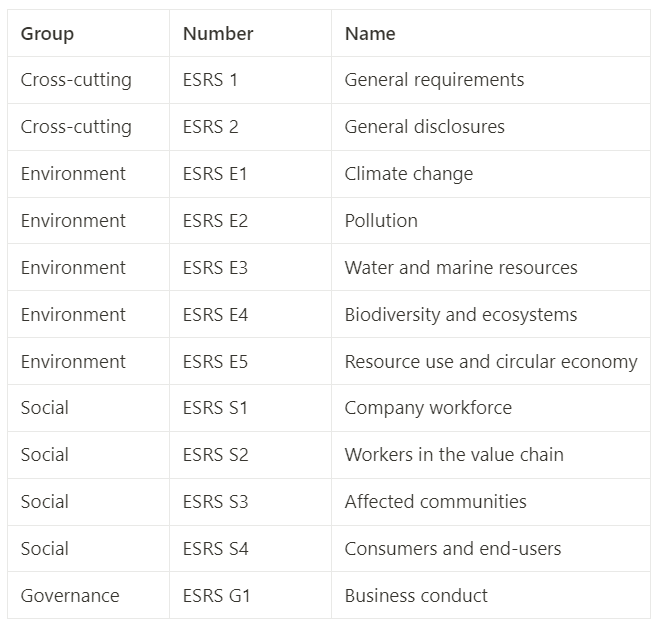
The ESRS standards have been designed as management tools for the company to facilitate its transition to a sustainable business model.
Each standard requires the publication of certain indicators, elements related to the company's strategy, risk management system, and impacts, as well as its objectives. Each standard is divided into sub-themes, each with several disclosure requirements, which themselves consist of several data points.
Let's take the example of the climate standard (ESRS E1). Companies covered by the CSRD must include (among other things) in their management report:
- their transition plan to mitigate climate change (with specific required objectives, for example, on reducing greenhouse gas emissions)
- an analysis of risks to their business related to climate change and the impact of their activities on climate change
- information on the resilience of their model to climate change
- their energy consumption and energy mix
- their scope 1, 2, and 3 greenhouse gas emissions
Find the ESRS standards, along with explanatory videos for each, on this page.
EFRAG has also published implementation support documents, including the Excel format list of data points required by each ESRS standard.
ESRS Standards to Report On
Only ESRS 1 and ESRS 2 standards are mandatory. For all others, the company is subject to reporting obligations only if the associated issue is deemed "material" following a double-materiality analysis (we explain this concept in the next paragraph).
However, if a company decides not to report on ESRS E1 (Climate), it must justify this decision by precisely presenting the analysis method that led to the conclusion that climate is not "material" to its business.
In practice, any activity impacting or impacted by climate change can be considered as requiring the inclusion of ESRS E1 in the management report.
Then, within each standard, it is up to the company to assess materiality for each sub-theme and indicator in relation to its business.
The Concept of Double-Materiality
The concept of double-materiality is crucial for the implementation of the CSRD by companies.
Double-materiality indicates a reciprocal interaction between a company's activity and society and the environment:
- the company's activity has an impact on society and the environment: this is referred to as impact materiality
- social, environmental, and governance issues can themselves have an impact (positive or negative) on the company's economic performance: this is referred to as financial materiality
The existence of financial materiality explains why the term "non-financial information" is no longer used to refer to ESG information, but rather "sustainability information." "Non-financial" is misleading as it suggests that ESG issues are not correlated with the economic performance of the company.
Companies subject to the CSRD must conduct a double-materiality analysis on each theme, sub-theme, indicator, and data point in the ESRS standards. This is how they determine the content to include in their sustainability report. This analysis must be done in collaboration with the company's stakeholders.
EFRAG has drafted a methodological guide to assist companies in conducting their double-materiality analysis.
How is CSRD Information Verified?
The sustainability report published by companies must be verified by an accredited independent third-party organization, which will conduct an audit of the information and assign it a level of assurance. The goal is to achieve a "moderate" level of assurance initially, progressing to a "reasonable" level from 2028.
How to Achieve Compliance with CSRD?
To comply with CSRD, a company must first conduct a double-materiality analysis to identify the sustainability information it needs to publish.
Next, it should perform a gap analysis to identify the information it already possesses and what is missing.
The company then gathers the missing information, incorporating it into the management report in the format required by the ESRS standards. The report must be available in XHTML electronic information format for submission to ESAP.
We emphasize the importance of promptly implementing processes for each of the steps described above and the opportunity to rely on guides published by EFRAG and ANC.
CSRD is complemented by other regulations that require supply chain data collection. To learn more, read our article about the European Textile Strategy.

Environmental Scoring: When Will Mandatory Deployment Hit Fashion Articles in France?
Definition of environmental labelling and eco-score
Before delving into the process of implementing environmental labelling and the associated methodology, it is important to understand what it entails.
Environmental labelling is a system that informs consumers about the environmental impacts of a product throughout its lifecycle.
It takes the form of a score (e.g., a scale from A to E or 1 to 100), which can be supplemented by sub-scores for specific impacts. The score is calculated using a transparent and established methodology based on life cycle assessments (LCAs). For more information, you can refer to our dedicated article on the methodology of environmental labelling.
It allows consumers to position a product on a quantified scale of environmental performance, compare it to other products within the same category, and make informed purchasing decisions.
It also serves as an effective communication tool for brands to highlight their eco-design efforts, as they can rely on the criteria during the product development phase.
It should not be confused with the mandatory product information sheet regarding environmental qualities and characteristics, as required by Article 13 of the AGEC law. This sheet presents certain qualitative characteristics of the product (e.g., country of manufacture, presence of hazardous substances), but not an environmental impact calculation.
Timeline of environmental labelling in France
With the AGEC and Climat et Résilience (Climate and Resilience) laws, environmental labelling is currently taking shape in France. However, this follows a long process that began with the Grenelle Environmental Roundtable in 2007. Let's review the key dates and milestones for this score, which have paved the way for its implementation on textile products, where it will soon be mandatory.
1. 2007-2013: The Grenelle Environmental Roundtable lays the foundations for environmental labelling.
The Grenelle 1 and Grenelle 2 laws of 2009 and 2010 were enacted to fulfill the commitments made during the Grenelle Environmental Roundtable in 2007. They introduced the principle of informing consumers about the environmental impacts of the products they consume, including greenhouse gas emissions.
This period marked the beginning of a consultation process led by AFNOR (French Standardization Association) and ADEME (Environment and Energy Management Agency) to determine sector-specific relevant indicators, best practices, and overarching impact assessment methodologies. In particular, the "GT5" working group was responsible for developing a technical framework for environmental labelling in the clothing sector.
An initial experimentation phase took place between 2011 and 2012, during which voluntary brands from various sectors tested environmental labelling with consumers. A report was subsequently submitted to Parliament.
The report confirmed the interest in environmental labelling based on life cycle assessments (LCAs) but highlighted methodological and technical difficulties, as well as potentially significant implementation costs. Common methodologies for each sector had to be developed, but in the meantime, work on product impact databases (such as ADEME's IMPACTS database, which was replaced by the Empreinte database) needed to continue.
This marked the beginning of a phase where the environmental labelling approach was guided by the recommendations of sector-specific working groups but remained flexible and voluntary.
2. 2015: The Energy Transition Law seeks to limit greenwashing.
As more companies began using environmental claims to characterize their products, measures to combat greenwashing were introduced in French law. Article 90 of the Loi de Transition Énergétique pour une Croissance Verte (LTECV, Energy Transition Law for Green Growth) requires producers and distributors to substantiate any environmental claims with relevant data on the overall environmental performance of the product.
The objective is to prevent brands from misleading consumers by making their products appear more environmentally friendly than they actually are, and to differentiate sincere eco-design efforts from false claims.
The LTECV provided a boost to the environmental labelling project as a useful tool for companies to ensure compliance. A well-constructed environmental score enables them to evaluate the environmental performance of their products based on a relevant methodology and communicate that performance reliably.
3. 2017-2020: Environmental labelling is pre-deployed in five pilot sectors.
In 2017, a new experimentation phase began to consolidate the technical framework developed by ADEME. Environmental scores were pre-deployed in five pilot sectors:
- Apparel
- Food
- Hospitality
- Furniture
- Electronics
The aim was to test impact calculation tools and reference frameworks, assess their usefulness in guiding eco-design efforts, and evaluate their effectiveness in communicating product performance to consumers.
In the fashion sector, companies like Decathlon and Okaïdi deployed environmental scores on their products and submitted reports to ADEME.
During this period, two additional texts further advanced environmental labelling in France:
- One of the 50 measures outlined in the Feuille de Route Économie Circulaire, (FREC, Circular Economy Roadmap) published in early 2018 focuses on the voluntary deployment of environmental labelling, initially in the five pilot sectors and subsequently in other sectors.
- The CESE (Economic, Social, and Environmental Council) published an opinion in March 2019, inviting the government to adopt a proactive policy on environmental labelling to follow up on the FREC (Circular Economy Roadmap). The opinion included 20 recommendations, notably suggesting legislation for a unified mandatory environmental labelling system that is clear and readable for consumers, with two levels (a single score and the possibility to access detailed information).
4. Since 2020: The AGEC and Climat et Résilience (Climate and Resilience) laws establish mandatory environmental scoring
With the aim of transforming all sectors of the French economy, the AGEC (Anti-gaspillage pour une Économie Circulaire, Anti-Waste for a Circular Economy) law was enacted in February 2020. One of its goals to reduce resource consumption and waste generation is to provide better consumer information.
Article 15 of the AGEC law introduces a voluntary framework for environmental labelling, which will subsequently become mandatory, with a priority focus on the fashion sector. The article stipulates an 18-month experimentation phase to evaluate different environmental labelling methodologies (calculation methodology and display modalities) in order to determine the system for each sector.
This article was later repealed with the publication of the Climate and Resilience law in August 2021. It was replaced by Article 2 of this law, which clarifies and strengthens the provisions for environmental labelling.
Here are the four key elements to remember from Article 2 of the Climate and Resilience law:
- Environmental labelling will be made mandatory through a decree that establishes the methodology and display requirements for each product category, following an experimentation phase. This will be prioritized for apparel articles.
- The labelling should be available to consumers at the time of purchase.
- It should provide clear and reliable information on the product's impact throughout its lifecycle, specifically addressing greenhouse gas emissions.
- Relevant indicators specific to each product category, including greenhouse gas emissions, biodiversity, and water and natural resource consumption, should be considered.
In line with the AGEC and Climate and Resilience laws, the ADEME has launched a new phase of experimentation for environmental labelling on clothing. The process involves three major steps:
- ADEME's call for projects known as "XTex" until November 2021, allowing various stakeholders to propose alternative methods to ADEME's technical framework.
- Experimentation with the selected methods from February to September 2022.
- Evaluation of the XTex experimentation results and submission of a report to Parliament in 2023.
Based on the findings of this report, a methodology will be developed. The goal was to validate a definitive version of environmental scoring for clothing by the end of 2023, accompanied by the publication of a decree specifying the mandatory display requirements.
It is worth noting that on the 18th of March 2023, the Secretary of State for Ecology, Bérangère Couillard, communicated the post-XTex experimentation work orientations.
During a meeting with textile companies, federations, NGOs, consumer associations, she identified eight impact criteria that are being further investigated to be considered in the environmental score calculation. Learn more in our article dedicated to the environmental scoring methodology.
The implementation timeline that has been then communicated is the following:
- 2024: voluntary display of the eco-score on fashion articles
- 2025: start of the mandatory display
As of December 2023, the implementation decree has not yet been published, and the timeline is likely to be postponed.
Toward European Environmental Labelling
With the Climate and Resilience law and the XTex experimentation, France is entering the final stretch of mandatory environmental labelling, which is expected to start in 2025 for fashion articles, after a voluntary phase in 2024.
Taking inspiration from the French approach, the European Commission has been working since 2013 to establish a common European methodology based on the Product Environmental Footprint (PEF) framework.
Thus, the communication modalities for environmental information are expected to be harmonized at the European level. We will provide an update on this harmonization in an upcoming article.

Mastering the European Union Strategy for Sustainable Textiles
Objectives and Timeline of the European Textile Strategy
The European Union's strategy for sustainable and circular textiles was adopted on March 30, 2022, by the European Commission in response to two major challenges:
- The expectations of European citizens regarding human rights, particularly after the awareness triggered by the Rana Plaza collapse.
- The urgency to establish rules to mitigate climate disruption, following the European Green Deal and the Circular Economy Action Plan.
Its objectives by 2030 include:
- Durable clothing over time, at affordable prices.
- Responsible and well-informed consumers.
- Extended producer responsibility throughout the entire value chain of their products (up to the end-of-life).
- Respect for social and environmental rights.
- Absence of hazardous substances.
- Recyclable materials and the use of recycled fibers in a closed-loop.
- Generalization of textile reuse and repair.
The approach is holistic, covering all aspects of the product and associated stakeholders: how clothes are designed, production conditions, consumer information, end-of-life, and shareholder information.
This strategy will have a significant impact on the textile sector in the coming years, with the implementation of 16 legislative texts. Here are the texts and measures related to the European textile strategy that you need to be aware of:
- CSRD Directive on non-financial reporting and the integration of the textile sector into the European taxonomy.
- CSDD Directive on due diligence.
- ESPR Regulation on eco-design and the digital product passport.
- Green Claims Directive on the regulation of environmental communication.
- Revisions to waste regulations: European textile EPR, European Waste Framework Directive, waste transfer regulation.
- Revision of responsible public procurement criteria (Green Public Procurement - GPP).
- Regulation against microplastics.
- Revision of the REACH Regulation on toxic substances and restrictions on allergenic substances, bisphenols, PFAS, PFHxA.
- Revision of the IED Directive on industrial emissions.
Among these proposed directives and regulations, only the CSRD has been enacted and will apply from the 2024 financial year. Next up on the list are the CSDD Directive and ESPR: agreements have been reach on final versions of both theses texts, and they are expected to be adopted by the end of march 2024. The others are still at the proposal stage, and we will keep you informed of any developments.
In the following paragraphs, we present the key European texts to understand how European regulations will transform the textile industry.
A text also crucial for the fashion and luxury sector, concerning leather and not associated with the European textile strategy, is the European anti-deforestation regulation. It will apply from 2024 to market operators of risk products (wood, leather, rubber, etc.). Please refer to our article on the subject for more information.
CSRD, European Taxonomy: ESG Reporting for Increased Transparency to Shareholders on Sustainability Issues
To promote ecological transition and enhance industry transparency, the European Commission aims to facilitate the development of sustainable finance and impose increasing reporting requirements on companies regarding social and environmental impact elements. This involves two mechanisms:
- European Taxonomy: The European Taxonomy aims to define economically sustainable activities towards which responsible investments should be directed. It came into effect in 2022 for sectors such as construction, energy, and transportation. As part of its textile strategy, the European Commission aims to integrate the textile industry into this taxonomy by specifying precise criteria for an actor to be considered circular and valued by investors.
- Corporate Sustainability Reporting Directive (CSRD): The Corporate Sustainability Reporting Directive replaces, within the framework of the European Green Deal, the Non-Financial Reporting Directive (NFRD) with more ambitious provisions. It will be gradually implemented from January 1, 2024. It applies to a broader range of companies, requiring more detailed disclosure of their environmental, social, and governance (ESG) risks, opportunities, and impacts according to harmonized European standards.
For fashion brands to meet the transparency regulatory requirements imposed by the CSRD, a prerequisite is a detailed understanding of their production chains up to the raw material origin. Traceability processes will be essential to collect all the required information for CSR assessments compliant with regulations.
To learn more about CSRD and sustainability reporting, read our article.
CSDD, Forced Labor Ban: Ensuring Ethical Clothing Production Conditions
Two European texts aim to establish a duty of vigilance for companies at the European level regarding the upstream of their production chain:
- Sustainable Corporate Due Diligence Directive (CSDD): The proposed directive seeks to establish minimum requirements for due diligence. Brands must understand the risks and impacts of their supply chains on human rights and the environment and take measures to prevent and mitigate them.
- Forced Labor Ban: This proposal aims to identify forced labor risks (geographical areas, industries) in cooperation with civil society to identify and block affected products at the Union's borders.
Similar regulations are already enforced in France and in Germany but these European laws will reinforce and extend their scope.
These measures particularly impact the textile industry, as it has complex and opaque production chains. They require fashion brands to trace their products to know all their indirect suppliers and thus identify and manage risks in their value chain.
Empowering Consumers, Green Claims: Informing Consumers and Shielding Them from Greenwashing
Similar to the French government (see dedicated article), the European Commission aims to provide consumers with better information about the environmental impacts of the products they consume.
This involves setting rules for clear and non-misleading information that highlights clothing with genuinely minimal impact on the environment and climate change. Two complementary texts address this:
- Empowering Consumers Directive: The March 2022 proposal aims to empower consumers to contribute to ecological transition. It encourages sustainable consumption by categorizing greenwashing practices (vague or misleading environmental claims) as unfair commercial practices. It also requires brands to communicate on the sustainability, repairability, and planned obsolescence of their products. It has been adopted by the European Parliament in january 2024, and member states will have 2 years to adopt the new law into their own legislations - meaning obligations will entry into force starting in 2026.
- Green Claims Directive: Published at the end of March 2023, this directive complements the first text.
Among the provisions established by the Green Claims Directive, we find:
- Defining common criteria whereby environmental claims are not considered greenwashing. These rules mandate that any environmental claim must be transparently justified, verified, and reflect a life cycle approach, under penalty of a fine of at least 4% of turnover.
- Restricting the proliferation of labels: New labels are prohibited unless developed at the European level for public labels, and they must be more demanding than existing labels for private labels.
- Stating that the Product Environmental Footprint (PEF) method is not comprehensive enough to account for the environmental impacts of textile products and cannot serve as the sole methodology for calculating environmental scores for clothing.
These measures also significantly impact fashion brands as they struggle to include scope 3 in their CSR and impact calculation strategies. To avoid being condemned for greenwashing, brands must collect robust evidence throughout the life cycle of their products to support their environmental communication.
ESPR: Making Eco-Designed Textile Products the Standard
The Eco-design for Sustainable Products Regulation, known as ESPR, aims to establish eco-design requirements for product families. It complements the 2009 eco-design directive, which only covered energy-related products.
Its goal is to define a precise framework for brands to bring only sustainable products to the market by 2030.
The proposed minimum sustainability requirements address various issues: physical durability, circularity, energy efficiency, resource consumption, carbon and environmental footprint, and consumer information, including a digital product passport.
The text also includes a ban on the destruction of unsold apparel and footwear products.
Revision of the Waste Framework Directive and Waste Shipment Regulation: Setting Conditions for a Circular Fashion Industry
The European Commission also plans texts regarding product end-of-life to promote a circular economy at the European level.
The European Commission has thereby made a proposal to revise the European Waste Framework Directive, published on July 5, 2023. This involves:
- Applying the Extended Producer Responsibility principle to textile products, as is currently the case in France.
- Prioritizing waste treatment methods: prioritizing prevention, then reuse, recycling, other types of valorization, before disposal.
- Defining "end-of-waste criteria," meaning criteria by which an article or substance is no longer considered waste but as a product or raw material that can be legally sold and used.
There is also a project to revise the Waste Shipment Regulation: While waste transit between countries is currently highly limited, the European Union plans to relax rules to promote circular economy in the European single market.

Navigating CSR Compliance: Essential Regulations for Fashion Brands in France and Worldwide
CSR regulations in the textile and apparel sector in France
France is a pioneer in CSR legislation, and as we will see, several of its laws will soon be adopted at the European level.
It has notably legislated on producer responsibility in product end-of-life, due diligence for brands, and consumer information on environmental issues related to products.
French Textile Extended Producer Responsibility (REP)
In France, based on the polluter-pays principle, any actor placing a product on the market must finance its end-of-life management (collection, sorting, and valorization). This is known as **Extended Producer Responsibility (**Responsabilité Élargie du Producteur, REP).
To organize this, REP schemes have been created for different product categories, including the apparel, household linen, and footwear (Textile, Linges de maison et Chaussures, TLC) sector, established in 2009.
Companies that are part of a REP scheme collectively finance an approved eco-organization through an eco-contribution. This organization takes care of their obligations related to the end-of-life of their products. For the textile sector, Refashion (formerly known as Eco-TLC) fulfills this role.
Recently, the AGEC law (Anti-Gaspillage pour une Économie Circulaire, Anti-Waste for a Circular Economy) has introduced new provisions related to REP, such as a unique logo to guide consumers in waste sorting, a bonus-malus system for eco-contributions by companies, and the creation of new REP schemes to include more products in the framework.
To learn more about the latest regulations related to REP for textiles, we invite you to consult our articles on the new waste sorting information labels, the eco-modulations in the textile sector or the prevention and eco-design compulsory plan.
Corporate Due diligence in France
On the 24th of April 2013, the Rana Plaza, a building housing clothing manufacturing workshops, collapsed, resulting in over 1,130 deaths. In response to this catastrophe, the French due diligence law was enacted on the 27th of March 2017.
All companies with over 5,000 employees if their headquarters are in France, or over 10,000 employees if their headquarters are abroad, must have a publicly available vigilance plan.
This vigilance plan should enable them to identify risks in their supply chains and prevent serious harm to people or the environment that could result from their activities, including through their subsidiaries, suppliers, or subcontractors.
Environmental Communication Regulation in France: AGEC and Climate and Resilience laws
To accelerate the ecological transition, the French authorities aim to promote sustainable consumption.
The AGEC and Climat et Résilience (Climate and Resilience) laws, enacted in 2020 and 2021, include several measures to better inform consumers about the environmental impacts of products.
For fashion brands, there are four key measures to note regarding consumer information:
- Display of environmental qualities and characteristics (qualités et caractéristiques environnementales, QCE) of products (Article 13 of the AGEC law)
- Environmental score for textile products (Article 2 of the Climate and Resilience law)
- Regulation of environmental claims (Article 13 of the AGEC law and Article 12 of the Climate and Resilience law)
- Waste sorting information labels (Article 17 of the AGEC law)
To learn more about these measures, please refer to our dedicated article.
Moreover, the Climate and Resilience Law has officially categorized greenwashing as a deceptive commercial practice punishable by law. To learn more, we invite you to read our dedicated article on the regulations governing greenwashing.
International CSR regulations in the fashion industry
While France is often cited as an example for its incentive laws promoting an ecological and social transition in the fashion industry, regulations are also emerging in other countries.
Textile CSR laws in the United States
The Uyghur Forced Labor Prevention Act (UFLPA) came into effect in June 2022 to ban products made through forced labor of Uyghurs in the Xinjiang region from the US market. Several products, including cotton-based textiles, are affected.
The UFLPA stipulates that companies importing into the United States must be able to prove
- either that their products do not come from the Xinjiang region
- or, if they do, that they are not produced through forced labor.
This requires the implementation of robust traceability processes that allow brands to map all actors in their supply chains and collect the necessary evidence for import authorization of their products.
Other laws signal a regulatory shift towards the duty of vigilance for fashion brands:
- The California's Garment Worker Protection Act, that prohibits California garment manufacturers from paying employees less than the minimum wage and holds ordering brands accountable.
- The proposed New York's Fashion Sustainability and Social Accountability Act (on the 2024 legislative agenda) and the federal FABRIC Act, inspired by the California law.
The State of California has also adopted a bill that will require companies with over 1 billion dollars in revenue operating in the Californian market to annually disclose their greenhouse gas emissions report (scopes 1 and 2 starting from 2026, scope 3 from 2027). This law is named the Climate Corporate Data Accountability Act.
The use of hazardous substance is also regulated by the TSCA (Toxic Substances Control Act) of 1976: the EPA (Environmental Protection Agency) has the ability to restrict the use of specific substances in the manufacturing process of finished goods or product parts. Penalties for non-compliance arise to $50,000 USD per day and per violation.
Textile CSR laws in Germany
In Germany, the duty of vigilance is also mandatory under the LkSG (Supply Chain Due Diligence Act). It came into effect on the 1st of January 2023, for companies with over 3,000 employees and will also apply to companies with over 1,000 employees from the 1st of January 2024.
Among the obligations it imposes are appointing a accountable person, conducting a risk analysis, publishing a risk management, prevention, and reduction strategy, establishing a complaint procedure within the supply chain, and reporting.
Textile CSR laws in the United Kingdom
In the United Kingdom, the Modern Slavery Act was enacted in 2015. It requires brands with a turnover of over £36 million to publish a modern slavery statement and imposes a due diligence mechanism.
Environmental reporting has also been made mandatory through two amendments regarding non-financial reporting by companies (The Companies (Strategic Report) (Climate-related Financial Disclosure) Regulations 2022 and The Limited Liability Partnerships (Climate-related Financial Disclosure) Regulations 2022). For more information, you can refer to the FAQs published by the UK government.
Regulating the fashion industry at the EU level: the European textile strategy
On March 30, 2022, the European Commission adopted the European Union strategy for sustainable and circular textiles to meet the expectations of European citizens regarding human rights, which have grown significantly since the Rana Plaza disaster, and to address the urgency of establishing rules to mitigate climate disruption.
In line with this strategy, as well as with the European Green Deal and the European Circular Economy Action Plan, the European Union has set ambitious goals for CSR regulations in the textile sector, aiming to transform it through a comprehensive approach.
The objective is to make the fashion industry sustainable, responsible, circular, environmentally friendly, and respectful of human rights by 2030.
For more details on the European Textile Strategy and its components, we invite you to consult our dedicated article.
Here is, however, the list of texts and projects to be aware of to understand how European regulations will impact the textile industry:
- The regulation on ecodesign for sustainable products (ESPR): minimum sustainability requirements for textile products.
- The directive on sustainable corporate due diligence (CSDD).
- The proposal to ban products made through forced labor (Forced Labour Ban).
- The Empowering Consumers and Green Claims directives that regulate environmental claims and labels to combat greenwashing and demand greater transparency from brands regarding product sustainability.
- The project to revise the Waste Framework Directive and the Waste Shipment Regulation to promote circularity in the textile sector.
- The project to integrate the textile industry into the European taxonomy to define criteria for sustainable textile actors according to investor standards.
- The directive on corporate sustainability reporting (CSRD), that has replaced the non-financial reporting directive from 2024, with increased requirements.
Another European law, this time addressing leather goods or furniture brands, demands complete traceability across the entire production chain: the European Regulation on Deforestation-free Supply Chains. Enacted in June 2023, it will come into effect in 2024. To grasp the obligations stemming from this new legislation, please refer to our article.
Table summary of all the regulations to know
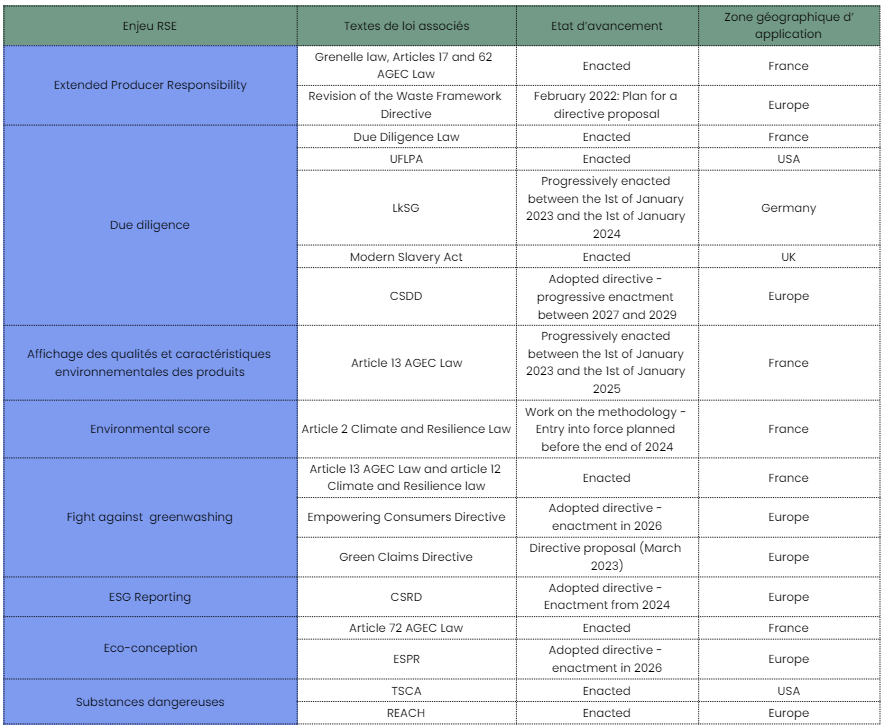
Conclusion
As the European Union and national governments gradually regulate the fashion industry to make it sustainable, it becomes urgent and strategic for brands to map their supply chain, including their tier 2 and higher-tier suppliers.
Indeed, traceability is essential to:
- Identify social and environmental risks as required by due diligence
- Collect the necessary data for mandatory ESG reporting and impact measurement.
- Meet regulatory transparency requirements.
- Verify the accuracy of claims regarding the environmental and social performance of products.
- Demonstrate compliance with increasingly stringent environmental and social laws.

AGEC, ESPR: the new ecodesign regulation in France and Europe
Ecodesign in France: Article 72 of the AGEC law and its prevention and ecodesign plan
France was among the first countries to propose eco-design principles for all products through the AGEC Law (Anti-Waste for a Circular Economy), enacted in February 2020. Article 72, especially Art. L. 541-10-12, thus requires producers to implement an ecodesign plan with three objectives:
- Reduce the use of non-renewable resources.
- Increase the use of recycled materials.
- Enhance the recyclability of products.
A "producer" is defined by the law as "any natural or legal person who designs, manufactures, handles, processes, sells, or imports products that generate waste or elements and materials entering their production."
The prevention and ecodesign plan imposed by the AGEC law must be developed for five-year periods, including reviews and lessons from previous plans. It can be individual, common, or developed by eco-organizations for their sector. In all cases, eco-organizations receive all sector plans and create a public synthesis.
Regarding the TLC sector (apparel, household linens, footwear), producers had until July 31, 2023, to submit their prevention and eco-design plan to Refashion. The eco-organization planned to publish a synthesis in late 2023. Templates for prevention plans and a writing guide are available on the Refashion website.
Players in the textile, fashion, and luxury sectors in France are also required to comply with other obligations related to the AGEC law: find on our blog explanations of Article 13 of the AGEC law and its QCE sheet, or the presentation of the new Triman labeling for the apparel and footwear sector.
In addition, brands will soon be subject to the European ESPR regulation on eco-design for sustainable products.
Objectives and enactment schedule of the European Ecodesign for Sustainable Product Regulation (ESPR)
At the European level, eco-design principles were first introduced for energy-related products in 2009 within the directive establishing a framework for the setting of ecodesign requirements for energy-related products.
The ESPR regulation aims to replace this directive and extend its measures by defining a general framework for promoting ecodesign. It applies to all products in the European market, except for food, medicines, plants, animals, and human products.
The ESPR regulation defines areas of action and basic principles, then delegates power and responsibility to the European Commission to adopt delegated acts to specify these topics in practice. Certain sectors identified as priorities by the Commission due to their particularly significant environmental impact, such as apparel or furniture, will be the subject of the first texts.
Note that industries stakeholders have the option to submit "self-regulation measures" validated by companies representing at least 80% of the market share before the publication of a delegated act, meeting the goals outlined in the regulation. These measures would then replace the delegated act.
The operational realization of this regulation will only be known upon the adoption of delegated acts by the European Commission or the submission of self-regulation measures.
After the publication of each delegated act, industries will have 18 months to adapt to the new eco-design requirements. However, the starting date of the ban on destruction of unsold fashion products is already set: it will be 2 years after the ESPR enactment.
The Regulation was adopted in May 2024. The Commission now has to publish delegated acts in the next 6 years. These will come into effect if the European Parliament or the European Council does not express objections within 3 months after being notified.
The ESPR regulation is part of a wave of CSR regulations underway in the European Union. To learn more about other relevant texts, please refer to this article.
The 3 key measures of the European proposal for the Ecodesign for Sustainable Product Regulation (ESPR)
The ESPR regulation proposes three main areas of action:
- The definition of a general framework for promoting ecodesign
- Consumer information, especially through the creation of a mandatory digital product passport
- A ban on destruction of unsold textiles and footwear products
The general framework for promoting ecodesign defined by the ESPR regulation
The first objective of the regulation is to define a framework for the implementation of concrete ecodesign measures by the European Commission.
Ecodesign is defined here as "the integration of considerations related to environmental sustainability into the characteristics of a product and the processes implemented throughout the product's value chain."
The regulation proposes a list of 14 action areas for the ecodesign of products:
- Sustainability
- Reliability
- Reusability
- Improvability
- Repairability
- Maintenance opportunities
- Presence of concerning substances
- Energy consumption
- Efficient use of resources
- Presence of recycled content
- Remanufacturability
- Opportunities for material valorization
- Environmental impacts
- Planned waste production
By defining the concept of ecodesign, these criteria are at the heart of the ESPR regulation: their improvement and information about them should be the ultimate goal of all measures to be taken by the Commission.
The regulation also specifies that measures aimed at improving these criteria should not, in return, disproportionately affect the competitiveness of economic actors, the cost of products, or their functionalities. SMEs can receive special assistance to implement these measures.
Consumer Information: ESPR and the Digital Product Passport
The second area of action proposed by the European ESPR regulation is the sharing of information with consumers regarding ecodesign criteria, notably by developing a mandatory digital product passport.
The product passport is defined here as a 'set of data specific to a product [...] accessible electronically [...] and includes the information [provided by delegated acts adopted under the ESPR regulation].'
The ESPR regulation invites the Commission to adopt delegated acts to define, according to sectors and products, the display obligations for eco-design information to consumers. For example, in some sectors, the following must be published:
- General product information: reference number, composition, weight, traceability of all manufacturing stages.
- Information on product use, maintenance, and repair to reduce the product's impact on the environment and enhance performance according to the criteria mentioned above.
- End-of-life treatment information.
- Information related to hazardous and polluting substances (according to a list established by the Commission), including the name of substances, their location, their concentration, and instructions for safe use.
- All other information related to the environmental performance of the product: carbon footprint, eco-score, and more.
Furthermore, delegated acts must specify display modalities by imposing readability criteria or mandatory mentions. They must ensure that this information is accessible directly on the product (mandatory for information related to hazardous substances) or, as appropriate, on its packaging, labels, user manual, website, or the product passport.
The goal of this initiative is to facilitate product traceability because the product passport will identify each product and each actor in the value chain by a unique identifier. The European Commission will keep a register of these identifiers to facilitate checks.
The modalities for sharing this information, especially which actors must integrate information into the product passport, who can access it, or the period of availability of information, must be specified by delegated acts. These acts will also specify whether product passports will identify products on a model, lot, or item scale.
The ESPR regulation ban on destruction of unsold textile and footwear products
The third area of action proposed by the European regulation on eco-design for sustainable products (ESPR) is the regulation of the treatment of unsold goods, particularly the fight against product destruction.
The final version of the law introduces a ban on destruction of unsold fashion goods that will start in 2026, 2 year after the ESPR enactment. There will be a derogation for small companies and a 6-year transition period for medium companies.
The regulation proposes the adoption of delegated acts requiring producers to publish the number of discarded products, the reason, and the chosen treatment method – from reuse to destruction. These same acts will prohibit the destruction of products in other sectors than fashion when the environmental impact is deemed too high.
Responsibilities, Controls, and Sanctions in Case of Non-compliance with ESPR Regulations
While leaving it to the Commission and the member states to define the applicable sanctions in case of non-compliance with ecodesign principles, the ESPR regulation proposal outlines the responsibility relationships among economic actors and control procedures.
Every manufacturer will have to issue a compliance declaration indicating adherence to the ecodesign requirements of the ESPR regulation, enabling the mandatory CE marking on products. This marking must be visible, legible, and indelible.
Importers and distributors are considered manufacturers when marketing products under their brand name or when significantly modifying the products.
Furthermore, throughout the value chain, importers and distributors will be responsible for verifying product compliance.
The final marketeer will additionally bear the responsibility of providing the product passport and labels visibly. These obligations also apply online.
Finally, delegated acts will specify the control modalities for compliance with ESPR directive obligations (e.g., minimum number of checks per sector).
Each state will designate a "notifying authority" (e.g., customs authorities) empowered to request accredited evaluation bodies to inspect products.
In case of non-compliance with the controlled products, authorities can impose corrective measures and prohibit their sale.

CSDD and French Law: A Comprehensive Guide to Due Diligence
Due diligence regulation in France: vigilance plan, scope, and sanctions
France was among the first countries to legislate on due diligence. It drew inspiration from the OECD's definition of "due diligence": "a process that companies should implement to identify, prevent, and mitigate the actual and potential negative impacts of their activities, supply chains, and business relationships, and also be accountable for how these impacts are addressed."
Law No. 2017-399 "on the duty of vigilance of parent companies and ordering companies", published in 2017, thus imposes on companies the establishment of a vigilance plan for serious violations of human rights and fundamental freedom, health and safety, and the environment.
This plan, which must be made public, includes five measures:
- Identification and prioritization of risks,
- Regular assessment of subsidiaries, subcontractors, and suppliers of the company,
- Actions to mitigate risks or prevent serious violations,
- A mechanism for alerting and reporting risks,
- Ongoing monitoring of measures and an assessment of their effectiveness.
One of the major developments resulting from this law is that the scope of due diligence must not only include the companies and their subsidiaries but also to their suppliers and subcontractors with whom they have an "established relationship."
The report from the General Council of the Economy on the evaluation of the implementation of the due diligence law explicitly states that indirect relationships with subcontractors must be considered across the entire usual supply chain.
The law applies to companies and groups:
- With at least 5,000 employees if the headquarters are in France,
- With at least 10,000 employees if the headquarters are abroad.
However, the scope of these measures will soon be significantly expanded through their inclusion in the European directive on the corporate sustainability due diligence.
If a company has not published a compliant vigilance plan, any member of civil society (trade union, employee, NGO, etc.) can issue a formal notice to compel compliance within 3 months.
If, after being served notice, the company still does not comply with the law within 3 months, legal action can be taken, and the company may be ordered to pay a sum of money for each day of delay.
European Directive on Corporate Sustainability Due Diligence (CSDD)
The Corporate Sustainability Due Diligence Directive is heavily inspired by the due diligence integrated into French law in 2017, providing further clarification.
This directive was proposed by the European Commission in February 2022, then amended and adopted by the European Parliament on June 1, 2023.
After 'trilogue' negotiations between the European Parliament, Commission, and Council, a deal was reached on the 14th of December. The text was ready to be adopted, but the European Council ended up adopting a watered-down version of the bill that the Parliament confirmed in May 2024.
What does the European CSDD Directive entail?
The European Directive on Corporate Sustainability Due Diligence defines the concept of negative impacts on human rights and the environment, requiring companies to integrate a due diligence policy into their strategy.
This due diligence policy comprises four components:
- Identify, assess, and prioritize potential or actual negative impacts arising from the company's activities, its subsidiaries, or entities in its value chain with which it has a business relationship. This is a key dimension of the directive, similar to the French due diligence law: companies must extend their due diligence to their business partners and support them in implementing vigilance measures.
- Prevent potential negative impacts by developing action plans, monitoring indicators, contractual guarantees with direct partners, or product traceability processes.
- Eliminate actual negative impacts by addressing damages, compensating affected communities, obtaining new contractual guarantees, or terminating the relevant business relationship.
- Establish complaint and alert procedures to report negative impacts.
These measures must undergo consultations with affected communities, continuous reassessment, and public disclosure. It is also emphasized that companies must pay special attention to situations of armed conflict.
To assist companies in their due diligence, the EU will publish thematic fact sheets by country and sector, especially for sectors at risk of negative impacts on the environment and human rights, such as fashion. A support desk will also be set up in each member country.
Finally, an additional noteworthy measure is the obligation for large companies to develop and put into effect a transition plan for climate change mitigation.
Who does the European CSDD Directive apply to?
The directive distinguishes between companies established within the European Union and those outside. The CSDDD applies to the European companies with over 1000 employees and a net worldwide turnover over €450 millions.
Companies established outside the EU are subject to the directive when their turnover in the EU exceeds 450 million euros.
How will the enforcement of the European CSDD Directive be monitored, and what sanctions are envisaged?
Each EU member state will designate an independent control authority competent on its national territory, collaborating with control authorities in other European countries.
Sanctions for non-compliance will also be determined individually by the states:
- Financial sanctions must have a maximum cap of at least 5% of the company's annual worldwide turnover.
- States may provide for the exclusion of non-European infringing companies from European public procurement markets.
In case of negative impacts on human rights or the environment, companies will be judged based on the proportionality of preventive, mitigating, or reparative measures taken in relation to the circumstances (company size, sector, length of the value chain, available resources, etc.).
Timeline for the application of the European CSDD Directive
📅 February 23, 2022
- Proposal for the directive by the European Commission
📅 May 25, 2024
- Adoption of the CSDDD final version
📅 1 to 3 years after the adoption of the final version (2025-2027)
- Member States adopt the provisions of the directive into their domestic law
📅 3 to 5 years after the adoption of the final version (2027-2029)
- Entry into force of the due diligence obligations
.png)
The keys to successful traceability with Jonak
🎥 Watch our webinar replay on supplier Engagement, Consumer Communication, and Onboarding Data: Discover the Keys to Successful Traceability through a Practical Case Study - Jonak.
Speakers: Lisa Nakam, CEO of Jonak and Juliette Rose, Quality & CSR Manager at Jonak
Language: French

Mastering Textile Certificate Management: A Comprehensive Guide
How to ensure that the certificate is valid?
GLOBAL ORGANIC TEXTILE STANDARD - GOTS
1. Carefully read the certificate and pay particular attention to four key pieces of information:
- The validity date
- Supplier data: the name, address, and license number - that you can use to verify the supplier through the freely accessible GOTS database (for reference only: remember to check the consistency of the available data).
- The name of the certification body, which should correspond to one of the approved entities by the label. The list is available here. This allows you to access the guidelines from each certifying body to authenticate the certificates they have issued.
- The list of products or "product categories" covered by the certification.
2. If you have any doubts or find incorrect information or an expired validity date, contact your supplier and specify your request. It is most probably just a mistake. For your information, GOTS, OEKO-TEX, or Textile Exchange certificates need to be renewed each year, and suppliers can often struggle to manage all their certifications and clients' requests!
3. If your supplier is uncooperative or fails to provide the correct certificates, contact the certification body directly, as mentioned on the certificate (the list of contacts is available here), and provide them with the supplier's name and license number.
TEXTILE EXCHANGE STANDARD : OCS, GRS, RWS, RCS, RDS, RMS, RAS, CCS
The verification process described above for GOTS certificates can be replicated for Textile Exchange certificates as well:
1. Carefully read the certificate and verify its validity using the list of certified companies or the list of certification bodies. If the document is a transaction certificate, you can authenticate it by conducting a search in the dedicated database. However, please note that Textile Exchange is still refining this database, and some valid certificates might be missing. If you can't find a transaction certificate there, refer to the verification instructions provided by the certifying body that issued the certificate.
2. If in doubt or if there is any inconsistency, contact your supplier and specify your request.
3. Contact the certification body directly. Depending on the certification body, you can find here the details of the procedure to follow.
OEKO-TEX
1. Just like with GOTS and Textile Exchange, carefully read the certificate (validity date, supplier information, list of relevant products). To verify its authenticity, you have several options:
- Scan the QR Code on the certificate, which redirects to Oeko-Tex's certificate verification page.
- Enter the certificate number on the Oeko-Tex's certificate verification page.
- Conduct an advanced search.
2. If you have any doubts, consult the list of certificates that have been revoked by Oeko-Tex, or contact your supplier and specify your request.
3. Contact the certification body directly. The list of bodies by country with associated contacts is accessible through this link.
What is the difference between a supplier certificate and a product certificate?
GLOBAL ORGANIC TEXTILE STANDARD - GOTS
The certification body issues two types of GOTS certificates:
1. The scope certificate attests that the supplier is capable of conducting its activities according to GOTS standards for the products listed in the certificate's appendix(Template Scope certificate GOTS)The supplier is then considered a "GOTS certified supplier" and is listed in the database of GOTS certified suppliers. The facilities and subcontractors inspected and evaluated for the certification of that supplier are listed in the scope certificate's appendix (Facility Appendix of the Scope Certificate) but are not mentioned in the database of certified suppliers.
2. The transaction certificate attests that the product meets GOTS criteria. A product is labeled GOTS when all stakeholders in the production chain have undergone an on-site inspection(Template Transaction certificate GOTS).
Good to know: Many brands only request the supplier certificate (scope certificate), which is easier for the supplier to share as it is the same for all clients. However, the product certificate (transaction certificate) is the one that matters for the final product.
Find here all details about different types of GOTS certificates.
TEXTILE EXCHANGE STANDARD : OCS, GRS, RWS, RCS, RDS, RMS, RAS, CCS
The Textile Exchange standards' certificates have aligned with GOTS certificates. You can refer to the explanations above to distinguish between the scope certificate and the transaction certificate.
You can also refer to the resources available on the Textile Exchange website: the database of certified suppliers or the explanations with diagrams about the various types of Textile Exchange certificates.
OEKO-TEX
Oeko-Tex has developed several standards, and different types of certificates are issued depending on the standards:
- STANDARD 100 by OEKO-TEX® and LEATHER STANDARD by OEKO-TEX® issue product certificates. These certifications subject the product to a series of tests and focus on chemicals directly associated with it.
- STeP by OEKO-TEX® and DETOX TO ZERO analysis by OEKO-TEX® issue supplier certificates. They focus on implementing industrial processes that aim to improve their social and environmental practices.
- MADE IN GREEN by OEKO-TEX® issues both product and supplier certificates. This standard is equivalent to combining STANDARD 100 by OEKO-TEX® or LEATHER STANDARD by OEKO-TEX® with STeP by OEKO-TEX® . It identifies textiles that have been tested for harmful substances and are manufactured under sustainable working conditions.
For more information on the product and supplier certificates of different Oeko-Tex labels, please refer to their official resources here.
Under which circumstances are you allowed to communicate about these labels?
GLOBAL ORGANIC TEXTILE STANDARD - GOTS
Be cautious about communicating the label to your customers. GOTS specifies on its website that it will take action against brands or retailers that misuse the label on their e-commerce sites, which could result in a fine.
To associate the label with your garment and communicate about it, you must have three documents:
- The scope certificate
- The transaction certificate
- The certifier release (the QR code that validates the GOTS labeling for the product)
These are three documents that your supplier should be able to provide you with!
TEXTILE EXCHANGE STANDARD : OCS, GRS, RWS, RCS, RDS, RMS, RAS, CCS
Textile Exchange allows two types of communications:
- General communication at brand level regarding your Textile Exchange commitments ("general marketing claims"). For example, you can mention the standards in the "commitments" section of your website, in your annual reports, advertisements, or social media.
- Communication at product level ("product-related claims") is allowed under certain conditions for the final product:
- Every actor in the value chain - up to the brand - must be certified.
- The last actor in the certified value chain must possess a valid scope certificate mentioning the product in question and a valid transaction certificate for all claimed materials and products purchased.
- The product must contain the minimum required amount of certified materials.
- Any claim related to the product and the graphics of the label/banner associated with it must be approved by the certification body.
- Only certified companies are allowed to attach a printed claim (e.g., hangtags, sewn-in labels) to the certified products. Brands and retailers that do not require certification must, therefore, ask their directly certified supplier to attach the hangtags.
Find all the details on marketing claims and product labelling here.
OEKO-TEX
To be able to associate the STANDARD 100 by OEKO-TEX® and LEATHER STANDARD by OEKO-TEX® labels, all components of the garment must be tested and certified (meaning, every thread, button, or accessory!).
Also, be very cautious about label usage; OEKO-TEX scrutinizes mentions of the label on e-commerce sites and takes action against both small and large brands that do not comply with the conditions.
Checklist to remember
Three best practices to implement in managing your certifications:
✓ Verify the validity of your documents (by accessing the label database - for reference - or by contacting the certification body).
✓ Collect and centralize your product and supplier certifications (note that certifications need to be renewed annually).
✓ Implement a validation process for label communication (once you are sure you meet all the conditions).

Green Claims Directive, Climate and Resilience Law: Everything You Need to Know About Laws Against Greenwashing
Climate and Resilience Law: Overview of the Regulation of Environmental Communication by French Law
New deceptive commercial practices related to greenwashing in France
The Climate and Resilience Law, enacted on August 24, 2021, is the result of the work of the Citizen's Convention for Climate and aims to accelerate ecological transition in all aspects of French life.
To transform our consumption patterns, it includes several measures on consumer information by brands, which you can find summarized in our dedicated article.
These measures not only aim to provide more information to consumers but also to prohibit providing information that may mislead them about the environmental performance of products.
Hence, Article 10 of the Climate and Resilience Law explicitly includes greenwashing among deceptive commercial practices in the consumer code.
In Article L121-2 of the consumer code, which defines deceptive commercial practices, false or misleading claims are now included concerning:
- The properties of a product or service, "especially its environmental impact."
- The scope of a brand's commitments, "especially in environmental matters."
Note that certain terms, such as "environmentally friendly" or "carbon-neutral," considered particularly vague or misleading, are prohibited by the AGEC law and the Climate and Resilience Law; you can find them in this article.
Greenwashing: What Sanctions are Provided by French Law?
In France, penalties for deceptive environmental claims include imprisonment for 2 years and a fine ranging, depending on the profits, from €300,000 to 10% of the average annual turnover or 80% of the expenses incurred for advertising or practices constituting this offense.
Official Guidelines to Avoid Greenwashing: CNC's Environmental Claims Guide
In late May 2023, the French Ministry of the Economy published a practical guide to environmental claims, drafted by a working group of the National Consumer Council (CNC).
This guide is intended for both consumers, to help them better understand brand environmental communication, and professionals, as a reference tool.
It contains non-binding but authoritative recommendations, designated as a reference document for the DGCCRF in its mission to sanction deceptive commercial practices.
The document has two parts:
- A reminder of the legal framework for environmental claims.
- Specific recommendations for the use of certain environmental claims (e.g., eco-designed, natural, upcycled).
In the annex, there is a practical sheet for brands to ensure that an environmental claim is fair. We summarize its content here for you.
To communicate the environmental characteristics of a product without engaging in greenwashing, there are three steps to follow, each accompanied by key questions:
Step 1: Relevant content that provides a real advantage considering the significant impacts of the product throughout its life cycle and supply chain. This involves the principle of "proportionality of the claim" compared to the total impacts of the product.
→ Do I know the main environmental impacts of the product? Is the claim relevant to these impacts? Does the claimed advantage not lead to a transfer of pollution to another stage in the life cycle?
Step 2: A clear, precise, and understandable presentation of the claim that leaves no room for ambiguity about its scope and limitations.
→ Does the claim describe the environmental advantage associated clearly and precisely? Are graphical representations (including symbols, images, or labels) relevant to the claim used?
Step 3: The existence and availability of justifications that prove the claim (origin of results, details of the methodology used, evidence).
→ Have the results been obtained by appropriate and recognized standard methods? Are the supporting information for a claim accessible to the public or readily available upon request?
Empowering Consumers for the Green Transition Directive: Greenwashing Integrated into EU Unfair Commercial Practices
As part of a series of measures to make the single market more sustainable, the European Union is also addressing greenwashing. This takes the form of two directive proposals:
- Empowering Consumers for the Green Transition
- Green Claims
The empowering consumers for the green transition directive was published in March 2024 in the Official Journal. It aims, among other things, to include greenwashing in the register of EU unfair commercial practices.
Here is the list of practices that the text proposes to add to the list of unfair practices:
- An allegation about future environmental performance not accompanied by clear and verifiable commitments through independent control.
- An allegation presented to the consumer as an advantage or distinctive feature when it is actually a common practice or a legal requirement.
- In a service that compares products, especially in terms of sustainability, the omission of the comparison method used and measures taken to keep the information up-to-date.
- An environmental label not based on a certification system or established by public authorities.
- A generic environmental claim without evidence.
- An environmental claim that covers the entire product, whereas the advantage only applies to one of the product's features.
- Lack of information on planned obsolescence features.
- False claims of temporal or physical sustainability or repairability.
- Encouraging the replacement of components without technical necessity.
- Lack of information on the limitation of a product's performance when the consumer uses spare parts or accessories not provided by the original producer.
In practice, generic claims such as "environmentally friendly", "natural", "biodegradable", "eco" or “climate neutral”, and claims based on carbon offsetting schemes will be banned unless they are provided along with substantive evidence on a lifecycle perspective.
The adoption of the bill in March 2024 has opened a 2-year time period for member states to adopt the new law into their national legislation. The new obligations will consequently entry into force by 2026.
How will companies practicing greenwashing be sanctioned?
Similar to other unfair commercial practices, greenwashing will be subject to a fine of at least 4% of the turnover of the concerned company or 2 million euros in certain cases of major cross-border offenses.
Green Claims Directive Proposal: Specifications for Environmental Communication
Overview of the Green Claims Directive
The proposal for the Green Claims directive was published by the European Commission in March 2023, complementing the "Empowering Consumers" text. Its aim is to clarify the principles of environmental communication and put an end to the proliferation of environmental labels.
The objective is to highlight genuine efforts by businesses and provide consumers with reliable, comparable, and verifiable information to make informed consumption choices.
The key provisions of the Green Claims directive include:
- Prohibition of environmental claims that do not meet a minimum set of criteria.
- Prohibition of labels that do not meet minimum requirements for transparency and credibility.
Similar to the Empowering Consumers directive, the European Commission emphasizes that non-compliant claims could lead to fines of at least 4% of the company's turnover in the concerned Member States.
The Green Claims directive is not expected to be adopted before mid-2024 or even 2025. It requires however significant proactive anticipation efforts from brands.
Minimum Criteria for Environmental Claims
Article 3 of the Green Claims directive proposal establishes a multi-criteria approach for environmental claims, based on the entire life cycle, to prevent greenwashing. To justify an environmental claim, brands must apply these eight rules:
- Specify if the claim pertains to the entire product or only a part or certain aspects.
- Rely on recognized scientific evidence, consider relevant international standards, and use accurate information.
- Demonstrate that the claim involves a significant benefit concerning all product impacts and the entire life cycle.
- Ensure the claim does not correspond to a legal requirement and prove that it genuinely provides a significant advantage compared to common compliance practices.
- Identify potential impact transfers related to the highlighted advantage (e.g., improving the carbon footprint at the expense of pollution or biodiversity).
- Do not include greenhouse gas emission offsets in the claim but provide this information separately, specifying the nature of these offsets.
- Make primary data (actual company data) supporting the claim accessible.
- Include relevant secondary data (representative data of the product or company's value chain).
Article 4 of the proposal includes additional provisions for comparative claims on a product versus other products, ensuring meaningful comparisons (e.g., considering the same life cycle stages, using similar methodologies, and equivalent data).
How to Ensure Green Claims Compliance in Environmental Communication
Article 5 of the Green Claims directive defines a list of requirements concerning environmental claims. In addition to using only justified environmental claims based on the criteria listed in the previous paragraph, brands must adhere to specific rules and provide certain information for the claim to be presented clearly enough for the consumer.
When making an environmental claim about a product with a significant portion of its impacts concentrated during product use, brands must indicate how the consumer should use the product to achieve the expected environmental performance.
If the claim is related to the brand's future performance, it must be accompanied by time-bound commitments regarding its operations and value chain.
The information underlying the environmental claim must be made available, either physically or digitally (QR code, internet link, etc.). The minimum information to be communicated includes:
- The environmental aspects or impacts covered by the claim.
- Relevant European or international standards related to the claim.
- Studies or calculations supporting the claim, specifying their scope and limitations.
- A short explanation of how environmental performance is achieved.
- The certificate of compliance with the claim's justification and contact information for the third party performing the verification (more details in the paragraph dedicated to verification).
- For claims related to greenhouse gas emissions, the extent to which they rely on offsets and the nature of these offsets.
- A summary of the brand's assessment of the claim, including the 8 points indicated in the previous paragraph.
The Green Claims Directive and Labels
Articles 7 and 8 of the Green Claims directive focus on environmental labels, with a dual objective:
- Ensure they correspond to genuine environmental added value.
- Put an end to their proliferation, which causes confusion for consumers.
To ensure that labels (especially private ones) provide real environmental added value, the Green Claims directive proposal requires them to comply with the justification and communication criteria presented in the two previous paragraphs.
Additional transparency criteria for labels are added, including open access to information about the labeling organization's governance, objectives, requirements, and compliance control system. The directive proposal also demands that participation conditions (e.g., labels pricing) be adapted based on the size of businesses to include small structures.
To curb label proliferation, from the directive's entry into force, member countries cannot create new national or local labels. Any new public label must be created at the European level.
Existing public labels will remain valid, except for aggregated score labels, which must all be established at the European level. For the Eco-score being developed in France for food and textile products, this means that harmonization will be necessary upon the directive's entry into force. The European Union will likely draw inspiration from the French methodology to create its score, facilitating this harmonization.
Public labels from non-EU countries must be approved by the European Commission before being used in the Union market.
Private labels must be approved by member states and can only be approved if they provide added environmental value compared to pre-existing labels.
Verification Procedures: How will Green Claims Compliance be Checked?
Article 10 of the Green Claims directive proposal addresses verification procedures that must be implemented by member states to ensure the compliance of environmental claims and labels. Before being presented to the consumer, an environmental claim must be verified by an independent and accredited third-party organization, issuing a certificate of compliance.
Why the PEF Score is not Chosen as the Sole Method for Justifying Environmental Claims
A paragraph in the Green Claims directive proposal is dedicated to the lessons learned from the European Commission's work on the Product Environmental Footprint (PEF) method (a method for measuring the environmental performance of a product based on life cycle analysis).
Although the PEF score could be a useful internal tool for companies to improve their environmental performance, it has at least two limitations mentioned in the text:
- It does not cover all significant product impact categories, especially in the case of fashion products, such as the release of microplastics.
- It is not relevant for justifying environmental claims about certain product characteristics, such as physical durability, recyclability, repairability, etc.
Conclusion: Knowing your Product and the Impacts of your Production Chain is Now Essential to Substantiate any Environmental Claim
The exact content of the texts against greenwashing that will ultimately be adopted by the European Commission and Parliament at the end of the legislative process is not yet known. However, a certainty emerges from these directive proposals: to communicate effectively, brands must indispensably substantiate their claims with information covering the entire life cycle of the products in question.
It is, therefore, essential for them to implement mechanisms enabling the collection of data related to the environmental performance of their entire production chain. Operational traceability processes are thus a prerequisite for any communication.

The European regulation against deforestation explained to brands
Introduction: Presentation of the European Regulation against Deforestation
The European Regulation against Deforestation and Forest Degradation is part of the European Union's fight against imported deforestation.
It currently applies to 7 particularly high-risk commodities that may originate from deforested areas: cattle products, cocoa, coffee, palm oil, rubber, soy, and wood, as well as their by-products. It is also announced as the first step before expanding to other product categories.
This regulation defines 3 compliance criteria for all products imported into or exported from the EU. These products must:
- Be deforestation-free
- Comply with the legislation of the country of production
- Undergo a due diligence declaration
The first evolution allowed by this regulation is the legal definition of deforestation as the conversion of forest for agricultural use, with "forest" defined as an area of more than 0.5 hectares with trees higher than 5 meters and forest cover exceeding 10%.
The EU's ambition is to extend this definition in the future to include other forested areas that are currently excluded, such as the Brazilian Cerrado.
The second major evolution is the establishment of a due diligence procedure for products that may originate from deforestation.
This regulation is accompanied by a series of other environmentally-focused texts, both French (AGEC law, Climate and Resilience law) and European (CSDD, Green Claims Directive, European textile strategy).
The due diligence procedure of the European regulation against deforestation: supplier data collection, risk assessment, and information sharing
The European regulation against deforestation and forest degradation imposes 3 steps of due diligence on all operators importing or exporting products containing any of the 7 concerned commodities (beef, cocoa, coffee, palm oil, rubber, soy, and wood) within/outside the EU.
These 3 steps are:
- The collection of all necessary data for upstream and downstream traceability of the product.
- A documented assessment of the risk of deforestation.
- A deforestation risk mitigation plan.
We detail them below.
At the heart of this new legislation is an ambition to systematize information sharing among value chain actors and with authorities. The regulation introduces an obligation to share with downstream operators and traders all information demonstrating that due diligence has been exercised. An online declaration system will also be implemented.
1 - The collection of all necessary data for upstream and downstream traceability of the product
The data collection required to comply with the regulation against deforestation includes:
- The product description (name, list of materials used, and quantity of products used).
- The country of production and the geolocation of all plots of land (or establishments for cattle) where the base products were produced.
- The date or period of production.
- The name, postal address, and email of any product supplier.
- The name, postal address, and email of any downstream trader in the value chain.
- Any information that is "sufficiently conclusive and verifiable" attesting that the products in question are deforestation-free and comply with the legislation of the country of production.
2 - A documented assessment of the risk of deforestation
The risk assessment required by the regulation against deforestation is based on a list published by the EU assigning a general risk level to each country based on the presence of forests, the risk of corruption, the existence of consultations with indigenous populations, etc.
It is then supplemented with product-specific information such as the complexity of the supply chain, the quality of available information, or the risk of mixing with other products derived from deforestation.
3 - A deforestation risk mitigation plan
If the risk assessment does not demonstrate a negligible or zero risk of deforestation, the European regulation against deforestation requires brands to implement a deforestation risk mitigation plan.
Examples include conducting audits or requesting additional information.
Controls and sanctions in case of non-compliance with the European regulation against deforestation
The European regulation against deforestation provides for compliance checks carried out by the Member States, which will be more frequent for products with a high risk of deforestation.
Sanctions for non-compliance include:
- Recall and confiscation of products.
- Confiscation of income related to the product.
- Prohibition of selling products containing the same commodity.
- Fines of up to 4% of the annual turnover within the EU.
Timeline for the adoption and entry into force of the European regulation against deforestation
📅 June 29 2023
Entry into force of the law, 20 days after its publication in the Official Journal of the EU in early June and following adoption by the European Parliament and the Council of the EU in April and May.
📅 December 2024 (18 months after the entry into force of the regulation)
Implementation of obligations for large companies.
📅 End of 2024
Publication by the European Commission of the risk zones classification.
📅 June 2025 (24 months after the entry into force of the regulation)
Implementation of obligations for SMEs and micro-enterprises.
Leather, wood, rubber : details of certain products covered by the regulation.
Non-exhaustive of cattle-related products included in the regulation:
- Live domestic cattle
- Raw hides and skins of bovines (fresh or salted, dried, limed, pickled, or otherwise preserved, but not tanned, parchmentized, or further prepared), even without hair or split
- Tanned or crust hides and skins of bovines, without hair on, even split, but not further prepared
- Bovine leather, prepared after tanning or crusting, including parchment-dressed leather, without hair on, even split.
Non-exhaustive of rubber-related products included in the regulation:
- Natural rubber, balata, gutta-percha, guayule, chicle, and similar natural gums, in primary forms or plates, sheets, or strips.
- Unvulcanized compounded rubber, in primary forms or plates, sheets, or strips, or in other forms.
- Vulcanized rubber threads and cords.
- Plates, sheets, strips, rods, and profiles of unhardened vulcanized rubber.
- Inner tubes, of rubber.
- Clothing and accessories (including gloves, mittens, and mitts) of unhardened vulcanized rubber, for all purposes.
Non-exhaustive of wood-related products included in the regulation:
- Firewood
- Rough wood, even without bark, sapwood, or roughly squared.
- Prefabricated wooden buildings.
- Wooden frames for paintings, photographs, mirrors, or similar objects.
- Wooden articles for table or kitchen use.
- Marquetry and inlaid wood; jewelry or silverware boxes, cases, and similar articles, of wood; wooden statuettes and other ornaments; wooden furniture not falling under Chapter 94.
- Seats [...], even convertible into beds, and their parts, of wood, wooden furniture and their parts.
Details of the content of a due diligence declaration
The due diligence declaration must include, among other things:
- The name and address of the operator and the registration and identification number of the economic operators.
- The harmonized system code / description in free text form, including the trade name and, if applicable, the full scientific name, and the quantity of the product in question that the operator intends to place on the market or export. [...]
- The country of production and geolocation of all plots where the relevant basic products were produced. [...]
- If the declaration refers to an existing declaration, the reference number of the latter.
- A statement confirming the absence of risk of deforestation

AGEC Law: Key requirements and guidance for textile suppliers
French regulation is shifting fast, and brands now rely more than ever on their suppliers to provide clear, reliable information.
This white paper gives textile suppliers a straightforward, pragmatic overview of the AGEC Law, and what it really changes in your day-to-day collaboration with brands.
This white paper breaks down the AGEC Law in simple, practical terms to help suppliers understand what brands will increasingly expect from them: product information, proof of compliance, transparency on materials and processes, and the ability to respond quickly to regulatory requirements.
You’ll learn:
How the AGEC Law impacts your documentation flows,
What data you may be asked to provide,
And how to prepare without unnecessary complexity.
A clear, accessible resource designed to help textile suppliers stay aligned with new expectations — and strengthen long-term partnerships with the brands they work with.

The Debates Surrounding Textile Environmental Impact Scores
Impacts to Consider for an Environmental Labeling Representative of Fashion Footprint
The goal of an environmental score for apparel is to reveal their impact on the environment so that consumers are encouraged to choose truly virtuous garments.
However, the French official methodology, which will become mandatory, has not yet been finalized, mainly due to challenging decisions on the choice of indicators to consider and their weighting.
In France, a methodological foundation has been formed by ADEME (Agency for the Ecological Transition), which you can read more about in this article. The choices made are challenged by various stakeholders in the textile industry (e.g., DEFI Mode, UIT) and impact calculation specialists (e.g., Clear Fashion), who have proposed alternative methods during the Xtex call for projects organized by ADEME.
Here are the main challenges that arise when choosing indicators for the environmental score.
The number of indicators to integrate into the environmental score calculation
Two dimensions must be considered when selecting impacts to integrate into the environmental display methodology: feasibility and the quality of indicators.
A too limited choice of indicators does not capture the product's impact on the environment, but the multiplication of indicators can make the environmental score calculation too complex and costly, thus hindering its feasibility.
Moreover, some impacts are challenging to measure with quality indicators. Ecobalyse, the automated impact calculation tool developed within the Ministry of Ecological Transition, classifies environmental indicators of the PEF (Product Environmental Footprint European) score into 3 levels of recommendation:
- Level I: Satisfactory quality
- Level II: Satisfactory quality but needs improvement
- Level III: Incomplete data, use with caution
For example, indicators used to model land use, mineral or metallic resource use, and fossil resource use – although the best available to date – are classified as level III.
When using indicators for comparison purposes, such as for the environmental score, Ecobalyse indicates that level II indicators can be used – with precautions in their interpretation. However, it expresses a reservation about level III indicators and recommends discussing results obtained with and without their integration into the calculation method.
Two priorities emerge from the reflection on the selection of environmental display indicators:
- Choose indicators that model the most significant impacts of clothing, with a focus on data quality.
- Continue working towards continuous improvement of data and calculation methodologies so that more and more indicators are of satisfactory quality and can be added to the method.
Weighting of Indicators in the Final Environmental Score of a Garment
Once the indicators have been selected, they need to be aggregated into a single environmental score. To achieve this, decisions must be made regarding the weight assigned to each indicator in the final result.
This weighting should reflect the objectives set for environmental labeling and how they have been prioritized.
The PEF method prioritizes greenhouse gas emissions, as they represent 21% of the aggregated score, while other indicators range between 1 and 9%. You can find the coefficients of the 16 impacts considered in the PEF score here.
Article 2 of the French Climate and Resilience Law states that environmental labeling must account for relevant impacts for each product category, impacts that will be published through an implementing decree. The law still emphasizes greenhouse gas emissions, biodiversity impacts, and the consumption of water and other natural resources.
More specifically, to ensure that the aggregation of impacts does not mask the garment's impact on climate change, the most urgent challenge for legislators, the law requires that environmental labeling specifically discloses greenhouse gas emissions, in addition to the aggregated score.
The Limits of Existing Methodological Foundations for a Comprehensive Consideration of Clothing Impacts
The indicators chosen for the ADEME technical foundation and the PEF methodology have limitations, highlighted by Ecobalyse in a section on methodological limitations, and several impact calculation actors, including Clear Fashion, in a Tribune published on February 27, 2023.
Here are the limitations of life cycle assessment (LCA) references for textile environmental labeling:
- Biodiversity: Some PEF indicators are linked to biodiversity impact but are insufficient to accurately reflect it.
- Plastic pollution: Synthetic fiber clothing releases microplastics during washing and use, causing massive environmental pollution and entering our food chain. This significant impact of the textile industry is not considered in the LCA methodological foundation, introducing a questionable bias in favor of synthetic fibers.
- Physical and emotional durability of clothing: The quality of products and the speed of collection renewal strongly influence how quickly consumers discard their clothes and buy new ones. These parameters have a significant impact on the textile industry's environmental impact. However, they are not considered in existing references; currently, LCAs are calculated based on standard product lifetimes.
- Production mode: The current LCA reference calculation method does not consider the geographical origin of natural materials, which has an impact (e.g., irrigation needs vary by country), or agricultural practices (organic or conventional agriculture). For example, this does not allow for the valorization of organic cotton compared to conventional cotton, despite its significantly lower impact.
The limitations of the PEF method were confirmed in the European Green Claims directive proposal, highlighting its inability to account for textile microplastic release. The European Commission suggests that a unique environmental label should not rely solely on the PEF method.
In response to these biases, Ecobalyse raises the question of considering labels (e.g., Oeko-Tex, organic agriculture) in environmental labeling. This would allow for a more nuanced reflection of the environmental impact of textile clothing items, such as water pollution.
It is still necessary to find a way to integrate this qualitative information, unlike quantitative indicators in LCA, into the environmental score calculation. For this, inspiration can be drawn from the Ecoscore, used for food products: a bonus system on the score has been established to reward virtuous agricultural practices.
The Level of Specificity of Data Used in the Environmental Score Calculation of Fashion Products
To calculate the environmental score of a garment, three approaches are possible in terms of data specificity:
- The generic approach relies on secondary data available in databases. These data are averages and do not allow for significant differentiation between two products with similar weight and composition.
- The specific approach relies on primary data collected by companies. This approach enables a detailed differentiation between products because it uses real data from the life cycle of each product (e.g., energy consumption in factories, product transport).
- The semi-specific approach, considered by ADEME as the most suitable for environmental labeling, involves companies entering primary data for key parameters and complementing them with secondary data (e.g., the company enters the country of a manufacturing stage, which is supplemented by default data on the energy mix of that country).
There is a significant challenge here, also raised by the Green Claims directive proposal, to find the right balance between:
- Default data, which are approximations but make environmental labeling accessible to all actors, including SMEs.
- Real data, which would enable the calculation of very precise environmental scores but are complex and costly to collect.
An approach suitable for all actors, regardless of their data collection capacity, should be adopted to generalize environmental labeling. However, it should encourage refining the data to continuously improve the precision of environmental labeling.
ADEME proposes an incentive solution for continuous data improvement: using default, conservative data (which tends to overstate the score), to be replaced when possible by specific company data.
A major challenge for fashion brands is to collect data on the entire life cycle of their products to refine their environmental scores and highlight their products. Given the opacity of textile supply chains, traceability processes must be established.
Textile Environmental Score and the Consumer
Once the environmental impact of the garment has been calculated, it needs to be presented to the consumer in the form of a score that allows them to compare the environmental performance of different garments.
Here, once again, questions arise about what the environmental score should precisely allow for comparison and its communication modalities to the consumer.
Scale of Rating
Once the impacts have been calculated and weighted, a grade must be assigned to the textile product.
To do this, a rating scale must be determined using market-representative products as benchmarks for grading. This requires extensive sampling of references available on the market and calculating their environmental performance. This will configure a scale that captures the diversity of products and highlights the most virtuous ones.
Achieving an A grade should be possible, corresponding to ambitious goals compatible with the trajectory outlined by the Paris Agreement, to encourage brands to transform in this direction. These benchmark goals must be regularly revised upwards as the industry progresses, while ensuring a certain stability in the rating scale over time.
The type and granularity of the scale (Letters from A to 5, a score out of 100 or 10, colors, absolute score, etc.) must also be chosen.
The Level of Detail to Display to the Consumer
One of the objectives of environmental labeling is to inform the consumer in a simple and clear manner about the environmental impact of clothing items. This aligns with a single score that aggregates all impacts, allowing for a quick interpretation of environmental labeling.
However, ADEME also aims to educate consumers and make them aware of the multi-criteria approach reflected in the environmental score.
So, should the detailed impacts be displayed? Multiple thematic sub-scores per impact category?
This depends on the available space on the product, but it is certain that the aggregated score must be prominently featured to serve as a tool for consumer comparison, and sub-scores should only serve to illuminate the methodology and meaning of environmental labeling.
Regardless of the level of explanations displayed on the product, the methodology must be transparent, and its details must be accessible to the consumer.
Additional information can also be added to environmental labeling to provide more references to consumers: the score of the "average product" in the category (with a methodological challenge in defining this average product), a CO2 "budget" reference per person, etc.
The Appearance and Communication Medium of Environmental Labeling
The visual presentation of environmental labeling is crucial to guide consumers' clothing purchases toward the most sustainable options. A clear color code should be chosen to enhance the impact of the score and comparability between products at a glance.
The question of the medium arises when selecting the modalities of environmental labeling: should it be physically affixed to the product? Accessible in a digital format?
In a report on its discussions with the working group responsible for food environmental labeling, ADEME emphasizes the complementarity of these two solutions:
Physical labeling allows environmental labeling to be immediately accessible to the widest range of consumers.
Digital labeling provides more information and ensures the transparency of the methodology without overloading the label with information.
The Prohibition of Alternative Methods for Calculating Environmental Impact
To enable consumers to compare all textile apparel products based on harmonized criteria, the Climate and Resilience Law plans to prohibit alternative environmental labels: only the official methodology, to be validated by decree by the end of 2023, will be authorized.
This raises concerns among several environmental impact assessment actors (Clear Fashion, Ecoeff Lab, Good Fabric, Green Score Capital, La Belle Empreinte), who fear censorship of additional information and the widespread adoption of an imperfect methodology without the possibility of improvement.
So, should there be one or multiple authorized methods of environmental labeling?
It is obvious that for the sake of clarity and the cross-applicability of the environmental score, a singular system of calculation and display must be featured on products. The coexistence of multiple competing scores, based on different calculation methods with incomparable results, would only contribute to consumer confusion.
However, it should still be possible to provide supplementary information on the product's environmental performance (e.g., social impact, impact on human health, animal welfare).
The method chosen by public authorities must also be updated and refined as data quality improves, methodologies evolve, and market dynamics and relevant impacts change. The working group currently engaged in constructing environmental labeling must persist even after the official methodology is implemented and continue working towards its continuous improvement.
Conclusion
According to ADEME, if consumption patterns do not change, the fashion industry will account for more than a quarter of greenhouse gas emissions by 2050. Urgent transformation is therefore essential, and environmental labeling must serve as an effective tool to address this urgency.
To achieve this, the development of environmental labeling must be guided by ambitious public policy objectives, and the system must be aligned with existing standards to avoid multiplying tools and creating uncertainty that could foster greenwashing.
The choice of methodology indeed involves a significant challenge in combating greenwashing: environmental labeling should enable the distinction between actors genuinely committed to ambitious eco-design initiatives and those whose strategies do not truly align with a trajectory of substantial reduction in greenhouse gas emissions and impact on biodiversity.

Environmental Scoring Methodology for Textiles in France: An In-Depth Exploration
Environmental Score in France: ADEME's Technical Foundation
The purpose of environmental labeling is to empower consumers to consider the environmental impact when choosing products. It takes the form of an Eco-score reflecting the main environmental impacts of a product, calculated throughout its lifecycle.
For more information on the objectives, deployment timeline, and the future mandatory nature of environmental labeling, you can refer to this article.
Currently, it is a voluntary system that can be displayed on products at the discretion of the brands. However, to fulfill its functions, it is regulated: fashion brands choosing to use it must comply with ADEME's technical foundation.
The ecological transition agency has indeed selected and co-developed various tools to enable a harmonized and reliable calculation of impact scores:
- General principles and a methodological framework transversal to all products: the European Product Environmental Footprint (PEF) and the AFNOR's (French official Standards Agency) best practice reference (BP X30-323-0).
- Sectoral reference frameworks: these indicate how Life Cycle Assessments (LCAs) should be conducted for each product family (functional unit, indicators selected based on the environmental issues of the products, calculation method, etc.). We will delve into the textile reference framework in the next section, and reference documents are available on the Empreinte database website.
- A public database: Empreinte (previously Impacts). It provides generic data for conducting LCAs, such as the average impact of a material, a type of energy consumed, a mode of transportation, etc.
- Automatic calculation tools for pilot sectors: Ecobalyse for clothing articles. The aim is to make environmental labeling accessible to all companies in pilot sectors by facilitating the evaluation of their product's impact. Simply inputting key data (type of clothing, mass, raw materials, country of certain stages of the production process) into the simulator provides the calculated impact according to reference methods using data from the ADEME database (a list of detailed impacts and the aggregated PEF score for Ecobalyse). This is a semi-specific approach: a calculation based on generic/average data, but with some information that can be specified to refine the result.
- Visual proposal: A chart has been developed by ADEME to represent the environmental impacts of products. It can be downloaded from the cross-cutting documents available on the Empreinte database website. It offers several more or less compact variants, with more or less detail on different environmental indicators depending on the available space. Even in cases where only the aggregated version is displayed, consumers must always have access to the details of the indicators, following the transparency principle.
The controls on environmental labeling are conducted by the DGCCRF (French General Directorate for Competition, Consumer Affairs, and Fraud Prevention), as part of the fight against misleading advertising. Environmental labeling differs in this regard from labels (e.g., Oeko-Tex), which are controlled by approved third-party organizations.
Environmental Impact Assessment of Apparel: ADEME's Textile Reference Framework
ADEME has been working since 2008 to define relevant methodologies by product category in collaboration with stakeholders from each sector (e.g., apparel, food, electrical and electronic).
A working group has notably developed an environmental labeling framework for the textile sector and apparel items. You can find the detailed information in the reference documents on the textile industry available on the Empreinte database website (Documents → Base Impacts), but we summarize here the important elements for you.
Environmental indicators selected for the impact assessment of apparel textiles
A working group identified the three most significant environmental challenges for the textile sector:
- Climate change
- Water-related consequences, considering consumption and pollution through eutrophication and aquatic ecotoxicity
- Consumption of non-renewable natural resources and energy
The study conducted led to the selection of the following three indicators for ADEME's environmental labeling method in 2016:
- Greenhouse gas emissions (in kg CO2 eq.) - a common indicator for all products, textiles or not
- Eutrophication (in kg phosphorus eq.)
- Water consumption (in m3)
ADEME also chose the calculation rules for these indicators.
In March 2023, the government, in a communication on the methodological work orientations, indicated that the following 8 impact criteria are being studied for the future fashion eco-score:
- Water consumption
- Physical durability of textiles
- Production conditions
- Use of pesticides and chemicals
- Release of micro-plastics
- Valorization of recycled materials
- Valorization of reconditioned textiles
- Impact of fast fashion
Following methodological advancements, Ecobalyse, the automatic impact calculation tool built from ADEME's technical foundation, considers 16 indicators (derived from ADEME, the PEF), plus 2 complementary indicators to better capture textiles environmental impacts.
Life cycle stages considered in the LCA of clothing
The working group modeled the life cycle of fashion items and established that the impact assessment methodology for apparel should consider the following stages:
- Production of raw materials (breeding/cultivation/extraction and production of fibers)
- Production and end of life for certain accessories (e.g., zippers)
- Production and end of life of packaging
- Clothing manufacturing (spinning, finishing, weaving, knitting, garment assembly)
- Transportation of items between manufacturing stages
- Transportation of items from the manufacturing location to the store
- Use: washing, drying, ironing
- End of life (disposal, reuse, recycling)
Methodological choices made for the calculation of the environmental impact of fashion items
Choices have been made regarding the data used as the basis for calculations. For example:
- The functional unit (the scale at which Life Cycle Assessments are conducted) is "a worn and maintained clothing article" and its packaging system as provided to the consumer.
- The reference usage duration (used as input data for Life Cycle Assessments) is modeled based on the number of maintenance cycles, which vary by clothing category (50 cycles for a shirt, 30 for a sweater, 2 for a scarf).
- Reference sizes have been established for women (38), men (L), and children's clothing has been segmented by ages and standardized at 6 months, 4 years, and 10 years. If a company wishes to perform a calculation for another size, it must apply a corrective factor as a percentage of the article's mass.
- The calculation of the end-of-life impact of clothing is based on the average distribution of clothing at the end of life among reuse, fraying, incineration, burial, etc.
- Three types of data are used in Life Cycle Assessments:
- Generic data, set based on averages, for example, the electricity consumption of consumers' washing machines.
- Semi-specific data, where a default value is also used, but with a higher level of precision from specific product information provided by the operator. For example, specifying the country where a manufacturing step is carried out allows the use of the country's generic energy mix in the calculation.
- Primary, or specific, data obtained from direct measurements (e.g., product composition).
To learn more about the questions that may arise from the methodological choices and trade-offs made during the design of environmental labeling, we invite you to read our dedicated article.
The Xtex Call for Projects: Experimenting Alternative Fashion Eco-score Methodologies
In 2021, ADEME launched the Xtex call for projects following the Climate and Resilience Law, Article 2 of which provides for environmental scoring and experimentation to determine a method. The goal is to allow stakeholders to propose alternative methodologies to the ADEME technical foundation for the textile sector.
To anticipate mandatory environmental labeling, it is interesting to delve into this call for projects because the selected and studied proposals are the basis for the method chosen by the public authorities.
To be eligible to participate in the Xtex experiment, proposed methodologies had to comply with the following conditions:
- They must include a precise description:a. of their multi-criteria and multi-stage approach allowing the calculation of the product's environmental performance through LCA, accounting for its significant environmental impacts, following ISO 14040 and ISO 14044 standards.b. of the method of displaying environmental performance to the consumer, via a score or a rating that must notably indicate greenhouse gas emissions.
- Three different companies must commit to testing the methodology in real conditions if selected and subsequently produce a report for ADEME.
The call for projects includes other optional criteria: compliance with other ISO standards for environmental communication (ISO 14025 or ISO 14027), the possibility of considering qualitative indicators if justified and relevant, or the integration of consumer tests.
In January 2022, ADEME published the list of 11 alternative methodologies selected.
A methodology is also being developed in parallel by Ecobalyse and the Digital Factory of Ecology.
The participants in the experiment suggested - in addition to the LCA indicators - additional indicators they deem relevant for a more representative score of the environmental impact of clothing (e.g., eco-design, micro-plastics, traceability, social impact, certifications, and labels).
After case studies, the test results of these methods are currently being analyzed, and a report will be submitted to Parliament soon, of which we will keep you informed of the content.
This will open a period of deliberations and adjustments to the method, development of tools for its deployment, and testing. A decree will then be published - presumably by the end of 2023 - making environmental labeling progressively mandatory.
As of the end of 2023, the decree has still not been published, which means that the implementation of the official methodology is likely to be delayed.
Conclusion: Environmental labeling, a device based on trade-offs
Environmental labeling will become mandatory by 2024 in France, after extensive work by public authorities and stakeholders who have co-constructed it since 2008.
But the adoption of a methodology involves choices and biases that can be subject to debates. To express their concerns about the choices that could be made by public authorities, five environmental assessment actors (La Belle Empreinte, Clear Fashion, Green Score Capital, Goodfabrics, and ECOEFF LAB) published an op-ed in Le Monde in early March.
For further details, we invite you to consult this article summarizing the debates on methodological choices in designing environmental scores for clothing articles.

Unveiling the New Compulsory Triman Label and Textile Recycling Information in France
The context: the AGEC law, the principle of Extended Producer Responsibility (REP), and Refashion
To move towards a circular economy, the AGEC law aims for better waste valorization. One of the prerequisites is improved waste sorting so that they can be directed to appropriate recycling or reuse processes.
For this purpose, consumers need to be better informed about the sorting rules for used products they wish to dispose of.
That is why the AGEC law, in its Article 17 further defined by an application decree, requires the mandatory display of the following elements on all products**: the Triman logo accompanied by the info-tri sorting signage**, which indicates the sorting methods applicable to the specific waste category. The combination of these two elements, which the law asserts as inseparable, is commonly referred to as "info-tri" (sorting-info), "signalétique Triman" (Triman signage) or "signalétique info-tri" (info-tri sorting signage).
The eco-organizations of each Extended Producer Responsibility (EPR) sector were tasked with developing appropriate signage for products within their scope.
💡 Extended Producer Responsibility (EPR) sectors
In France, under Extended Producer Responsibility (EPR), any entity that imports, manufactures, and/or distributes a product is responsible for its end-of-life management.
The collection, reuse, and recycling of waste from a product are thus financed and implemented by those who put the product on the market.
In this context, brands have two options:
- Manage the end-of-life of their products themselves.
- Join sector-based eco-organizations that coordinate and financially support the stakeholders involved in the end-of-life management of the products. Brands then finance this organization through an eco-contribution.
In practice, the second option has been widely adopted.
There are 25 sectors, corresponding to major product categories, including 11 that were created by the AGEC law. For each sector, an eco-organization is approved by the authorities and committed to prevention, collection, and recycling obligations defined by law in a specification.
Among these sectors, the Textile sector, known as the TLC sector, includes apparel, household linen, and footwear.
The eco-organization responsible for the Textile EPR sector is Refashion (formerly Eco-TLC). In compliance with the AGEC law, Refashion has developed a Triman signage, which we will explore in the following paragraphs.
Refashion has also been involved in other articles of the AGEC law. To learn more, you can refer to our articles on eco-modulation (article 62) and product environmental qualities and characteristics sheets (Article 13).
To find out about all the measures concerning consumer information resulting from the AGEC and Climate and Resilience laws, we invite you to read this article.
Products covered by Refashion's mandatory sorting information
The Triman signage must appear on the following items:
- All clothing textiles, except for all-leather products, leather goods, and items made of natural fur.
- All shoes, except for certain special shoes (medical, sports).
- All household linen, except for household textiles or furnishing textiles.
The detailed list of products covered and exceptions can be found in Refashion's downloadable nomenclature.
The responsibility for implementing the new signage lies with the entities that place these products on the market, including manufacturers, contractors, importers, or distributors (own brand).
Please note that packaging falls under the Citeo info-tri sorting signage.
The Triman and sorting signage to be displayed for apparel and footwear products
The reference info-tri sorting signage
The signage developed by Refashion is presented in the following way (both in vertical and horizontal versions):
It comprises three main elements:
- The Triman logo: a character with three arrows, encouraging sorting.
- The informative cartouche about sorting instructions: the type of product, an arrow pointing to the voluntary drop-off point (depicted clothing container), the letters "FR" indicating that this instruction is valid in French territory.
- The URL of the ADEME simulator: it corresponds to a search engine that, for any entered product/waste and address, provides corresponding sorting instructions, a map of nearby collection points, and other information and advice.
Possible variations allowed by Refashion:
Variations of the basic signage described above can be used.
1. Product category pictograms
Only one category of TLC (clothing, linen, or shoes) can be indicated in the info-tri sorting cartouche, depending on the brand's preference :


2. Additional drop-off points
The info-tri sorting cartouche may include, in addition to the reference drop-off point (clothing container):
- One additional drop-off point: associations/NGOs.
- Two additional drop-off points: associations and voluntary stores, noting that only brands that have set up in-store collection points can use this variation.
3. Additional text
For products placed on the market exclusively in France:
- The phrase “Vos textiles et chaussures ont de l’avenir, donnez-les !” (Your textiles and shoes have a future, donate them!) can be added above the chosen signage.
- If the info-tri sorting cartouche includes multiple drop-off points, a mention indicating their names can be added (with or without the phrase "Vos textiles et chaussures ont de l’avenir, donnez-les !").


You can find all the symbol combinations and download them in the documents available on the Refashion website.
The graphic guidelines for Refashion's sorting signage:
Refashion has provided graphic guidelines that govern the use of its info-tri sorting signage in terms of dimensions, typography, and colors.
- The minimum dimensions are as follows (invert length and height if the logo is used in its vertical version):
- 1 cm in height, or 0.6 cm in case of technical difficulty
- 7 cm in length
- The Poppins typography is used, in its Light, Medium, and Semi-bold variations.
- The background must allow perfect readability of the info-tri sorting information, and if not, it must be applied in its version with a white background.
- Black and white are recommended, but colors can be used as long as the signage remains monochrome.
- The pictograms present in the cartouche cannot be modified.
For more details, we invite you to refer to the documents available on the Refashion website.
Modalities of displaying the Triman and sorting information
The methods of displaying the info-tri sorting signage (physical format, digital format) are also strictly regulated by the regulations.
The application decree of Article 17 of the AGEC law, published on June 29, 2021, specifies that the signage must be available to the consumer at the time of purchase in a physical format. This can be:
- On the product (sewn label, printed, or embroidered)
- On the product's temporary label known as "hangtag"
- On the product's packaging
- In the form of a sticker
The signage can be communicated to the consumer in a digital format (web page, product sheet...) only in the following cases:
- If the largest side of the article has an area smaller than 10 cm² AND the article is not provided with documents, the entire signage can be digital.
- If the largest side of the article has an area between 10 cm² and 20 cm², only the Triman logo must appear physically. The info-tri sorting cartouche can be digital.
For example, this applies to fine lingerie products.
Refashion emphasizes that if the product is sold with elements that have different sorting instructions, the signage specific to each element must appear, for instance, the CITEO info-tri sorting information for packaging or labels, and the Refashion info-tri sorting information for the textile article, each associated with its Triman logo.
Timeline for the implementation of the new Triman and sorting signage
The new Triman signage became mandatory for the textile sector on February 1, 2023, one year after its validation by the ministries of the economy and ecological transition.
However, there is a grace period for products that were manufactured or imported before February 1, 2023: they can be placed on the market without the info-tri sorting information until August 1, 2023, at the latest.
For packaging, the CITEO info-tri sorting information became mandatory on September 9, 2022, and the grace period for stock clearance ends on March 9, 2023.
Penalties for the absence of sorting information on products
Failure to comply with the info-tri sorting information obligation is subject to a fine of up to €15,000 for a legal entity.

Navigating the French CSR Regulation: the 4 Key Consumer Information Measures that Fashion Brands need to know
Introduction: presenting the French Regulation - AGEC and the Climate and Resilience laws
The French AGEC law
The AGEC law, enacted on the 10th of February 2020, aims to transform all sectors of the economy with the objective of limiting waste and preserving resources.
Here are its 5 main axes:
- Moving away from disposable plastic
- Providing better information to consumers
- Combating waste and promoting solidarity through reuse programs
- Taking action against planned obsolescence
- Improving production practices
Among these points, the objective of providing better information to consumers has a strong impact on the fashion industry. It requires a profound transformation, prompting a review of supplier relationships and product data management practices to establish upstream traceability throughout the production chain.
In this context, here are the 3 articles of the AGEC law that companies in the textile sector should be aware of:
- Article 13 establishes mandatory labeling of environmental qualities and characteristics of products starting from the 1st of January 2023.
- Article 15 concerns the implementation of environmental labeling, and has been replaced by Article 2 of the Climat et Résilience (Climate and Resilience) law of 2021.
- Article 17 imposes new waste sorting information labels, effective from the 1 of February 2023.
The implementation details of these different articles are defined progressively through decrees and regulations, such as the implementing decree for Article 13 of the AGEC law.
Note that the AGEC law also addresses other topics related to consumer products, such as eco-design in its Article 72.
French Climat et Résilience (Climate and Resilience) law
The Climat et Résilience (Climate and Resilience) Law, enacted on the 24th of August 2021, aims to combat climate change and make our society more resilient to its consequences. It was drafted based on the work of the Citizens' Convention on Climate.
This comprehensive law includes numerous objectives, such as improving air quality, supporting renewable energies, and transitioning to sustainable food systems. The focus of this article is on the objective of providing better information to citizens.
Here, the following two articles of the Climat et Résilience (Climate and Resilience) Law are of notable interest:
- Article 2 lays the foundation for future mandatory environmental labeling on products.
- Article 12 strictly regulates the use of the claim "carbon-neutral" for a product or service.
The 4 key consumer information measures to remember from the French Regulation related to sustainability
The AGEC and Climat et Résilience (Climate and Resilience) laws have established a legal framework for consumer information regarding fashion items. Let's summarize the important points for brands that emerge from this series of legal articles:
- Display of environmental qualities and characteristics of products
- Environmental labelling
- Regulation of environmental claims
- New waste sorting information labels
- An explicit ban on greenwashing
The subtlety of the content of these measures with similar names and their progressive implementation, governed by different decrees and regulations, can generate confusion.
Let's clarify the content of these regulations and their application timeline.
1. Display of environmental qualities and characteristics of products
In accordance with Article 13 of the AGEC law, consumers must have access, at the time of purchase, to a "sheet containing information on the environmental qualities and characteristics of the product."
This sheet includes information on the countries of the three main manufacturing stages, the release of microplastics into the environment, the presence of recycled materials, hazardous substances, and the bonuses and penalties paid for this product.
The objective of this provision is to raise consumer awareness about the manufacturing conditions and certain impacts of the new products they purchase.
We have dedicated a detailed article to this impactful measure for the fashion industry. You will find everything you need to know to implement it.
The obligation to display environmental qualities and characteristics gradually comes into effect as follows:
- 1st of January 2023: 50 million cumulative annual turnover for all products concerned by the AGEC law and 20,000 units put on the French market
- 1st of January 2024: 20 million cumulative annual turnover for all products concerned by the AGEC law and 10,000 units put on the French market
- 1st of January 2025: 10 million cumulative annual turnover for all products concerned by the AGEC law and 10,000 units put on the French market
Note: Both conditions specified (turnover and number of units) must be met for the obligation to be valid on the indicated date.
2. Environmental labeling
Article 2 of the Climat et Résilience (Climate and Resilience) Law aims to establish harmonized environmental labeling on products. What is the difference between this environmental labeling and the display of environmental qualities and characteristics?
- The product sheet related to environmental qualities and characteristics provides qualitative information about the intrinsic nature of the product (e.g., countries where the main manufacturing stages took place).
- The environmental labeling, on the other hand, will provide quantified information about the environmental impacts of the product (greenhouse gas emissions, damage to biodiversity, and consumption of natural resources).
It will take the form of a single, simple, and harmonized indicator that reflects the multiple environmental impacts of the product throughout its lifecycle. This score, similar to the Nutri-Score displayed on food products, will allow consumers to compare products based on their environmental impact.
The objective is to guide and empower consumers in their purchasing decisions while providing brands with areas for improvement.
So, when will mandatory environmental labeling be implemented?
The official methodology to be adopted, prior to the enforcement of the obligation, has not yet been published by the authorities. After experiments conducted until the end of 2022 using various evaluation and communication methods, the Ministry of Ecological Transition plans to make a decision on this matter by the end of 2023.
The expected timeline is stated as such: voluntary display in 2024, compulsory display starting in 2025.
For more information, we invite you to consult our dedicated article.
3. Regulation of environmental claims
This includes:
- The AGEC law's prohibition of terms such as "biodegradable," "environmentally friendly," or any equivalent claims. Following the publication of the implementing decree for Article 13 of the AGEC law, this measure came into effect on the 1st of May 2022, with a tolerance period for stock depletion that ended on the 1st of January 2023.
- The strict regulation by the Climat et Résilience (Climate and Resilience) Law of the claims "carbon-neutral," "zero carbon," or any equivalent formulations. Following the publication of the implementing decree for Article 12 of the Climate and Resilience Law, this regulation has been in effect since the 1st of January 2023. These carbon neutrality claims can only be used if the following elements are disclosed:
- The direct and indirect greenhouse gas emissions of the product
- Quantified annual objectives for the prevention, reduction, and compensation of said emissions
- Modalities for compensating residual emissions
The Climate and Resilience Law has also explicitly banned greenwashing practices. Learn more in our article about anti-greenwashing regulations in France and in Europe.
4. The new waste sorting information labels
The AGEC law requires the display of a pictogram with waste-sorting information, which must be associated with the "Triman" logo (see image below). These new visuals must be present on products starting from the 1st of February 2023, with a tolerance period until the 1st of August 2023, for the depletion of stocks of products manufactured or imported before the 1st of February 2023.
This labeling aims to inform the consumer about the steps to follow when they wish to dispose of their product, with the objective of better waste valorization.
In this article, we detail its characteristics.
In summary: timeline for the implementation of all measures from the AGEC and Climat et resilience (Climate and Resilience) laws related to consumer information
📅 May 1, 2022:
- Prohibition of claims such as "biodegradable," "environmentally friendly" (tolerance period until the 1st of January 2023)
📅 1st of January 2023:
- Mandatory product sheet on environmental qualities and characteristics for companies with a turnover of over 50 € million and 25,000 units on the market (possible exemption for references where the last unit will be placed on the market no later than the 31st of March 2023)
- Prohibition of claims such as "carbon-neutral," "zero carbon" except under certain conditions
📅 1st of February 2023:
- Mandatory new waste sorting information labels (tolerance period until the 1st of August 2023, only for products manufactured or imported before the 1st of February 2023)
📅 In 2023:
- Publication of the selected methodology for environmental labeling and the beginning of the regulatory adaptation process
📅 1st of January 2024:
- Mandatory product sheet on environmental qualities and characteristics for companies with a turnover of over 20 € million and 10,000 units on the market
📅 1st of January 2025:
- Mandatory product sheet on environmental qualities and characteristics for companies with a turnover of over 10 € million and 10,000 units on the market
📅 In 2025:
- Compulsory environmental score on fashion articles

Refashion Rates in France: the 3 Eco-bonuses in the Apparel and Footwear industry.
Context: Bonuses and Penalties and the Extended Producer Responsibility
The AGEC law aims, as its name suggests, to make the economy more circular. Many of its measures are based on Extended Producer Responsibility (EPR) sectors. These sectors group producers and distributors by product categories and hold them responsible for managing the end-of-life of their products, following the "polluter-pays" principle.
In practice, the concerned companies join an eco-organization accredited by the government for their sector. They then pay an eco-contribution to this organization, which is used to finance their waste management obligations related to their products (prevention, collection, sorting, recycling, etc.).
The AGEC law establishes a system of bonuses and penalties, also known as bonus-malus, in Article 62. Depending on environmental performance criteria, these can either reduce or increase the amount of eco-contribution paid by companies to their eco-organizations; this is called eco-modulation.
According to Article 13 of the AGEC law, the allocation of a bonus or penalty for a product must be communicated to the consumer. Each eco-organization is responsible for establishing an eco-modulation scale for its sector.
The eco-organizations have also been tasked with proposing an informative sorting logo for their sector in accordance with Article 17 of the AGEC law (see our dedicated article for more information).
The 3 types of eco-modulations in the textile sector
Refashion is the eco-organization responsible for the textile sector. It has implemented 3 eco-modulations, applied from the 1st of January 2023:
- Bonuses for product durability
- Bonuses related to certain environmental labels
- Bonuses linked to the incorporation of recycled material
Before delving into how to calculate their amounts, let's look at the criteria for awarding these bonuses.
Criteria for awarding the durability bonus
Here, the criteria depend on the category to which the product belongs. Refashion defines the following 10 product categories in the TLC sector:
- Tops
- Bottoms
- "Intimate" Products
- Outdoor wear
- Bath Linen
- Bed Linen
- Table Linen
- Open Shoes
- Closed Shoes
- "Sneaker" type Shoes
For each type of product belonging to one of these categories, sustainability criteria are listed in Appendix III of the specifications of eco-organizations in the TLC sector, defined by a decree on the 23rd of November 2022. The distribution of products by category is available here. When a product meets all the listed sustainability criteria, the company placing it on the market can benefit from the durability bonus for that product.
Criteria for awarding the bonus related to obtaining environmental labels
A company can receive the label bonus for a product reference when it obtains one of the 8 labels from the following list:
Please note, this bonus is not cumulative: a reference will only be eligible for one bonus even if it has obtained several labels from the list.
Criteria for awarding the bonus related to the incorporation of recycled materials
For a reference to qualify for this bonus, it must contain a portion of recycled material that meets the following criteria:
- It must have been collected or supported by Refashion or another accredited eco-organization (from the TLC industry or not, but excluding food-grade plastic resin).
- It must have been produced under proximity conditions:
- Within 1500 km of the collection point.
- Within 1000 km of the sorting center or the geographical center of France if traceability from the collection point is not possible.
Refashion specifies that the bonus does not consider materials from production waste or unsold products; the recycled material must come from post-consumer waste.
Food-grade plastic resin is not eligible, which means that certain recycled polyesters do not qualify for the recycled material bonus.
Amounts of eco-modulations in the textile sector
Amounts of the durability bonus
For the durability bonus, Refashion has set a reference amount per unit placed on the market. To determine the bonus value per unit, this amount must be multiplied by a coefficient called the "multiplicative factor," ranging from 0.5 to 1.5, and varying for each of the 10 TLC product categories listed here.
The reference amount per unit is:
- €0.70 for the first 100,000 units of a product category placed on the market.
- €0.07 beyond the first 100,000 units per product category.
The multiplicative factors defined for market placements in 2023 and 2024 are available in Refashion's eco-modulation file. They aim to take into account the difficulty of eco-design in each category.
Amounts of the label bonus
To determine the value of the label bonus, the same calculation principle applies as for the durability bonus: a reference amount per unit, multiplied by a multiplicative factor set for each of the 3 major TLC categories (clothing textiles / household linen / shoes).
The reference amount per unit is:
- €0.30 for the first 100,000 units of a product category placed on the market.
- €0.03 beyond the first 100,000 units per product category.
The 3 multiplicative factors are set at 1 for market placements in 2023 and 2024.
Amounts of the recycled material bonus
The amount of the recycled material bonus is determined per tonne of eligible recycled material (criteria listed here) used in the composition of products placed on the market:
- €1000 per tonne of raw material from recycling waste by an accredited TLC eco-organization.
- €500 per tonne of raw material from open-loop recycling by a non-TLC eco-organization, excluding food-grade plastic resin.

Article 13 of AGEC law - What has changed in France in 2023 for brands in the textile industry?
Understanding the 3 components of the AGEC law: Article 13, implementation decree, FAQ
Several complementary texts are important to know to understand the new regulation enacted by the AGEC law and the recent updates on its implementation in practice. We have analyzed these texts in the following article to help you navigate the legal landscape more easily in your compliance process.
Three texts contain information essential to the good understanding of the new regulation enacted in the AGEC law:
- The AGEC law itself, of which Article 13 imposes the display of the environmental qualities and characteristics of products.
- The Council of State decree n°2022-748 of the 29th of April 2022, enacting Article 13 of the AGEC law. The decree details the terms of Article 13 by further defining the environmental qualities and characteristics to communicate, the categories of products concerned and the methods of communication.
- The Frequently Asked Questions (FAQ) section published by the Ministry for the Ecological Transition, last updated on the 15th of February 2023, which helps to interpret the legal statutes and addresses questions on their practical implementation.
In the following paragraphs, you will find all the key information to know from these three texts to understand and comply with Article 13 of the AGEC law.
If you wish to understand the AGEC law beyond Article 13 and its interconnection with the Climat et Résilience (Climate and Resilience) law, we invite you to read our dedicated article.
Timetable and conditions for the implementation of Article 13 of the AGEC law
The provisions included in Article 13 of the AGEC law have started to come into force in January 2023, in a progressive manner. When will you need to comply?
Below is the timetable of the obligations to comply, which depend on annual turnover and number of product units put on the French market by the brands:
- January 2023 for companies with a turnover greater than 50 million euros, and which market more than 25,000 units. The only exempted products are those put on the market by the 31th of March at the latest.
- January 2024 for companies with a turnover greater than 20 million euros and which market more than 10,000 products
- January 2025 for companies with a turnover greater than 10 million euros and which market more than 10,000 products
These obligations apply to all textile products (clothing, footwear, household linen) and leather shoes sold in France, but not yet to other leather goods nor to jewelry.
Compulsory indications, forbidden indications, methods of communication: what article 13 of the AGEC law stipulates
Now that we have identified the key components of the law and the timetable of implementation, let’s dive in: in practice, how to comply with article 13 of the AGEC law?
Compulsory indications required by the AGEC Law
The decree enacting Article 13 of the AGEC law stipulates that a product sheet displaying the environmental qualities and characteristics of the purchased item must be available to consumers at the time of purchase. What information should this display contain?
Brands are required to inform consumers on the following 5 key topics:
- Geographical traceability, at country level, of the following three manufacturing steps:
- For clothes: manufacturing, dyeing and printing, weaving and knitting.
- For footwear: finishing, assembling, stitching. - Microplastics: the display must indicate « rejette des microfibres plastiques dans l’environnement lors du lavage» (sheds microplastics into the environment upon washing) if more than 50% of the product, by weight, is made of synthetic fibers.
- Hazardous substances: All SVHC labelled substance (Substances of Very High Concern), as defined by Article 59 of the EU REACH regulation n°1907/2006, is considered hazardous. The decree and the FAQ section published in January 2023 allow for a tolerance period until the 1st of April 2023, and offer two alternatives:
-> Either: The indication “contient une substance dangereuse” (contains a hazardous substance) or “contient une substance extrêmement préoccupante” (contains an extremely concerning substance) accompanied by the name(s) of said substance(s), at the latest 6 months after their identification as hazardous and when they represent at least 0.1% of the product, by weight.
-> Or: a link to the Scan4Chem app. This app will make the information on hazardous substances available to consumers. - Integration of recycled material: for clothing and footwear items – except leather products –, an indication reading “produit comportant au moins [%] de matériaux recyclés” (product containing at least [%] of recycled material)
- Premium or penalty: an indication of the premiums or penalties received or paid by the brand for the specific product as a result of its environmental performance, at the latest 3 months after they are enacted.
Focus on recyclability: is it one of the compulsory indications?
You may have noticed that we have not listed product recyclability in the five topics above. Article 13 of the AGEC law does however require that the recyclable nature of the product be displayed on the environmental qualities and characteristics sheet.
Here, an important update should be noted: following a notice from Refashion, the industry’s EPR organization, and although this point is indeed listed as compulsory in the AGEC law, indications on product recyclability will in the end not be included in the product sheet.
Refashion however reserves the right to issue a new notice if the situation evolves.
As a point of caution, this notice only applies to the recyclability of the product itself. If the latter has packaging, the recyclable nature of the packaging will need to be mentioned in all cases stipulated in Article 13 of the AGEC law.
Focus on products sold in packaging: what does the AGEC law say?
When the product is put on the market in primary packaging, or sales packaging, the environmental qualities and characteristics of the packaging (recyclability, share of recycled material and existence of hazardous substances) must also be included on the product sheet.
The governmental FAQ section further details that the sheet will in such cases be divided in two parts:
- Environmental qualities and characteristics of the product
- Environmental qualities and characteristics of the packaging
Consumer communication media for the AGEC law information
All information pertaining to environmental qualities and characteristics must be made available to consumers at the time of purchase, on a freely accessible digital format. The decree implementing Article 13 details that this must be done through a page or a dedicated website, in a section labelled “fiche produit relative aux qualités et caractéristiques environnementales” (product environmental data sheet).
This information must remain accessible at least 2 years after the last product is put on the market.
If the brand wishes, in addition, to communicate the information pertaining to environmental qualities and characteristics on a physical support, it must follow the same guidelines that apply to the dematerialized version.
Indications banned by the decree implementing the AGEC law
Since the 1st of May 2022, when the decree came into force, it is forbidden to display environmental allegations such as “biodégradable” (biodegradable) or “respectueux de l’environnement” (environmentally friendly) on products or their packaging.
This ban applies to all brands with an annual turnover above 10 million euros and which produce more than 10,000 product units. The tolerance period to dispose of existing stock, running until January 2023, is now over.
It is important to note that the Climat et Résilience (Climate and Resilience) law also regulates the use of allegations such as “neutre en carbone” (Carbone neutral). For more details, we invite you to read this article.
Controls and sanctions pertaining to Article 13 of the AGEC law
Controls regarding labelling and compulsory indications will be introduced from January 2023 by the Direction Générale de la Concurrence, de la Consommation et de la Repression des Fraudes (DGCCRF, General directorate for competition policy, consumer affairs and fraud control), first in a sensibilization approach.
The potential penalty will then amount up to 15,000€ for legal entities.
Conclusion and future prospects: anticipating upcoming regulations
The entry into force of Article 13 of the AGEC law has, therefore, a very strong impact on clothing brands. In an industry characterized by complex and opaque supply chains, brands must initiate traceability processes to at least know their suppliers for the three main manufacturing steps.
The importance of these traceability efforts is further reinforced by the fact that Article 13 of the AGEC law is only the first step towards increasingly precise data collection requirements pertaining to the social and environmental impacts of textile products throughout their lifecycle. Well-designed traceability processes will therefore become paramount to follow the rhythm of new legislations.
Textile companies must, in particular, already prepare to adopt both the environmental display made compulsory by Article 2 of the Climat et Resilience (Climate and Resilience) law, and the due diligence processes reinforced by European legislation.
.jpg)
Achieving high supplier engagement for effective traceability
Regulation is tightening, expectations are rising, and supplier engagement has become the make-or-break factor of any traceability effort.
This white paper offers a pragmatic approach to help you move from scattered data requests to a structured, collaborative, and scalable engagement strategy.
Built around field insights and the analysis of more than 1,200 suppliers, the white paper breaks down what truly drives, and blocks, supplier engagement today.
It explains:
Why internal alignment is the first step,
How to clarify motivations and benefits for suppliers,
And why a one-size-fits-all approach can’t work across diverse networks.
You’ll explore four major supplier typologies, each with its own challenges and actionable levers, and learn how to structure a realistic, step-by-step plan that secures reliable data, builds stronger partnerships, and supports long-term compliance.
Collections

The French Eco-score for textilesThe French Eco-score for textiles
Learn about the French Eco-score, a lifecycle-based indicator that helps assess and compare the environmental impact of products.
Learn about the French Eco-score, a lifecycle-based indicator that helps assess and compare the environmental impact of products.


Mastering Green claims in fashionMastering Green claims in fashion
A practical module designed to help fashion brands communicate environmental claims accurately and confidently. Learn how to structure your messages, avoid misleading wording, comply with current and upcoming regulations and build consumer trust through verifiable, transparent information.
A practical module designed to help fashion brands communicate environmental claims accurately and confidently. Learn how to structure your messages, avoid misleading wording, comply with current and upcoming regulations and build consumer trust through verifiable, transparent information.
The AGEC Law, articles 13 & 17The AGEC Law, articles 13 & 17
This training module provides a practical overview of the key obligations set out in Articles 13 and 17 of the AGEC law: two major pillars of transparency and anti-greenwashing requirements for fashion brands.
Its objective is to equip teams (CSR, product, communications, legal, quality) with a clear understanding of these requirements, help them assess current gaps, and guide them in implementing concrete corrective actions.
This training module provides a practical overview of the key obligations set out in Articles 13 and 17 of the AGEC law: two major pillars of transparency and anti-greenwashing requirements for fashion brands.
Its objective is to equip teams (CSR, product, communications, legal, quality) with a clear understanding of these requirements, help them assess current gaps, and guide them in implementing concrete corrective actions.
Further research
Find answers to your questions easily