The French Eco-score
A new benchmark for your customers: the environmental cost is becoming a key differentiator for brands that want to give tangible value to their sustainability commitments.
With Trace For Good, you can collect, centralise, and verify your data to communicate transparently about the environmental cost of your products.

Understanding the French Eco-score
The French Eco-score, also known as environmental labelling, overseen by ADEME, provides fashion brands with a standardized framework to measure and communicate the environmental impact of their products.
The Trace For Good platform features dedicated modules that enable you to:
- Collect the data you need to calculate the environmental cost of your products.
- Generate this cost according to ADEME’s criteria.
- Automatically integrate the score into the corresponding product passport.
This ensures reliable, compliant communication about the environmental impact of your products.
What is the purpose of the French eco-score?
The French eco-score was established by the Climate and Resilience Law of August 24, 2021, following the work of the Citizens’ Convention for Climate.
The goal: make the environmental impact of clothing visible across the entire life cycle through clear, accessible, and standardized information.
This initiative aims to:
- Help consumers make informed decisions by comparing products on a common basis.
- Encourage brands to improve their practices by rewarding eco-design efforts.
Overseen by ADEME, it relies on a transparent methodology and harmonized rules to ensure consistent interpretation by all stakeholders.
What is the scope of application of the French eco-score?
The scheme applies to any company selling new or remanufactured textile products to consumers in France, whether online or in-store.
Participation remains voluntary but is accessible to all businesses, regardless of their size or maturity level.
Which products are eligible for calculating the French eco-score?
The current pilot phase includes clothing only.
Shoes, accessories, and home textiles are currently excluded from ADEME’s calculation methodology. The scope may evolve, but for now, only apparel textiles are included.
Which methodology should be used to calculate the French eco-score?
The recommended tool is Ecobalyse, developed by ADEME. It follows the main principles of the Product Environmental Footprint (PEF).
Ecobalyse uses basic information, such as the product’s weight, category, and raw materials, to model environmental impacts across 14 of the 16 PEF impact categories for textiles, plus two additional categories: plastic microfibers and exports outside the EU.
These results are combined into a single environmental score, which is then adjusted by a durability factor to calculate the final environmental cost per product.
Trace For Good automatically transfers environmental scores to ADEME’s reporting portal: no manual input is required.
All calculation data are centralized, verifiable, and securely stored within the platform, allowing you to justify each published score with ease and stay compliant with European regulations on environmental claims.
What are the French eco-score regulatory requirements?
The environmental cost calculated for each product must be submitted to the ADEME reporting portal to ensure traceability and public access.
Even though participation is voluntary, the displayed score remains the brand’s responsibility. It must be based on reliable, up-to-date data that accurately reflects the product’s real characteristics. Any inaccurate or poorly justified information may be challenged under EU regulations on environmental claims.

French eco-score: what changes for your brand
You need to centralize your product and supplier data
While some information such as materials, logistics, and production processes are often already available, they must be identified, consolidated, and validated to ensure the reliability of environmental scores.
You need to collect missing information from suppliers
If data on processes, locations, or transport is incomplete, default “worst-case” values will be used, which can raise your product’s environmental score.
You must follow a standardized calculation method
ADEME’s Ecobalyse tool is public and fixed: no custom scoring or changes are permitted.
You decide how to display the score
Label, QR code, product sheet, etc. Choose the most relevant format for your customer journey and communication strategy.
You must update scores whenever product details change
The environmental cost reflects the product at a given point in time. If composition, origin, or production methods evolve, the score must be updated accordingly.
Maîtriser vos produits,engagez vos fournisseurs,informez vos clients.
The French eco-score with Trace For Good
Import your product and supplier data into the platform
Collect missing data directly from suppliers
Automatically calculate the environmental cost using Ecobalyse
Transfer results to ADEME’s portal
Integrate the French eco-score into your digital passports
Key featuresfor the French eco-score
Environmental cost calculation
Automate your products’ environmental cost calculation
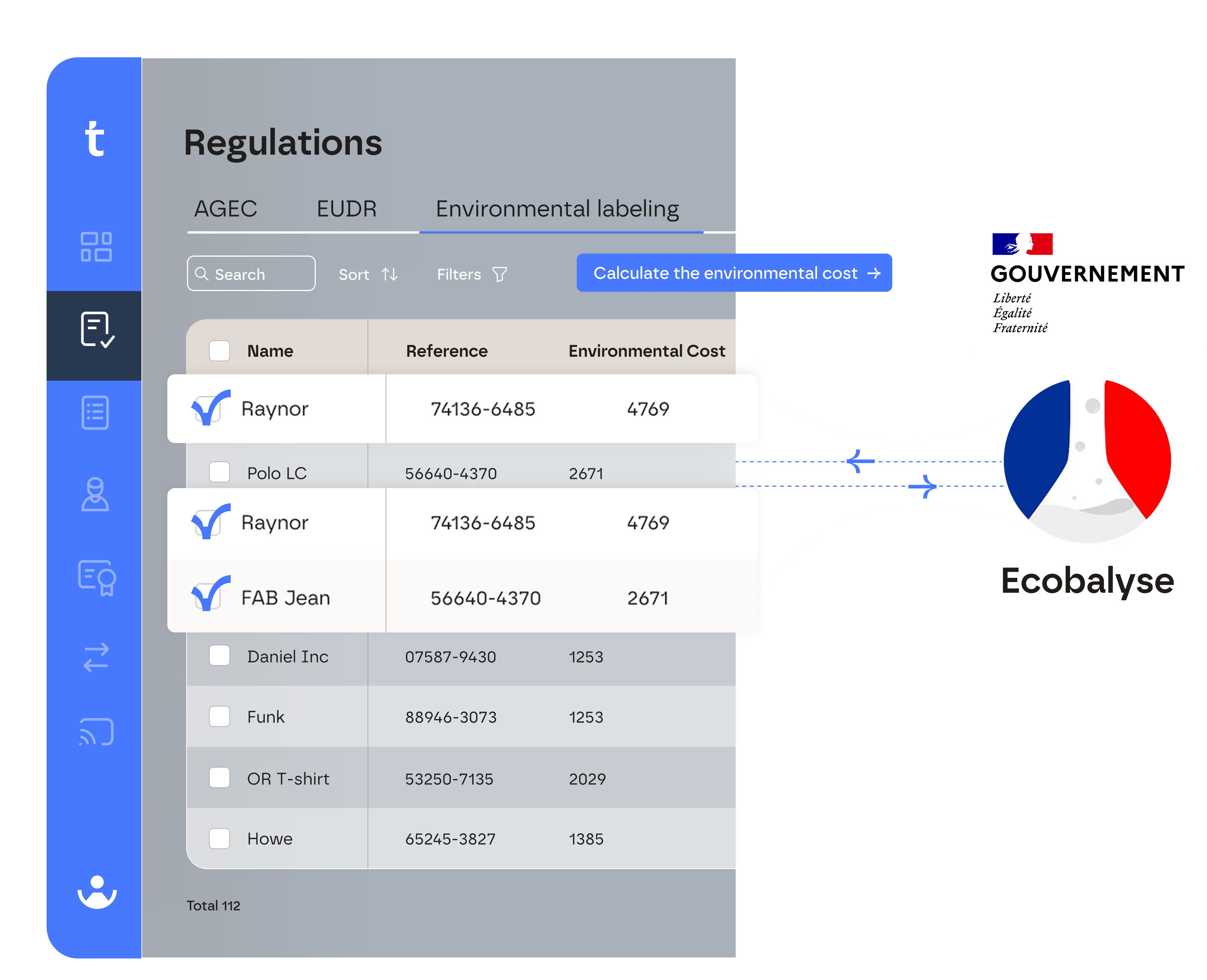
The environmental score is automatically calculated withTrace For Good, using ADEME’s official methodology.
Ecobalyse is fully built into the platform, eliminating the need for any manual input and ensuring seamless, reliable calculations.
Save time and get reliable results instantly.
Automatic submission to ADEME
Declare your products’ environmental cost in one click
Trace For Good automatically submits your data to ADEME’s declaration portal: no exports, no manual re-entry. Your process stays seamless, compliant, and fully traceable.
Save time and ensure confident, accurate reporting.


Useful ressourcesfor the French eco-score

.avif)
.avif)
.png)
.png)
.jpg)
.png)

Our collaborations
relating to the french eco-score



FAQ
Do environmental scores need to be updated?
Yes. The score reflects the product’s environmental impact at a specific moment.Any change in composition, materials, lifespan, or data availability requires recalculation. Outdated or misleading information could breach EU environmental claims or unfair commercial practice rules (UCPD).
Do I have to display the score on physical labels?
Not necessarily. ADEME allows several display options, such as:
- Online product pages
- QR codes linked to the product passport
- Physical labels or printed notices
The main requirement is clarity and accessibility at the time of purchase, but there is no fixed rule about where the score must appear. However, the visual format is regulated: brands must follow ADEME’s official graphic template (including layout, colors, typography, and units) to ensure consistency across all communication channels.
Is the French Eco-score mandatory for fashion brands?
No. The system is not yet mandatory. Introduced by the 2021 Climate and Resilience Law, it currently operates on a voluntary basis.The ongoing pilot program, led by ADEME, applies only to new or remanufactured clothing (B2C). Shoes, accessories, and home textiles are not yet included.
What happens if my data is inaccurate?
Even if it is on a voluntary basis, environmental labeling represents a public commitment.All data must be reliable, traceable, and up to date. Providing inaccurate or unsupported information can expose your brand to regulatory action for misleading communication under EU and DGCCRF rules.
What is needed to calculate environmental cost?
To calculate a product’s environmental score, several technical data points must be provided, including:
- Product weight
- Textile category (standard nomenclature)
- Raw materials (type and % composition)
- Estimated lifespan
- Repair or reuse incentives
Some contextual data, such as geographical traceability or the type of industrial processes used, can be used to refine the calculation. If these data are not calculated, they can be replaced by proxy values, which will be higher by default and will increase the reported environmental cost.
Which products are covered by the French eco-score?
At this stage, only clothing textiles are included.
This covers apparel sold to consumers (B2C), both online and in stores. Shoes, bags, accessories, and home textiles are not yet part of the scope. The list of eligible products may expand over time, in line with ADEME’s defined categories.