25 August 2025
Maïlys REBORA
6-minute read
The French Eco-score for textiles

Table of contents
Learn how France’s eco-score system marks a major step toward transparency and accountability in the fashion industry
The textile industry carries a heavy environmental legacy: it alone accounts for 20% of global water pollution and 10% of greenhouse gas emissions. The rise of ultra–fast fashion only accelerates the push for higher and higher production volumes.
At this pace, global textile production could increase by more than 150% by 2030.
Yet this rapid growth is increasingly at odds with what consumers want and value. Sixty percent of consumers say they want to adopt more sustainable consumption habits, and seven in ten are ready to change brands to favor products with a lower environmental impact (1).
It is at the crossroads of this ecological and social pressure that the French eco-score emerges. Designed as a standardized framework, it aims to combat greenwashing, still practiced by some, and to rebalance the flow of information between brands and consumers.
Often described as the potential “Nutri-Score” for fashion, the system introduces a quantified environmental cost for each product. While it is non-mandatory for now, this initiative could spark a genuine paradigm shift across the textile industry.
However, as essential as it is challenging, this ambition is difficult to translate into practice. Providing consumers with clear, comparable, and scientifically robust information on the environmental impact of products requires overcoming many technical, economic, and organizational challenges.
What remains to be understood is how this ambition translates into law. The French eco-score is no longer just an idea: from the AGEC Law to the Climate and Resilience Law, and now the 2025 Decree, it is built on a solid legal foundation that defines its framework and introduces the first obligations for the textile industry.
The ambition to create a French eco-score is not new. As early as 2009, the Grenelle de l’environnement initiated the concept of informing consumers about the environmental footprint of products.
It took more than a decade, however, for this vision to become true. In 2020, the AGEC Law (Anti-Waste for a Circular Economy) enshrined the principle of environmental information for consumer goods.
One year later, the Climate and Resilience Law broadened the scope of the initiative. Article 2 introduced the framework for mandatory labelling for various industries, including textiles, to ensure “reliable, comparable, and verifiable” information on product environmental impacts throughout their life cycle.
Decree No. 2025-957 of September 6, 2025 turns this ambition into action by setting the practical rules for the French eco-score's implementation. Importantly, it remains voluntary but regulated: any communication must follow the calculation and presentation standards defined by the decree. The text also outlines company obligations and assigns ADEME (the French Agency for Ecological Transition) the role of overseeing and ensuring consistency of the system.
It’s impossible to talk about the French eco-score without mentioning ADEME. As the driving force behind the initiative, France’s Agency for Ecological Transition ensures both scientific credibility and operational consistency of the French eco-score system. By standardizing practices, ADEME helps prevent the proliferation of private labels built on inconsistent or competing methodologies.
After leading the initial experimentation phase, ADEME now works alongside the State-backed start-up Ecobalyse to develop the calculation methodology.
ADEME also manages the national platform where companies must submit their data. From the official graphic template to calculation protocols and data integrity, ADEME ensures that brands comply with the regulatory framework.
The September 2025 Decree clearly defines the scope of application:
It applies to manufacturers, importers, and distributors placing textile products on the French market. The term “placing on the market” refers to the first time a product is made available on the French national market.
As for the products themselves, the scope is deliberately limited. The text applies only to clothing textiles, whether new or remanufactured. Footwear and other textile articles are not yet included, as they require further methodological development before being incorporated into the framework.

The scope will be confirmed by a joint decree from the Ministries of Economy and Environment, in alignment with the EU Regulation No. 1007/2011 on textile fibre labelling.
The French eco-score goes beyond the textile sector. Other pilot industries, such as the food and hospitality industries, are also taking part in this initiative.
That said, our module is primarily designed for textile brands, as this sector is the first to be directly affected by the decree’s entry into force.
For the environmental score to reflect reality, brands must rely on reliable, verifiable, and complete data, avoiding approximations or default “proxy” values that can inflate the final score. The quality and precision of the information provided directly determine the credibility and reliability of the score.
The data must be:
Each product sheet must be calculated using the Ecobalyse methodology (aligned with the PEF and other textile-specific parameters) and uploaded to the ADEME portal. The data submission must include: product identification, methodology used, calculation date, impact breakdown by category.
The data provided may be publicly disclosed, consistent with the system’s commitment to transparency.
Communication rules make sure brands are compared fairly and transparently.
Companies cannot change the environmental score format or showcase only the indicators that make them look better.
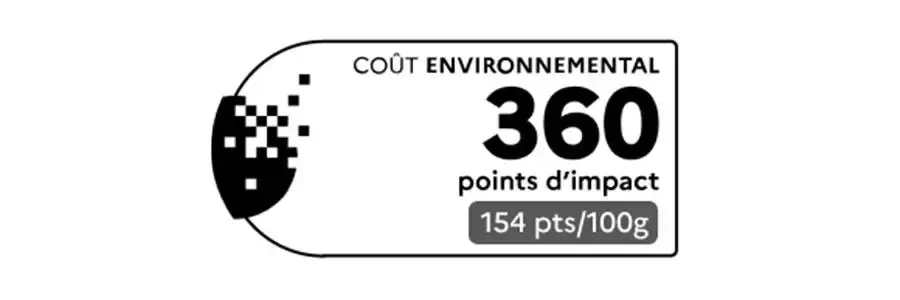
The environmental cost must be displayed using the template established by ministerial decree (format, pictogram, unit).
The information must be visible at the time of purchase, both online and in stores, and reproduced identically across all media.
No graphic modification, simplification, or rewording is allowed: consumers must be able to compare two products on the same basis.
If a brand communicates on one metric, such as carbon footprint or water usage, it must also show the full environmental cost, calculated with ADEME’s official methodology.
This rule prevents “green cherry-picking” and gives consumers a clear picture of the product’s overall impact.
The displayed score must exactly match the version submitted to the ADEME platform.
Any discrepancy between the communicated score and the recorded data constitutes a breach of the law.
The framework requires continuous monitoring of data quality and relevance. The eco-score must never rely on outdated or incomplete information.
ADEME and the DGCCRF (French Consumer Protection Authority) may audit data and communications.
Any misleading or incomplete information may qualify as deceptive commercial practice under Articles L121-2 of the French Consumer Code.
Violations can result in:
While France leads the way with the eco-score, its framework is part of a broader EU effort to create a common approach to environmental labeling.
In March 2025, the technical secretariat of the Product Environmental Footprint (PEF) recommended that environmental scores be used only for B2B communication, as they are too complex for consumers to understand.
France, however, chose a different path: keeping environmental scores visible to consumers (B2C).
This means companies will have to work with two complementary systems:
By 2026, three major EU initiatives- the Ecodesign for Sustainable Products Regulation (ESPR), the Green Claims Directive, and the Digital Product Passport (DPP)- are expected to come together under a single method. The goal is to prevent greenwashing and ensure fair competition across the EU market.
Textile environmental labeling is no longer just a political idea: it’s now supported by a strong legal framework, built through the AGEC Law, the Climate & Resilience Law, and the 2025 Decree.
For brands, this is an important step towards being more transparent, compliant, and responsible.
Starting early helps you stay compliant, lower risks, and keep control of your environmental messaging, especially as data sharing becomes increasingly accessible to third parties.
The key question now is: how is the environmental cost actually calculated?
The legal framework is already in place, but it’s the methodology developed by ADEME and Ecobalyse that brings it to life.
The next section of this module will take you through the step-by-step process behind calculating the environmental score.
(1) Kantar sustainability sector Index report, 2025
France’s new Eco-score system for textiles marks a major step toward transparency and accountability in the fashion industry. Rooted in the AGEC Law (2020), the Climate & Resilience Law (2021), and the 2025 Decree, it introduces a standardized framework for assessing and communicating the environmental cost of clothing products. Managed by ADEME and powered by the Ecobalyse methodology, the system requires brands to collect, verify, and submit detailed life-cycle data from raw materials to end-of-life and to calculate a reliable and comparable score. While participation remains voluntary, communication must strictly follow official rules, ensuring scientific credibility and preventing greenwashing.
More than a compliance requirement, the eco-score represents a strategic shift for the textile industry. It gives consumers access to clear, standardized information and pushes brands to improve their data quality, supply chain traceability, and sustainability performance. As France leads the way, the system is expected to align progressively with upcoming EU regulations, including the ESPR, Green Claims Directive, and Digital Product Passport, paving the path toward a unified European framework for sustainable product communication.

.avif)
.avif)



.png)
.png)