Learn how to breakdown and calculate the environmental cost of your apparel textiles
Introduction: Why measure the environmental impact of textiles?
As explained in our article on the regulatory framework for the textile French Eco-score, the goal of calculating an environmental cost for apparel products is to make their impact measurable, comparable, and transparent to consumers.
But this system goes beyond transparency. Calculating the environmental cost also serves as a regulatory readiness tool. It helps companies anticipate the requirements for the upcoming ESPR(Ecodesign for Sustainable Products Regulation) and prepare for the future Digital Product Passport (DPP), which will likely include an environmental impact index for textiles.
This guide details the methodology behind this environmental cost based on the official ADEME validated framework and implemented through the state start-up Ecobalyse.
For a deeper understanding on the regulatory context and obligations related to environmental labeling in the textile industry, see our dedicated article.
1. French Eco-score: a Life Cycle Assessment better designed for textiles
To guarantee consistency and avoid unreliable or non-comparable scoring methods, the textile environmental cost is determined through a Life Cycle Assessment (LCA) method specifically developed for the industry.
This method is based on the European Product Environmental Footprint (PEF) framework, the scientific standard used for Life Cycle Assessments (LCAs). It has been adjusted for the textile industry to account for specific factors such as microfiber release during washing and the export of end-of-life products outside Europe.
In practice, the calculation is performed by Ecobalyse, the state-supported platform managed by ADEME.
Free and open source, Ecobalyse enables any brand to generate a standardized environmental score using its own product data.
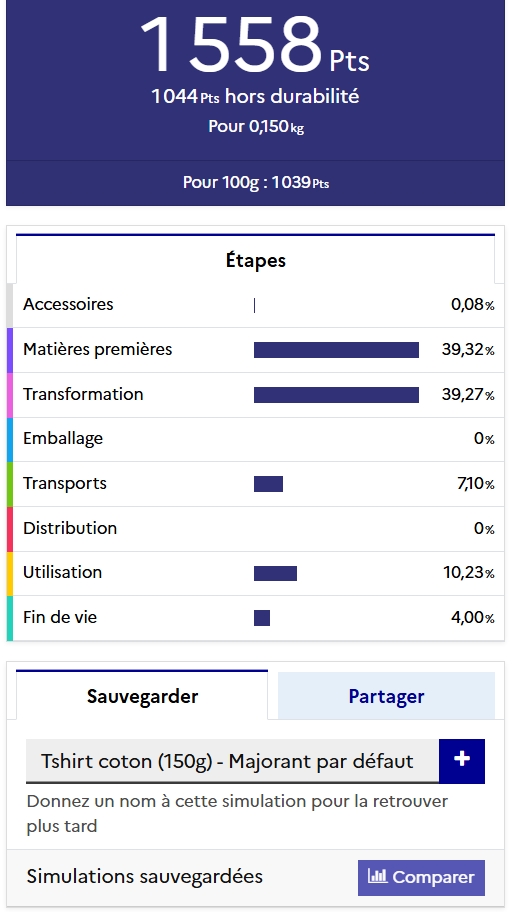
💻 Ecobalyse interface: each product is assigned a single score (in points) representing one millionth of the average annual impact of an EU citizen.
2. Input data required for calculating and declaring the textile environmental cost
Test submission
Field name:test
Description: indicates whether this is a test declaration or a real submission. This field is sent to the ADEME reporting platform, along with the data used to calculate the environmental cost.
Data type: boolean (true / false)
Expected value:true = test, false = real
Requirement: optional
Use: exclusively for the ADEME platform
Product GTIN/EAN codes
Field name:gtins
Description: list of unique GTIN (or EAN) codes used to identify the product.
Data type: list of strings (string[])
Expected value: 8 or 13 digit codes (eg. 1234567890123)
Requirement: mandatory
Use: exclusively for the ADEME platform
Product internal reference
Field name:internalReference
Description: internal reference specific to the brand.
Data type: string (string)
Expected value: eg. REF-123
Requirement: mandatory
Use : for ADEME reporting and internal identification
Product brand
Field name:brand
Description: brand name of the textile product.
Data type: string (string)
Expected value: eg. Trace For Good
Requirement: optional
Use: exclusively for the ADEME platform
Product environmental cost
Field name:declaredScore
Description: represents the environmental cost calculated by Ecobalyse, if this cost has already been computed before sending data to the ADEME platform. If the cost calculated by Ecobalyse does not match the one reported by ADEME, the product will trigger an error in ADEME’s submission system.
Data type: number (number)
Expected value: eg. 7421
Requirement: optional
Use: exclusively for the ADEME platform
Mass of the finished product
Field name:mass
Description: total weight of the finished garment.
Data type: number (number)
Expected value: in kilograms, min. 0.01 (eg. 0.17)
Description: share of air transport between manufacturing and distribution
Data type: number (number)
Expected value: between 0 and 1 (eg. 0.1 = 10 %)
Requirement: optional
Use: ADEME and Ecobalyse platforms
Company size
Field name:business
Description: company size and repair service availability.
Data type: string (string)
Expected value:
small-business : Micro-enterprise and SMEs
large-business-with-services : large business with repair service availability
large-business-without-services : large business without repair service availability
Obligation : mandatory
Use : ADEME and Ecobalyse platforms.
Dyeing/ finishing countries
Field name:countryDyeing
Description: country where the dyeing or finishing of the textile takes place. The country should be indicated using the two-letter ISO 3166 code available at: https://www.iso.org/obp/ui/#search.
Data type: ISO 2 letter code (string)
Expected value: eg. IN, TR, PT
Requirement: mandatory
Use:ADEME and Ecobalyse platforms
Country of fabric production
Field name:countryFabric
Description: country of the weaving/knitting stage of the textile
Type de donnée : ISO 2 letter code (string)
Valeur attendue : eg. CN, FR, BD
Obligation: mandatory
Usage :ADEME and Ecobalyse platforms
Country of manufacture
Field name:countryMaking
Description : country of manufacture of the garment.
Data type: ****ISO 2 letter code (string)
Expected value: eg. MA, BG, FR
Requirement: mandatory
Use :ADEME and Ecobalyse platforms
Spinning country
Field name:countrySpinning
Description: Country where the textile yarns are spun.
Data type: ****ISO 2 letter code (string)
Expected value: eg. IN, EG, CN
Requirement: optional. If this field is blank, it will automatically default to the country indicated for the main material.
Use:ADEME and Ecobalyse platforms
Washout process
Nom du champ :fading
Description : indicates whether a fading process has been applied (particularly relevant for jeans).
Type de donnée : boolean (true / false)
Valeur attendue :true = faded, false = non faded
Obligation : optional
Usage :ADEME and Ecobalyse platforms
Total number of references
Field name:numberOfReferences
Description: number of references in the brand’s catalog.
Data type: number (number)
Expected value: between 1 and 999 999
Requirement: mandatory
Use:ADEME and Ecobalyse platforms
Product price
Field name:price
Description: product selling price including tax, used to estimate durability.
Data type: number (number)
Expected value: between 1 and 1000 €
Requirement: mandatory
Use:ADEME and Ecobalyse platforms
Printing process
Field name:printing
Description: details of the printing process applied to the product.
Description: list of garment accessories (e.g., buttons, zippers, cords, elastics), which are included in the environmental impact calculation
Data type: array of objects (array)
Sub-data type:
id: unique identifier of the accessory (type string, format UUID). The complete list of accessories is available in the Ecobalyse reference database on le référentiel Ecobalyse.
quantity: Number of units of this accessory present on the product.(type integer, minimal value: 0).
Expected value:{ "id": "zip", "quantity": 1 }
Requirement: optional
Use: ADEME and Ecobalyse platforms
Remanufactured/ upcycled product
Field name:upcycled
Description: indicates whether the product was produced using upcycling or remanufacturing methods.
Data type: boolean (true / false)
Expected value:true = remanufactured product
Requirement: optional
Use: ADEME and Ecobalyse platforms
👉
Note: If some fields are left blank, Ecobalyse automatically applies default “penalizing” values (e.g., “unknown country,” “ultra fast-fashion”).
Providing accurate data is the first step toward improving your environmental score.
Each data field below is required to perform the environmental cost calculation and to submit results to ADEME’s official reporting platform.
What data is needed to calculate environmental costs?
Download the checklist!
Fill out the form and get your checklist to see what info you need to send to ADEME and Ecobalyse to figure out the environmental cost of your products.
3. The French Eco-score calculation method
Pre-calculation – Data collection and processing
The platform consolidates all declared data such as mass, materials, countries of origin, manufacturing stages, transport, durability, and accessories to precisely model the garment’s full life cycle, from raw material extraction to end-of-life.
When data are missing, default values are automatically applied to maintain consistency and accuracy across all calculations.
Step 1 – Life Cycle Assessment (LCA) following the PEF method (EF 3.1)
Ecobalyse calculates environmental impacts across 16 PEF categories, such as climate change, water use, acidification, resource depletion and freshwater ecotoxicity, etc.To allow for meaningful comparison, impacts are normalized against the average annual footprint of a European citizen and weighted according to their environmental relevance.
Impact category
Climate change
Weighing
21.06 %
Freshwater ecotoxicity (corrected)
21.06 %
Acidification
4.91 %
Particles
7.10 %
Water resources
6.74 %
Fossil resources
6.59 %
Mineral resources
5.98 %
Soil use
6.29 %
Other categories
2 to 5 % each
Eg: Climate change and freshwater ecotoxicity each account for 21.06% of the total weighting, while others vary between 2% and 7%.
Methodological adjustments include:
Exclusion of human toxicity indicators (carcinogenic and non-carcinogenic).
Doubling of organic molecule impacts in freshwater ecotoxicity to better reflect biodiversity effects.
Exclusion of long-term emissions (> 100 years) and correction of uranium resource weighting to reflect the EU electricity mix.
Based on the entered data, Ecobalyse quantifies the impact of each life cycle stage and consolidates them into a single score, expressed in Points (Pts).
💡
Does using recycled material always reduce the score?
Not necessarily. The impact depends on the material and recycling process.
Ecobalyse integrates this effect using the Circular Footprint Formula (CFF), which models the real benefits and impacts of recycling based on both input (R1) and end-of-life (R2) material flows.
For example, recycled cotton often improves the score, while recycled polyester may not, due to the additional processing required.
Step 2 – Textile-specific additions
Two addiitonal indicators (outside the LCA scope and not included in the standard PEF), are added to reflect textile-specific realities:
Export of end-of-life products outside Europe. Measures the impact of post-consumer textile exports, typically treated as waste abroad. Formula: 0.005 Pts/ kg x product mass x export probability (12.1% for synthetic textiles; 4.9% for others).
Microfiber emissions. Models the release of plastic or natural microfibers throughout the life cycle, using a coefficient of 0.001 Pt/kg adjusted by fiber type and biodegradability.
Step 3 – Aggregation into a single score
The 16 impact categories derived from the PEF methodology, tailored to the specificities of the textile sector, are then consolidated with the two additional indicators: microfiber emissions and exports outside Europe to produce an overall environmental score.
The result is an overall score, expressed in Points (Pts) and representing the product’s total environmental impact from production to end-of-life.
Step 4 – Applying the ‘durability’ coefficient
Finally, the score is adjusted to reflect product durability, using a coefficient that rewards garments designed for longevity and repairability.
This coefficient ranges from 0.67 (low durability) to 1.45 (high durability), based on two criteria:
The presence of repair or after-sales services, and
The width of the product range (fewer variants = higher durability).
The more durable the product, the lower its environmental cost.
Step 5 – Final Eco-score
The final environmental cost is automatically generated by Ecobalyse or through the ADEME submission platform (if used directly).
It is expressed in Points (Pts), a standardized unit allowing product-to-product comparison.
Conclusion
The environmental cost tells the story of your product, from design and production to transport, use, and end-of-life.
The score isn’t the goal; it reflects the quality and reliability of your data across the supply chain. It also reveals gaps and inconsistencies, helping you improve data accuracy and reduce real environmental impact.
More than a compliance metric, it’s a strategic communication tool that helps brands speak credibly about their impact, show progress, and earn consumer trust.
The next module explores why data reliability matters for both compliance and brand performance and how this score can drive transparent, trustworthy communication about sustainability.
.png)


.avif)


.avif)
.avif)
.png)


.png)