Navigating the French CSR Regulation: the 4 Key Consumer Information Measures that Fashion Brands need to know
The 4 key obligations: product sheets, environmental impact, claim control and recycling signage.
Introduction: presenting the French Regulation - AGEC and the Climate and Resilience laws
The French AGEC law
The AGEC law, enacted on the 10th of February 2020, aims to transform all sectors of the economy with the objective of limiting waste and preserving resources.
Here are its 5 main axes:
- Moving away from disposable plastic
- Providing better information to consumers
- Combating waste and promoting solidarity through reuse programs
- Taking action against planned obsolescence
- Improving production practices
Among these points, the objective of providing better information to consumers has a strong impact on the fashion industry. It requires a profound transformation, prompting a review of supplier relationships and product data management practices to establish upstream traceability throughout the production chain.
In this context, here are the 3 articles of the AGEC law that companies in the textile sector should be aware of:
- Article 13 establishes mandatory labeling of environmental qualities and characteristics of products starting from the 1st of January 2023.
- Article 15 concerns the implementation of environmental labeling, and has been replaced by Article 2 of the Climat et Résilience (Climate and Resilience) law of 2021.
- Article 17 imposes new waste sorting information labels, effective from the 1 of February 2023.
The implementation details of these different articles are defined progressively through decrees and regulations, such as the implementing decree for Article 13 of the AGEC law.
Note that the AGEC law also addresses other topics related to consumer products, such as eco-design in its Article 72.
French Climat et Résilience (Climate and Resilience) law
The Climat et Résilience (Climate and Resilience) Law, enacted on the 24th of August 2021, aims to combat climate change and make our society more resilient to its consequences. It was drafted based on the work of the Citizens' Convention on Climate.
This comprehensive law includes numerous objectives, such as improving air quality, supporting renewable energies, and transitioning to sustainable food systems. The focus of this article is on the objective of providing better information to citizens.
Here, the following two articles of the Climat et Résilience (Climate and Resilience) Law are of notable interest:
- Article 2 lays the foundation for future mandatory environmental labeling on products.
- Article 12 strictly regulates the use of the claim "carbon-neutral" for a product or service.
The 4 key consumer information measures to remember from the French Regulation related to sustainability
The AGEC and Climat et Résilience (Climate and Resilience) laws have established a legal framework for consumer information regarding fashion items. Let's summarize the important points for brands that emerge from this series of legal articles:
- Display of environmental qualities and characteristics of products
- Environmental labelling
- Regulation of environmental claims
- New waste sorting information labels
- An explicit ban on greenwashing
The subtlety of the content of these measures with similar names and their progressive implementation, governed by different decrees and regulations, can generate confusion.
Let's clarify the content of these regulations and their application timeline.
1. Display of environmental qualities and characteristics of products
In accordance with Article 13 of the AGEC law, consumers must have access, at the time of purchase, to a "sheet containing information on the environmental qualities and characteristics of the product."
This sheet includes information on the countries of the three main manufacturing stages, the release of microplastics into the environment, the presence of recycled materials, hazardous substances, and the bonuses and penalties paid for this product.
The objective of this provision is to raise consumer awareness about the manufacturing conditions and certain impacts of the new products they purchase.
We have dedicated a detailed article to this impactful measure for the fashion industry. You will find everything you need to know to implement it.
The obligation to display environmental qualities and characteristics gradually comes into effect as follows:
- 1st of January 2023: 50 million cumulative annual turnover for all products concerned by the AGEC law and 20,000 units put on the French market
- 1st of January 2024: 20 million cumulative annual turnover for all products concerned by the AGEC law and 10,000 units put on the French market
- 1st of January 2025: 10 million cumulative annual turnover for all products concerned by the AGEC law and 10,000 units put on the French market
Note: Both conditions specified (turnover and number of units) must be met for the obligation to be valid on the indicated date.
2. Environmental labeling
Article 2 of the Climat et Résilience (Climate and Resilience) Law aims to establish harmonized environmental labeling on products. What is the difference between this environmental labeling and the display of environmental qualities and characteristics?
- The product sheet related to environmental qualities and characteristics provides qualitative information about the intrinsic nature of the product (e.g., countries where the main manufacturing stages took place).
- The environmental labeling, on the other hand, will provide quantified information about the environmental impacts of the product (greenhouse gas emissions, damage to biodiversity, and consumption of natural resources).
It will take the form of a single, simple, and harmonized indicator that reflects the multiple environmental impacts of the product throughout its lifecycle. This score, similar to the Nutri-Score displayed on food products, will allow consumers to compare products based on their environmental impact.
The objective is to guide and empower consumers in their purchasing decisions while providing brands with areas for improvement.
So, when will mandatory environmental labeling be implemented?
The official methodology to be adopted, prior to the enforcement of the obligation, has not yet been published by the authorities. After experiments conducted until the end of 2022 using various evaluation and communication methods, the Ministry of Ecological Transition plans to make a decision on this matter by the end of 2023.
The expected timeline is stated as such: voluntary display in 2024, compulsory display starting in 2025.
For more information, we invite you to consult our dedicated article.
3. Regulation of environmental claims
This includes:
- The AGEC law's prohibition of terms such as "biodegradable," "environmentally friendly," or any equivalent claims. Following the publication of the implementing decree for Article 13 of the AGEC law, this measure came into effect on the 1st of May 2022, with a tolerance period for stock depletion that ended on the 1st of January 2023.
- The strict regulation by the Climat et Résilience (Climate and Resilience) Law of the claims "carbon-neutral," "zero carbon," or any equivalent formulations. Following the publication of the implementing decree for Article 12 of the Climate and Resilience Law, this regulation has been in effect since the 1st of January 2023. These carbon neutrality claims can only be used if the following elements are disclosed:
- The direct and indirect greenhouse gas emissions of the product
- Quantified annual objectives for the prevention, reduction, and compensation of said emissions
- Modalities for compensating residual emissions
The Climate and Resilience Law has also explicitly banned greenwashing practices. Learn more in our article about anti-greenwashing regulations in France and in Europe.
4. The new waste sorting information labels
The AGEC law requires the display of a pictogram with waste-sorting information, which must be associated with the "Triman" logo (see image below). These new visuals must be present on products starting from the 1st of February 2023, with a tolerance period until the 1st of August 2023, for the depletion of stocks of products manufactured or imported before the 1st of February 2023.
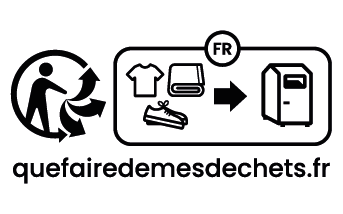
This labeling aims to inform the consumer about the steps to follow when they wish to dispose of their product, with the objective of better waste valorization.
In this article, we detail its characteristics.
In summary: timeline for the implementation of all measures from the AGEC and Climat et resilience (Climate and Resilience) laws related to consumer information
📅 May 1, 2022:
- Prohibition of claims such as "biodegradable," "environmentally friendly" (tolerance period until the 1st of January 2023)
📅 1st of January 2023:
- Mandatory product sheet on environmental qualities and characteristics for companies with a turnover of over 50 € million and 25,000 units on the market (possible exemption for references where the last unit will be placed on the market no later than the 31st of March 2023)
- Prohibition of claims such as "carbon-neutral," "zero carbon" except under certain conditions
📅 1st of February 2023:
- Mandatory new waste sorting information labels (tolerance period until the 1st of August 2023, only for products manufactured or imported before the 1st of February 2023)
📅 In 2023:
- Publication of the selected methodology for environmental labeling and the beginning of the regulatory adaptation process
📅 1st of January 2024:
- Mandatory product sheet on environmental qualities and characteristics for companies with a turnover of over 20 € million and 10,000 units on the market
📅 1st of January 2025:
- Mandatory product sheet on environmental qualities and characteristics for companies with a turnover of over 10 € million and 10,000 units on the market
📅 In 2025:
- Compulsory environmental score on fashion articles



.avif)
.avif)



No items found.
Summary
In the context of climate change and severe ecosystem degradation, our modes of production and consumption need to undergo profound transformation. In France, to align with this ecological transition, the "Anti Gaspillage pour une Économie Circulaire” (AGEC, Anti-Waste for a Circular Economy) law and the "Climat et Résilience” (Climate and Resilience) law were enacted in February 2020 and August 2021, respectively.
One of the focal points emphasized by the authorities through these laws is better consumer information, particularly for textile products. This is translated into several measures, the implementation of which is gradually established through decrees.
The product sheet on environmental qualities and characteristics of products, regulation of environmental claims, and mandatory environmental labelling are among the provisions with a significant impact on clothing brands and the textile sector.
In this article, you will find an explanatory summary of all the measures to be aware of regarding consumer information, along with a timeline of their implementation dates.
Download
white paper
white paper
Watch
replay
replay
Read
Summary
Summary
To access the full content, nothing could be simpler!
Fill out the form below.
Fill out the form below.